Community Corner
Hydroponically Grown Produce Now Available At the Market
Sundial Farm brings fresh, local, sustainable produce to the market, and it's all grown hydroponically. Find out exactly what that means.
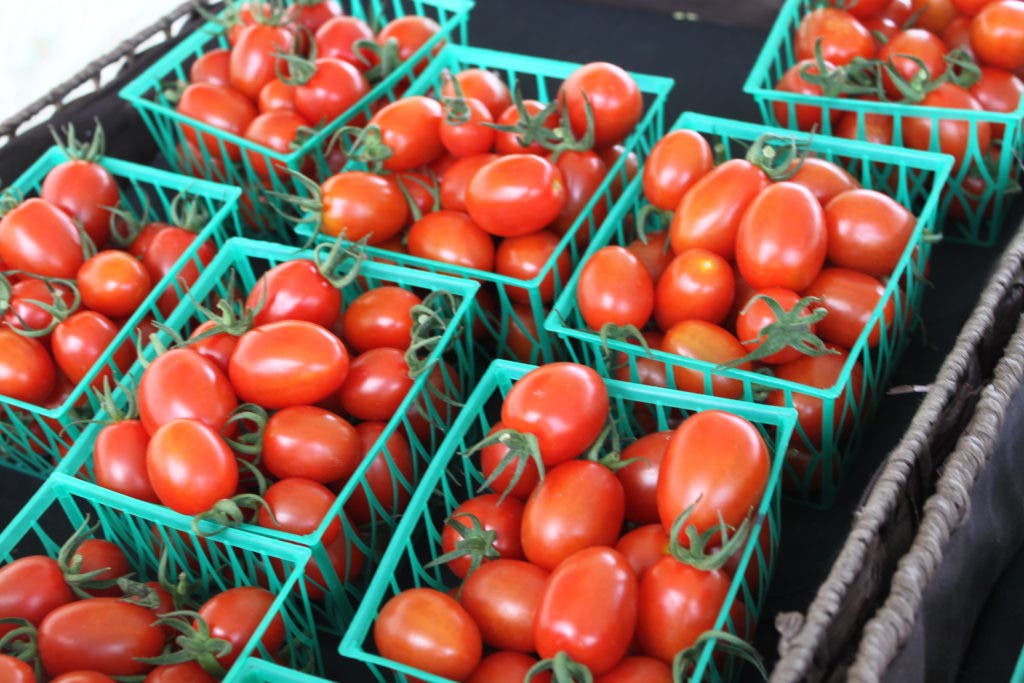


One of the best features of the is that there is always a new vendor or product to try. One of the newer produce sellers is Sundial Farm, a four-and-a-half acre family business in Vista.
While their fresh, beautiful butter lettuces, arugula, basil, tomatoes and cucumbers make them look like any other grower, their growing techniques are actually quite different. They grow hydroponically.
Hydroponic, what?
Find out what's happening in Encinitasfor free with the latest updates from Patch.
“[Hydroponics] is a system where we don’t use soil. [The plants are] all in water. It’s all sustainable,” said experienced hydroponic grower, Greg Reuschle. “So the leafy greens, we seed in these little cubes and grow [them] in a seedling area. And then they’re transferred into the greenhouse where they sit in these channels [which carry water]. And then, we’ll harvest it.”
But, any elementary school science student can tell you that all plants need soil to thrive, right?
Find out what's happening in Encinitasfor free with the latest updates from Patch.
In a hydroponic system, which includes a greenhouse and channels where nutrient-rich water flows to the situated plants, soil is not necessary.
“The nutrients are in the water so that the plants can grab any of the nutrients they need at any time,” said Resuschle. “[This is] instead of having to grab it from the soil that needs to break down the nutrients.”
In other words, in a hydroponic system, the key nutrients that plants need – like nitrogen, phosphorus and potassiumplants – are already broken down to a form that they can use. In the dirt, the fertilizers need to be broken down to a form that can be used by the plants.
“In the soil, there’s different bacteria and microorganisms within the soil that help break down whatever organic matter [like fertilizer] that you put in there,” said Reuschle. “To make it into a usable fertilizer – a usable form of nitrogen or potassium – it takes time.”
And since the plants are grown in a greenhouse, Sundial Farm does not have to compete with harsh winds, bad weather or insects. According to Reuschle, this helps him maintain the appearance and quality of his crops.
While these factors are certainly beneficial, a major benefit to the environment is that growing hydroponically conserves a lot of water.
“We use about ten to twenty percent of what you would use [traditionally],” Reuschle said. “And, the water is recycled. It’s all sustainable.”
“If you’re growing outside in the field, all the water that you put on — a lot of it evaporates. It goes right down into the soil, or it keeps going right down to the water table and that’s not good because a lot of the fertilizers are being leeched out into the soil,” Reuschle said. “And when it rains, organic and inorganic fertilizers are going to have some runoff.”
In contrast, because the hydroponic system is a closed one with intricate channeling, all the water can be captured and saved. For example, tomatoes and cucumbers are grown in buckets filled with paralite (expanded lava rock similar to dirt) and a drain at the bottom, Resuchle said. The plants are watered from the top every 2 hours for 5 to 10 minutes at a time and any excess water circulates down, gets captured in a bin and then saved until the next watering.
The lettuces, which are grown in channels, have a drain pipe through which extra water goes down into a reservoir.
Since the water is reused and is the conduit of all the nutrients that plants need, Reuschle and his colleague, Sean Keany, monitor the pH and nutrient levels continually. They can make adjustments as necessary.
Sundial Farm’s produce is not technically organic since there is no organic matter being put into soil. But he uses fertilizers like Epsom salt and since there’s no worry of insects, he does not have to use pesticides.
Reuschle does not think negatively of traditional and organic farming, but is personally interested in hydroponics because of its ability to conserve water and still produce good yields.
“And since we live in San Diego,” he said, “where there’s such an issue with the water and the quantities and the quality of water that we’re allowed to use, this is a big help that we’re able to save so much water.”
While Reuschle has been educating consumers about hydroponics and its benefits, he realizes there may be some negative connotations with it because of large corporations using the technique to simply produce large quantities. He said this is unfortunate and can only attest to the quality of produce he brings to market every week.
Give one of his tomatoes, cucumbers or lettuces a try this week!