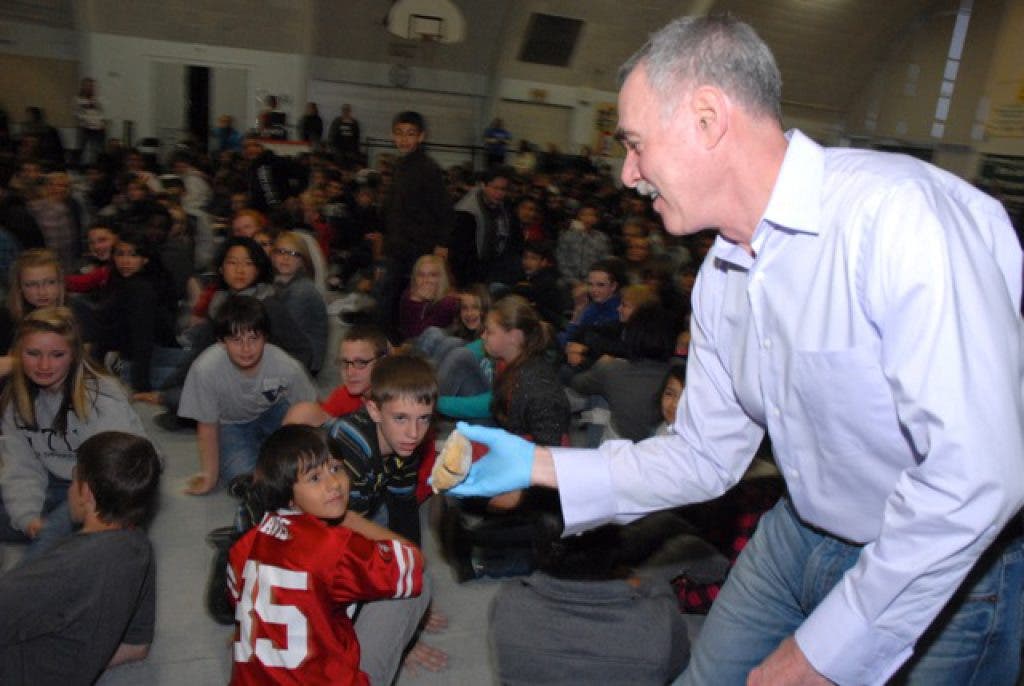
Hundreds of students at John Barrett Middle School attended an assembly like no other Tuesday – a presentation in which the guest speaker jogged around the multi-purpose room, cuddling a frozen human brain in the palm of his hand, which he shared with the children, up close and oh-so-ewww for some.
The speaker, anti-smoking crusader Dr. Victor DeNoble, was invited to the Carmichael campus to make a point: To show the damage that tobacco-related drugs such as nicotine do to the brain.
“Eighty-percent of all the people who are drug addicts in this country became drug addicts before the age of 21,” DeNoble told the sixth, seventh and eighth-graders.
Find out what's happening in Fair Oaks-Carmichaelfor free with the latest updates from Patch.
DeNoble was a research scientist working for Philip Morris when he turned against his employer as a whistleblower and testified in Congress in the 1990s about the dangers of smoking, which led to major reforms and record fines against the tobacco industry. Today, he’s a nationally-known anti-smoking advocate who speaks to 300,000 students a year about what he calls the tobacco industry’s “deceptions.”
He is in the Sacramento area visiting many schools during the month of March as part of a partnership between the Health Education Council and Kaiser Permanente, which provides Community Benefit funding to sponsor an annual tobacco education program and billboard contest called “Don’t Buy The Lie.”
Find out what's happening in Fair Oaks-Carmichaelfor free with the latest updates from Patch.
He’s also in town for the premier of a documentary about his advocacy, “Addiction Incorporated,” which opened at the Crest Theatre in Sacramento on March 16.
“You have a live hero, a star on campus,” is how Barrett School principal Lisa Smith introduced DeNoble to students.
DeNoble, often referring to a PowerPoint presentation showing photographs of his research days, told about how he was hired by Philip Morris to work on a top-secret project: find a substitute drug for nicotine, because the cigarette-maker at the time said more than 100,000 smokers were dying of heart disease every year.
But he was more interested in using the company’s laboratory rats to study the addictive nature of nicotine on the brain, a health issue that the company, he said, didn’t want to acknowledge. DeNoble and his research partner built a device that allowed rats to voluntarily pump nicotine into their bodies, which he said proved that the drug was addictive.
He also dissected the brains of rats, a monkey and a human (some of which he displays during his assemblies) and came to the same conclusion.
“It means nicotine is changing the way our brain works,” DeNoble told the students.
When he shared his findings with the company, his superiors grew nervous. They took away his rats and ordered him to refocus on finding a replacement drug that doesn’t harm smokers’ hearts.
Eventually, he found the new drug, but said his superiors refused to replace it for nicotine for two reasons: The tobacco industry had been telling the government and the public since 1953 there was nothing wrong with tobacco, and, he quoted his superiors as saying, “we’d have to admit that everything else we make hurts people.”
He got fired.
In the 1990s, a decade after he was terminated, his congressional testimony prompted the federal government to attack the tobacco industry by leveling hundreds of billions of dollars in fines and banning cigarette advertisements from billboards, cartoon characters and sporting events. Later, states, counties and cities throughout the nation joined the anti-tobacco movement by passing laws to restrict smoking at indoor restaurants and other locations.
DeNoble’s message remains relevant today.
“He knows what he’s talking about; he’s really good at making us not want to smoke,” said Caylin Smith, a Barrett eighth-grader.
For Sarah Freese, a sixth grader, seeing a frozen brain left her with a lasting impression about how “terrible” smoking is. “I would have never expected to see a human brain in my life; it was really neat, and it got the crowd in a different mood.”
DeNoble has been visiting the San Juan Unified School District for 19 years – the entire time he’s been affiliated with Kaiser Permanente’s anti-smoking effort.
Barrett Principal Lisa Smith said DeNoble’s visits have made for healthier choices not just for students, but their family members.
“What I really like about this is, so many of our parents are smokers, and the kids go home and they talk to their parents about this presentation,” Smith said. “And, probably within a week of this presentation, kids come back and say, ‘My mom decided to quit smoking.’”
For more information on how students can participate in the anti-smoking billboard contest, including the chance to win $1,000, go to: www.kpdbtl.com
To learn more about the documentary, “Addiction Incorporated,” go to: www.addictionincorporated.com.
---
Subscribe to newsletters | Follow on Facebook and Twitter | Blog on Patch | Claim your business or group's listing