Community Corner
Learning the Secrets of Potty Training
How Yo discovered the cure for her son's bedwetting was in a popular herb.
Parenting is often a series of “three steps forward, two (or more) steps back” progressions. The trick is to not get discouraged and to stay the course, which can be difficult since most of the time we as parents are improvising. It is hard to know if your course is correct when most of what you are doing is guesswork.
Nowhere is this truer than in the realm of potty training.
When I had my first child, I was somewhat of a conspiracy theorist in this arena. I noted that the diaper companies had not always made seven different sizes and that it was a relatively new development (Pampers introduced their largest size in 1998). I read about how in much of the rest of the world, children are toilet trained by age two, mostly out of necessity (when you live in less developed countries that do not offer disposable diapers or have humongous families, I guess you do what you have to in order to make it happen as soon as possible).
Find out what's happening in Glendorafor free with the latest updates from Patch.
So with my daughter, I started putting her on her own potty when she turned one. I figured that even if she was not fully trained any earlier than usual, each time she went in the potty and not in a diaper, I was sparing the environment and our wallet the cost of that diaper.
I parked her on the potty with a sippy cup and a stack of books and she enjoyed entertaining herself. She made steady progress until she turned 16 months, when she regressed for awhile. By 28 months, she was toilet trained, meaning she would tell me when she needed to go. Besides the occasional accident, she was dry both the day and night.
Find out what's happening in Glendorafor free with the latest updates from Patch.
I had always heard that girls were easier than boys in this department, so when it was my son’s turn, I was prepared for a longer journey. By then, I had read that there was a window of sensitivity to this skill around eight months, so I tried putting my son on the potty when he was nine months old. Imagine my delight when he gladly complied!
However, at around the same age, he regressed just as my daughter had done. At 31 months, he finally resumed using the potty and by his 3rd birthday, he would stay dry if I would remember to take him. Finally, when he was 3½, he was pretty regularly dry all day and night.
Unfortunately, a few months ago, he started bedwetting (enuresis) almost every night. I traced the start of this regression back to when I let him drop his afternoon nap because it was interfering with his ability to fall asleep at bedtime. But without his nap, he started sleeping so deeply that he stopped waking up to go to the bathroom. He was so fast asleep, often times he would not even wake up after he wet the bed.
At first, I viewed this as just a temporary setback. I restored his nap, waking him up by 4:30 to protect his bedtime. Still, there was no progress. Over the next several months I tried:
bribing with M&Ms * bribing with money * sticker charts * promising a two-wheeler bike * using disposable training pants * using waterproof cloth training pants * giving up disposable training pants * waking him up once before I went to bed * waking him up twice before I went to bed * restricting liquids a few hours before bed * restricting dairy products (one forum said dairy allergies could cause enuresis) * restricting citrus juices (the same forum explained they could irritate the bladder)
All my efforts were to no avail and I grew disheartened. I would not have been concerned by the bedwetting, except that my son had already been fully toilet trained for several months.
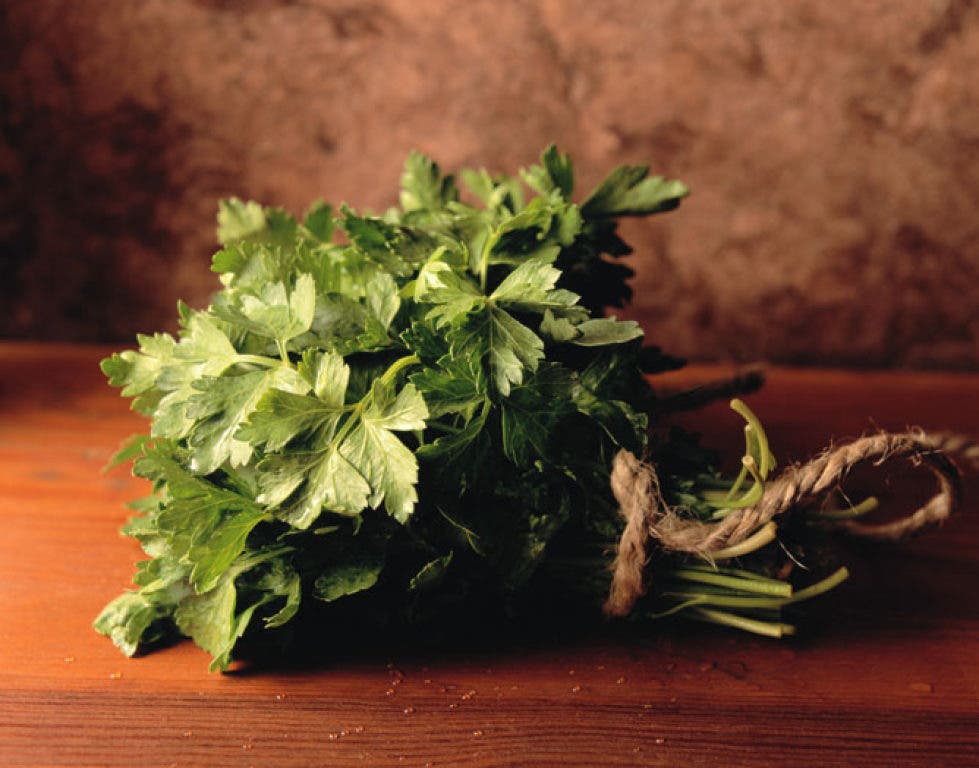
This week, an unexpected hero came to my rescue: parsley. An herb often dismissed as a garnish today, parsley was used in ancient times for medicinal purposes. I learned that besides being quite nutritious, a few sprigs around bedtime might help enuresis due to its diuretic properties. I was skeptical, but had nothing to lose. The only concern was that parsley is high in oxalic acid, which can be a problem for some with certain health issues; but for those in good health, it is no more (actually, less) of a threat than eating spinach.
The first night, I pondered how I would get my non-vegetable-eating son to eat a pungent herb. He tried a leaf and then proceeded to shove the rest of the stems into his mouth like a parsley-eating chipmunk. Phew! The first hurdle was cleared.
Just to be on the safe side, we still woke him twice to use the restroom that night, but the next morning, he was dry for the first time in months! So far, we have had one accident, followed by four straight nights of success, which is not a long track record, but much better than the one he had before.
I do not know if the parsley is merely a psychological tool for my son, or if the nutritional properties are actually the cause of success, but either way, I am cautiously optimistic. I will not yet claim victory, but it does go to show that in parenting, help can come from the most unexpected sources.