Neighbor News
California Isn’t Dead. But It Has to Fight for Its Economic Future.
Yes other states are catching up to the Golden State

Blog Design, Neighbor
In August 2026, Paramount’s board approved a five-year plan to move its headquarters and core operations out of California unless a multi-state antitrust lawsuit blocking its $110 billion merger with Warner Bros. Discovery is resolved. CEO David Ellison gave California an Oct. 1 deadline. The threatened destinations—Georgia, Texas, or Tennessee—are no accident. Each has spent years building a tailored pitch to California’s most valuable industries. This is not just a corporate tantrum. It is a signal.
At the same time, San Jose remains the most expensive city in the United States. Median home prices hover between $1.5 million and $1.9 million. A single adult needs roughly $147,430 a year to live comfortably. In Stockton, 9.2 percent of workers are supercommuters traveling 90 minutes or more each way. In Tracy, the figure is 13.8 percent; in Manteca, 12.6 percent. They drive over the Altamont Pass, ride the ACE train, or inch along Highway 17 from Santa Cruz. They fuel Silicon Valley but cannot afford to live in it.
California is not dead. But it is no longer the default center of American economic gravity. It has to compete—not just with lower taxes, but with other states that have learned to build entire ecosystems, not merely poach jobs. And it has to accept a harder truth: centralizing all the good jobs in one state was never a stable long-term strategy. The state will reinvent itself, as it has before. But where and when that reinvention happens are far from certain.
The Obituaries Are Premature
Every few years, a new wave of “California is dying” commentary appears. Companies leave. Celebrities sell. U-Haul prices spike. Yet California remains the largest state economy in the United States, with a GDP larger than most nations. It is home to the world’s leading technology firms, the dominant entertainment industry, a massive agricultural sector, top research universities, and a deep venture capital ecosystem. No other state can yet replicate the density of Stanford, Berkeley, Caltech, Hollywood, Silicon Valley, the ports of Los Angeles and Long Beach, and the Central Valley’s food production in a single geographic unit.
The state has survived booms and busts before. It survived the end of the Gold Rush, the decline of defense manufacturing after the Cold War, the 2000 dot-com crash, and the 2008 housing collapse. Each time, California reinvented itself. Aerospace gave way to semiconductors. Defense research gave birth to the internet. Hollywood absorbed new distribution technologies. Agriculture mechanized and globalized.
But survival is not the same as leadership. California can remain economically powerful while still losing the middle class, shedding production jobs, and watching new industries cluster elsewhere. The question is not whether California will exist in twenty years. It will. The question is whether it will be a place where a broad range of people can build a life—not just founders, investors, and high-income engineers, but camera operators, nurses, teachers, machinists, editors, and small business owners.
The Competition Is No Longer Theoretical
For decades, other states competed with California mostly by being cheaper. Texas had no state income tax. Nevada had lower property costs. Arizona had sunshine. That pitch still exists, but it has become far more sophisticated.
Today, Texas real estate developers do not simply sell houses to Californians. They sell a corporate ecosystem. They target Elon Musk’s workforce specifically: Tesla engineers headed to Giga Texas and xAI researchers in Bastrop County get marketed luxury homes near their new campuses. SpaceX employees moving to Starbase are funneled into Brownsville’s booming housing market. The pitch is not “move to Texas because it is cheaper.” It is “move to Texas because your company is building the future here, and you can own a mansion next to it.”
Georgia has done the same for entertainment. Atlanta is marketed as the “New Burbank.” Purpose-built studio campuses like Trilith Studios and Tyler Perry Studios offer soundstages, housing, and production facilities in one location. The pitch to Hollywood’s mid-level workforce—editors, cinematographers, animators, grips—is that they can have a lower cost of living and a stable production pipeline without leaving the industry. Georgia’s tax incentives make that pitch financially real.
Tennessee has become Nashville for the creative class. Los Angeles music executives, actors, and producers are courted with pastoral estates in Franklin and Leiper’s Fork that mirror the privacy of Hidden Hills but at a fraction of the cost. The pitch is cultural, not just economic: Nashville is no longer just country music. It is a dual-headquarters town for major agencies and labels. California creatives are told they can keep their careers and lose the traffic.
Paramount’s ultimatum is the logical endpoint of this competition. A California attorney general is leading a 12-state coalition to block a merger. The company faces millions of dollars in daily “ticking fees” if the deal is not closed. The threat to relocate is leverage, but it is also a test of California’s willingness to treat its core industries as assets worth keeping. If California responds only with legal hostility or nostalgia, it will lose more than a headquarters. It will lose the signal that the state understands why companies leave.
The Real Enemy Is Cost, Not Competition
California’s biggest vulnerability is not that Texas or Georgia are aggressive. It is that California has made it extraordinarily difficult for middle-income workers to live near the jobs they hold.
San Jose is the most expensive large city in the country. The median home price requires a household income above $370,000 to comfortably afford a mortgage. That is not a problem for a senior engineer with stock options. It is a crisis for the teacher, the nurse, the city planner, and the film editor. The result is a sprawling supercommuter class. Workers sleep in Tracy, Manteca, Stockton, Salinas, and Santa Cruz. They spend three or four hours a day in cars or on trains. They pay the cost in health, family time, and carbon emissions.
This is not a natural consequence of prosperity. It is a policy choice. California has underbuilt housing for decades. Local zoning, environmental review, and permitting delays make it nearly impossible to add enough homes near transit and job centers. The state has begun to address this with housing reform laws, but progress is slow. Meanwhile, Texas, Georgia, and Tennessee approve new housing at rates California can only envy.
The state’s cost problem extends beyond housing. Energy prices are high. Business regulations can be unpredictable. Taxes are heavy at the top. California does not need to become Texas. It should not race to the bottom on wages, environmental protection, or worker safety. But it does need to make it possible for a family with two working adults and ordinary incomes to live within a reasonable commute of their jobs. Otherwise, the workers California needs will keep leaving—and the companies that employ them will follow.
Centralization Is a Vulnerability, Not a Strength
California has spent decades concentrating its most lucrative industries in a handful of coastal metros. Silicon Valley, San Francisco, Los Angeles, and San Diego absorb the bulk of venture capital, high-wage jobs, and media attention. That concentration created enormous wealth. It also created enormous fragility.
When housing costs in San Jose and Los Angeles become prohibitive, the entire state feels the shock. Workers do not just leave San Jose; they leave California. When a single industry—tech or entertainment—slows, the state’s tax revenues and labor markets swing violently. When a major company threatens to leave, it can extract concessions because it knows the state has no diverse economic geography to fall back on.
Other states have learned from California’s concentration problem. Texas spreads growth across Austin, Dallas, Houston, and even the Rio Grande Valley. Georgia uses Atlanta as a hub but pushes production into smaller cities and rural counties. Tennessee links Nashville, Memphis, and Knoxville. None of these states is a model of equitable development, but they are not as dependent on a single metro or a single industry.
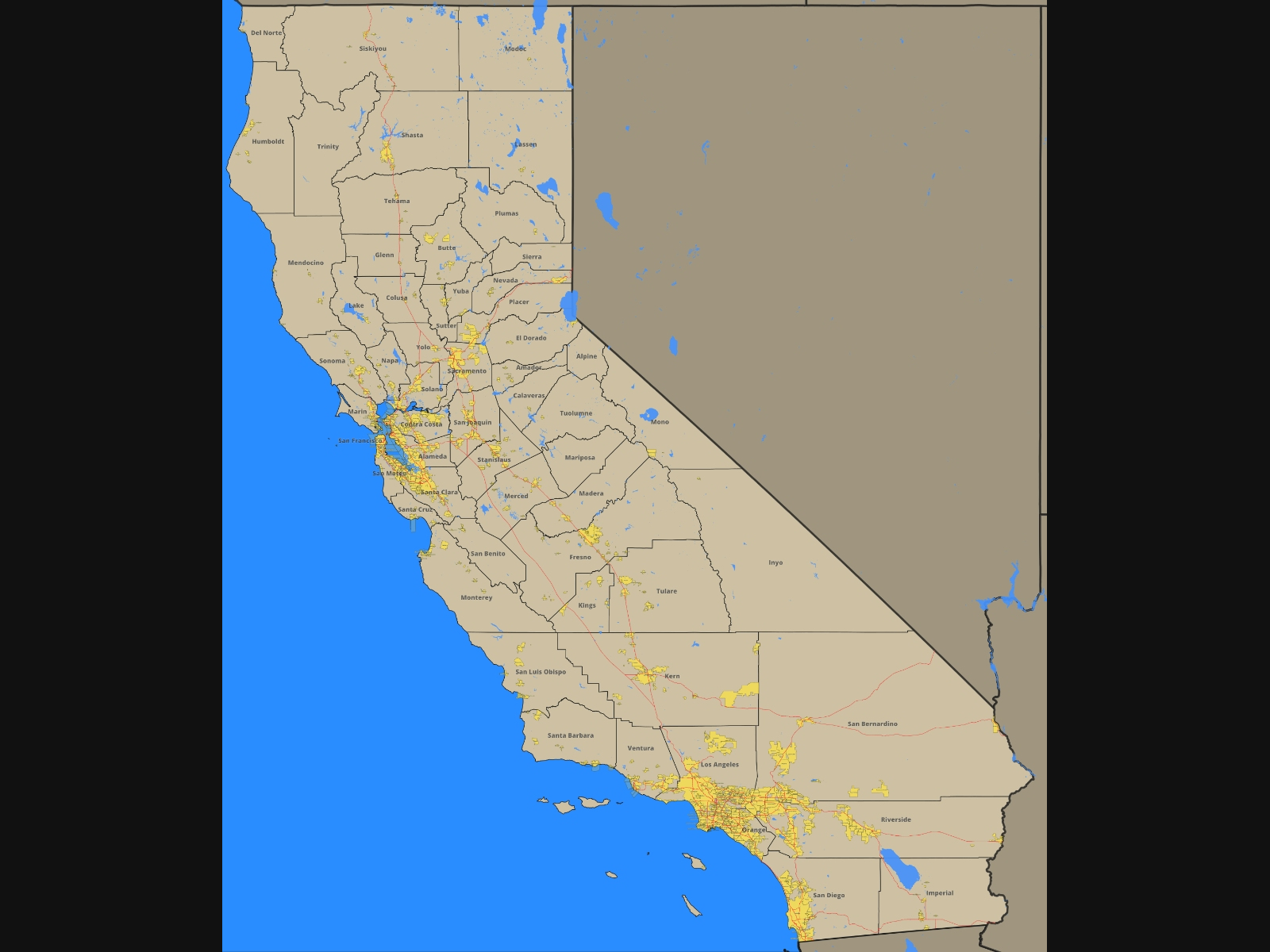
California should treat its supercommuter pipelines as a map of missed opportunity. The Central Valley is not just a bedroom community for the Bay Area. It could be a center for advanced manufacturing, logistics, food technology, and renewable energy. The Inland Empire is already a massive distribution hub but needs higher-wage jobs. The Central Coast has research capacity and quality of life but lacks housing. The North State has land, water, and energy potential. These regions should be connected by fast, reliable rail and supported by state investment in education, broadband, and infrastructure. Decentralization within California is not a concession to other states. It is a resilience strategy.
Reinvention Is Real but Unpredictable
California’s history is a series of reinventions. Gold and silver gave way to wheat and citrus. Oil and agriculture built Los Angeles and the Central Valley. Defense spending during World War II and the Cold War created aerospace and electronics clusters. The semiconductor industry turned orchards into Silicon Valley. Hollywood turned orange groves into the global dream factory. Biotechnology emerged from university research. Each transition changed the state’s economic geography.
The next reinvention is already underway in pieces: artificial intelligence, clean energy, battery technology, space launch, advanced biomanufacturing, climate adaptation, and electric vehicles. But there is no guarantee that the next Silicon Valley will be in California. The state has advantages—research universities, venture capital, a culture of risk—but those advantages can be eroded by cost, regulation, and complacency.
More importantly, the location of the next boom is uncertain. It might rise in the Central Valley, where cheap land and solar resources meet new manufacturing needs. It might cluster around the Port of Los Angeles, where offshore wind and green shipping create new logistics industries. It might emerge in the Inland Empire, already a laboratory for warehouse automation and electric trucking. Or it might bypass California entirely if another state builds a more hospitable environment first.
That uncertainty should not paralyze the state. It should push California to invest broadly rather than betting on a single region or sector. The state cannot simply assume that because Silicon Valley happened once, it will happen again in the same place. It must create conditions under which the next boom can happen in many places at once.
How California Can Compete Without Becoming Texas
California cannot and should not try to win by simply cutting taxes and gutting environmental rules. A race to the bottom would destroy the very assets that make the state attractive: clean air, protected coastline, strong universities, a diverse workforce, and a culture of innovation.
But California can compete on its own terms. That means:
· Build housing, especially near transit and jobs. The state’s housing crisis is its single largest economic weakness. Reforming zoning, speeding permits, and funding affordable housing are not anti-growth policies; they are pro-competitiveness policies.
· Reduce friction for small and mid-sized employers. Large corporations can afford lobbyists and lawyers. The businesses that need help are the film production companies, machine shops, clinical labs, and design studios that face the same regulatory costs with fewer resources.
· Invest in regional infrastructure. High-speed rail, modernized commuter rail, bus rapid transit, and broadband can connect affordable communities to high-wage job centers. The ACE train, Caltrain, and Highway 101 corridor should be part of a broader strategy, not just commuter relief.
· Stop treating every company relocation as a betrayal. Some out-migration is normal and healthy. California will always export talent and ideas. The goal is to keep the pipeline of new businesses and workers refilling faster than it drains.
· Market California’s strengths honestly. The state should have its own pitch: the best research universities, the deepest venture capital, the most diverse workforce, the largest ports, the strongest climate resilience. That pitch works only if the cost of living and doing business is not so punishing that it overwhelms every advantage.
The Bottom Line
California is not dead. It remains one of the most innovative, productive, and culturally influential places on earth. But it has lost its monopoly on the future. Other states are no longer just cheaper alternatives. They are building complete ecosystems—housing, schools, production facilities, transit, and cultural amenities—designed to make California transplants feel at home.
Paramount’s threat to leave is a warning, not a death sentence. The supercommuters of the Altamont Pass are a sign of dysfunction, not an unavoidable cost of success. The real estate pipelines from San Jose to Austin and from Los Angeles to Nashville are evidence that California’s biggest exports are sometimes its own workers.
California can adapt. It has done so before. But adaptation requires honesty: the state must build, not just dream. It must decentralize opportunity, not just celebrate its coastal enclaves. It must compete for jobs, not assume they will always come back. And it must accept that the next reinvention may happen in Fresno, Bakersfield, Riverside, or Stockton—not just in Palo Alto or Santa Monica.
The state has never been guaranteed a permanent place at the top. It earned that place through investment, openness, and a willingness to change. It can earn it again. But only if it stops mourning the past and starts building the next version of itself.