Politics & Government
MAVERICKS: Sheriff's Patrol Force Would Increase Access to Jet Ski Rescue
Stakeholders discuss potential program at federal advisory council meeting.
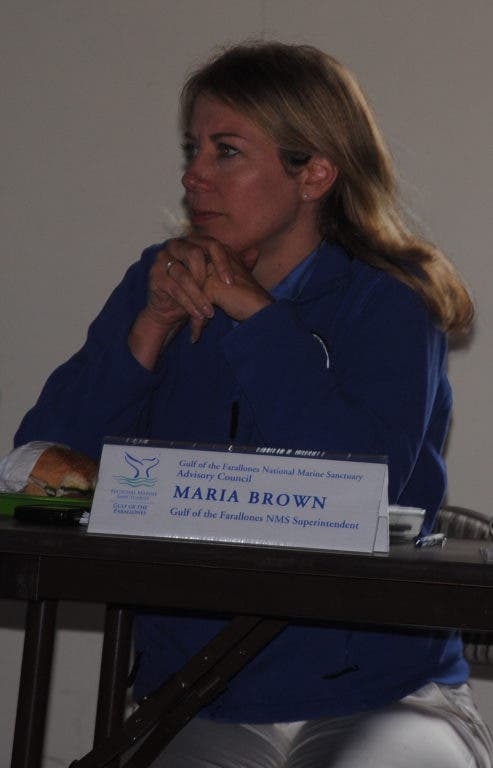


An idea to develop a volunteer jet ski patrol force certified to perform search and rescue at the Mavericks surf break was presented yesterday by the San Mateo County Sheriff's Office in front of an audience of marine sanctuary advisors and Coastside surfers.
On behalf of County Sheriff Lieutenant Ed Barberini, Sergeant Joe Sheridan spoke to the group about the concept of the patrol force at a Pacifica meeting of the National Oceanic and Atmospheric Administration (NOAA)'s Gulf of the Farallones National Marine Sanctuary Advisory Council.
Located less than a mile past Mavericks overlaps part of the Monterey Bay National Marine Sanctuary, which grants federal protections to marine life within its boundaries. The northern stretch of the Monterey Bay National Marine Sanctuary from to Marin County is governed by Gulf of the Farallones staff.
Find out what's happening in Half Moon Bayfor free with the latest updates from Patch.
Certifying the jet ski patrol volunteers as part of a public safety agency would allow for an increased presence of these units — also known as personal motorized watercraft — in the vicinity of the Half Moon Bay surf break due to the individuals' certified status, as well as their affiliation with a public safety agency, according to Barberini.
Barberini said that the Sheriff's Office was approached by marine sanctuary officials with the idea that the Sheriff could administer the volunteer patrol force, given the Sheriff's status as a public safety agency with the authority to conduct search and rescue in sanctuary waters whenever necessary.
Find out what's happening in Half Moon Bayfor free with the latest updates from Patch.
It is currently illegal for individuals to operate personal motorized watercraft at Mavericks during non-high surf advisory conditions, according to sanctuary regulations. Personal jet skis have been allowed during high surf advisory conditions since 2009, when the Gulf of the Farallones National Marine Sanctuary changed its regulations, according to Superintendent Maria Brown. NOAA has jurisdiction over when a high surf advisory is released.
The jet ski patrol force would ideally be incorporated as part of the Sheriff's volunteer program, a group of approximately 300 members trained in specialized skills such as cliff, dive and boat rescue, Barberini said.
In a letter written to on May 6, 2011, Brown suggested that the idea for the patrol force was prompted by the sanctuary's advisory council in light of two major accidents at the Mavericks surf break earlier this year — the near-drowning of Southern California surfer and the death of surfer , who traveled from Hawaii to in March.
Public comments by two Coastside surfers renewed the public discussion about the extent of the role that personal motorized watercraft should play at the treacherous surf break.
, Half Moon Bay native and founder of Mavericks, expressed strong support for additional jet ski patrols at the break while simultaneously advocating for surfers' skills using jet skis in high surf conditions.
"At this point, 90 percent of the surfers at Mavericks have [jet] skis and are trained to operate them safely," he said, citing the 1994 death of Mark Foo, a surfer from Hawaii, at the break as a catalyst for getting surfers trained in water rescue with the county sheriff.
Clark also spoke out against sanctuary regulations that use of jet skis at the surf break should be restricted in order to protect wildlife such as sea otters and sea lions from being disturbed or run over.
"My motto with jet skis is to go as slow as possible," he said to the marine advisors and assembled attendees in the audience. "We're not the ones who are damaging wildlife."
Santa Cruz resident Scott Jarrett, who also surfs Mavericks, added that he did not know of any example of wildlife in the sanctuary which had been run over by a personal motorized watercraft, and added that these animals are not in the area when big waves break anyway.
"We have an active case right now," said Brown yesterday, referring to what she says is a case of a personal motorized watercraft that ran over endangered wildlife in sanctuary waters. Brown also said that there have been cases of personal motorized watercraft in the marine sanctuary which have run over wildlife in the past.
Clark and Jarrett also called into question NOAA's judgement on surf conditions at Mavericks on January 22, the day of Trette's accident. They cited it as an example of a day NOAA did not issue a high surf advisory despite conditions fitting of the advisory — which they said restrained surfers from being able to legally use jet skis when there was a need for them.
On that day, Trette was rescued and brought to shore by a jet ski operated illegally by a photographer.
"Our regulations have never interfered with authorized agencies conducting search and rescue operations," said Mary Jane Schramm, a spokeswoman for the Gulf of the Farallones National Marine Sanctuary.
"I think there's been an overreaction to the use of personal watercraft in this context," said General Manager Peter Grenell and Gulf of the Farallones Marine Sanctuary Advisory Council alternate who attended the meeting.
"I have yet to see any documentation or evidence of personalized watercraft that has disturbed wildlife at Mavericks," he said. "It's not doing harm to the environment...I have yet to see any damage," he said.
Brown said that her agency has conducted an analysis of species of particular concern in the marine sanctuary — those that are "threatened and endangered," she said.
"We found that the breeding season of the harbor seals and the pups during the months of November and March are of concern," she said.
Barberini said the Sheriff's Office idea to develop a jet ski patrol force is still in a conceptual stage, and that it has not been determined who would pay for certification of the volunteers — nor whether volunteers could be certified in time for the 2011-2012 Mavericks surfing season.
"Sooner is better than later, but we don't want to compromise quality and we're not prepared to forecast when it would start," he said. "We're looking at this as a permanent ongoing resource."
If the jet ski patrol force was to get off the ground, it would be available throughout the county for all water users, not just surfers at Mavericks, he said.