Politics & Government
Panel Divided on Microbrewery
The planning commission deadlocks Tuesday on the question of whether to allow such businesses to open in M-1 zone near the Greenbelt.
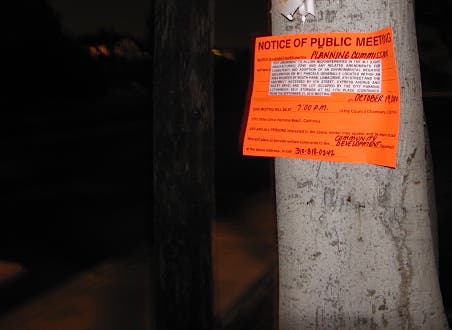


The Hermosa Beach Planning Commission failed to reach a consensus Tuesday on whether to allow microbreweries to operate within the city's M-1 light manufacturing zone, which is near the Greenbelt and bounded by South Park, Loma Drive, and 8th Street.
The commission deadlocked at 2-2 on the question of whether the city should change the M-1 zoning specifications and will consequently make no recommendation to the City Council on permitting microbreweries to open there.
Commissioner Peter Hoffman was not allowed to vote because he lives too close to the M-1 zone.
Find out what's happening in Hermosa Beachfor free with the latest updates from Patch.
The question of whether to change the M-1 specifications came up as a result of Hermosa resident Jeff Parker's efforts to open a microbrewery, Beachfront Brewing Company, in a building within the zone in the 600 block of Cypress Avenue. He was not present at the commission meeting Tuesday.
Hermosa resident and former microbrewery owner Sandy Saemann was at the meeting and told the commissioners that he opposes the idea of allowing the Beachfront microbrewery in the M-1 zone.
Find out what's happening in Hermosa Beachfor free with the latest updates from Patch.
"I owned and operated Brewski Brewing Company for over 12 years in which time we reached 21st in the nation in sales and rankings so obviously I'm for microbreweries," he told the commission. "But I'm also a resident and I have great concern. The odors can be quite strong from brewing, and I caution that if you allow this you could be causing some residents great unpleasures."
Commission member Ron Pizer, who voted against the zone change, admitted that he wasn't up to date on the impact of a microbrewery in the M-1 zone, which borders many homes. But that didn't keep him from having reservations about the potential smells the brewery may emit, he said.
"The basic idea of odors coming out of another facility, and if you compare it with surfboards and stuff like that … I don't know why we have to have this added to our city for permanent use," he said.
Commissioner Sam Perrotti voted to allow Parker's microbrewery within the M-1 zone. The business' impact on the surrounding area would be very minimal, he said.
"It's not like it's a full-time brewery, seven days a week, 24 hours a day," Perrotti said. "The only time there's going to be odors is when they're preparing the water. With an operation this small I think that would only be a few hours each week."
Commissioner Shawn Darcy agreed, and added that as long as the production is on a small scale he sees no reason now to disallow it.
"I don't see this being a real impact in that area," he said, before adding that the operation should be limited to 5,000 barrels a year to minimize the overall impact.
Parker's initial request to open a microbrewery was submitted to the city in July, and he planned for the operation to produce less than 4,000 barrels per year.
To date, the only microbrewery in the city is the Union Cattle Company on Manhattan Avenue, which is not in the M-1 zone. The operation produces 450 barrels annually for its in-house customers. All beer produced is sold on the premises.
And the city research committee said that officials have received no complaints from residents regarding odors from Union Cattle's production of craft beers.