
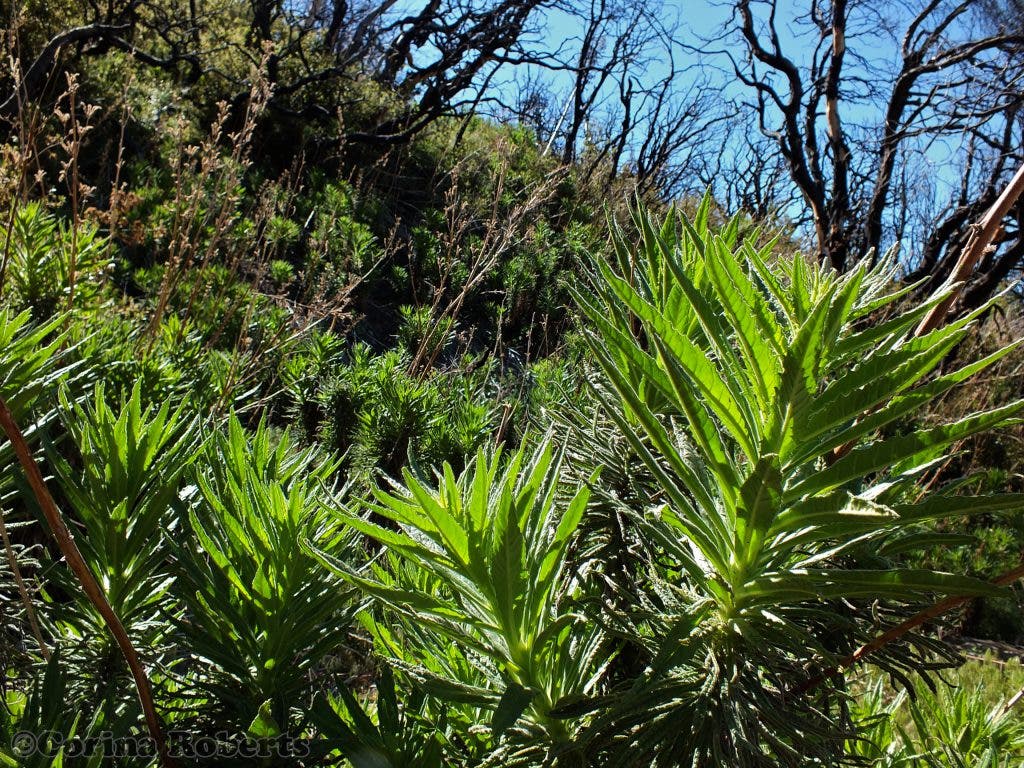


It is my all-time favorite fire follower. I had never seen it before the fire, not in the Angeles National Forest or anywhere else. It would not be until the winter of 2010 that Deputy J.Lopez of Los Angeles County Fire’s Division of Forestry would give me an education about poodle dog bush. By then I had encountered it many times without fully appreciating its properties.
Poodle dog bush is poisonous. Its effect is much similar to poison oak or poison ivy, but the dermatological conditions it produces can be more severe, and can persist for weeks. In the spring and summer, it is covered in a resinous coating that clings to skin, hair and clothing. It is also beautiful and fragrant, with tall, erect stalks of small purple flowers.
The plant has a fuzzy-headed appearance, with thick stems hosting thin, serrated, hair-covered leaves clustered in a sort of ball; as the plant grows taller, the ball shape remains at the head of each stem while the lower leaves die back, giving it the appearance of a show cut on a standard poodle. Glowing silver-green in the sunlight, exuding a heady fragrance with or without flowers, it is a joy to photograph and observe.
Find out what's happening in La Cañada Flintridgefor free with the latest updates from Patch.
Hummingbirds can access the flowers without getting tangled up in the sticky leaves of the plant, which grows most profusely above five thousand feet, where other plants were slower to regenerate after the fire. Poodle dog bush provided an upper-elevation source of nectar in the first post-fire spring and summer.
Over time I would begin to notice other characteristics about poodle dog bush that would enhance my appreciation of, and curiosity about, the unusual fire follower with the funny name.
Find out what's happening in La Cañada Flintridgefor free with the latest updates from Patch.
Poodle dog bush grows in density in relation to fire intensity. Where mild to moderate burning occurred, there is little or no poodle dog bush. Where the fire was hottest, exhibiting extreme fire behavior and consuming trees completely, poodle dog grows dense.
There is another essential relationship. Where you find poole dog bush, you find conifers...pine trees...and most frequently, you find the coulter pine. It may be that the coulter pine and poodle dog bush have a preference for the same altitude range and the relationship is no more complicated than that. Or there may be more to it.
In the presence of naturally occurring coulter and other pines which were fire damaged or destroyed, you will find poodle dog bush. Look carefully in the vicinity of the poodle dog bush, and you will likely find naturally occurring conifer seedlings.
Go to an area where conifer trees were introduced to the landscape (this was a popular strategy for increasing recreational areas within the Angeles National Forest from the 1950s to the 1970s) and subsequently consumed by fire, and you may find the lack of, or much less abundant, poodle dog bush. In those same areas, there will be fewer naturally occurring conifer seedlings...and the ones you do find will almost certainly be growing in the presence of, even touching or directly underneath, poodle dog bush.
Poodle dog bush is the great protector of conifer seedlings. It began to emerge shortly before the natural tree seedlings did, providing some soil stability and a bit of shade for the newly emerging conifers. As the pine seedlings grow taller, so does the poodle dog, but at a much faster pace; while the tallest of the natural pine seedlings have reached eighteen inches to two feet at best, by the summer of 2011 stands of poodle dog bush towered seven feet tall. Protected within them, the conifer seedlings grow unmolested. Nothing...on two legs or four...wants to spend a lot of time tangled in the jungle of poodle dog.
In five to seven years, the poodle dog bush will once again subordinate to regularly occurring coastal scrub and chaparral plants, leaving in their wake a community of bushes and trees ready to tackle the elements without their poisonous allies.
This is a perfectly harmonious arrangement for naturally occurring seedlings. It has proved less positive for the hand-raised and hand-planted seedlings that were lovingly placed by volunteers in the same areas. Hand-planted seedlings are put into the ground in the spring, after much of the rain and snow has already come and gone, and the majority of them need to be hand-watered, at least through their first summer and fall. Once the poodle dog bush began to grow rapidly, volunteers were no longer able to get to the trees they planted, and many of those planted trees did not survive their first year in the wild.
The relationship between poodle dog bush and the pine trees it protects is dynamic and multi-faceted. Perhaps some day we will enlist volunteers to plant conifer tree seeds rather than seedlings, and to plant along with them the seeds of the poodle dog bush; honoring the perfect harmony of nature and embracing forest management from a long-term perspective that understands fire as part of the life cycle of the ecosystem.