

Disclaimer: The views expressed on this website are entirely my own and do not reflect any position of the U.S. Government or the Peace Corps.
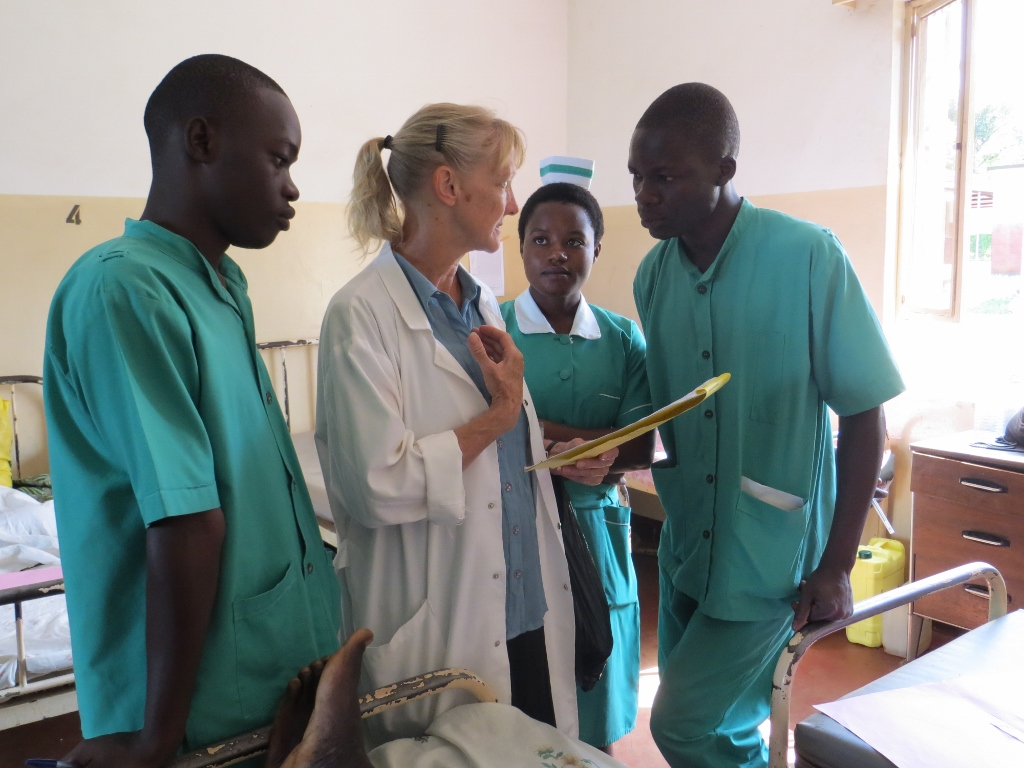
4/9/13: Another volunteer just completed a project in which she visited 30 volunteers in 30 days. It is a great program where she blogged about the sites of other volunteers in Uganda. I enjoyed having her visit. One of the things she gave me through this is a sense of peace with what I am doing right now. During her time with me at the hospital I answered some of the student’s questions about a patient who had a chest tube and a pneumothorax. I was drawing diagrams and explaining treatment and the students were really interested. There was even a housekeeper there who was listening and said she wanted to learn also. As I was finishing they all said, “ahhh” and I knew they got it. When she left, I told her that despite the frustrations of the job, times like those really make my day. For those who are interested and want to read about the 30 volunteers and what they are doing here in Uganda, you can go to http://therewontbesnowinafrica.blogspot.com/. Her blogs work backwards from the most recent.
4/28/13: Our first meeting with the orphans and albinos and their caretakers for HIV/AIDS education was very productive. We had 31 people attend, all over 15, with 15 signing consent forms for 28 children to be tested. They even had 2 radio stations there to promote the organization and their program. Three students who I trained for this project assisted me with the local language. We do our testing on May 6th with a follow-up meeting on nutrition, life skills, and treatment scheduled for May 12th.
A few statistics:
- HIV/AIDS in the World: 34,000,000 (UNAIDS, 2011)
- New infections: 2.5 million across the world
- 1.7 million people died from AIDS in 2011 (a decrease of 24%
- HIV/AIDS in Uganda (population 34.5 million) (UNAIDS, 2011)
- The prevealence of HIV/AIDS in people aged 15-49 is 7.2%
- Deaths: 62,000
- 1 in 20 living with HIV
- 69% of people in the world with HIV/AIDS are in Sub-Sahara Africa
5/6/13 You know we try to schedule and plan but things just don’t happen that way here. About 10 days ago we scheduled with the HIV clinic at the hospital to bring the orphans/albinos today for testing. Today, only the primary nurse remembered we were coming, but she didn’t arrive until after 9 (we were there at 8) and she had forgotten to plan. We waited about 2 ½ hours for them to be able to tell us that they did not have any testing kits and would not be able to test the children. We had a small 5 year old who came with the first group at 8 who was falling asleep! During this time, I am running back and forth to the wards to check on students, while talking to the lab about testing kits and working with staff at the clinic. Richard was in the field picking up students and his car got stuck in the mud because of serious rain last night. Benjamin had rented a boda motorcycle to pick up another family to try to save time. It was a bit crazy. One of our major problems was financing. We had already transported children and needed to get the testing done free. If we reschedule to another day, we have to find additional funding for the transport since there was no more grant funding. Most of the clinics charge for testing and the hospital was the only one we knew of that was free. Thankfully one of the staff members knew of a clinic that had just started free HIV testing and needed to get participants to build the program. He spoke with the lab technician and we received permission to go there. By this time we had about 19 children with another 9 on the way and we were not sure he would be agreeable to testing all of them. Well, he agreed to test all 28, but because he also had other patients to do blood work for, he asked me to fill out the paperwork required by the government. This was a one page questionnaire for each participant – yeah, overabundance of joy here. But, it really helped him and kept me busy too. The lab tech was fantastic and great with the kids. So, the project that we thought might take 4-5 hours ended up taking 8. That’s Africa for you! We didn’t plan for lunch, but were able to buy juice and a mandazi (small cake) for each of the children. Suffice it to say it was a productive yet tiring day. Oh, you want results? Well, we tested about 21 orphans and 7 albinos. 15 children under 10, 9 from 10-14, and 4 age 15-17. Only one had been sexually active (that is actually a good thing since an average of 16% have sex before age 15). All children were negative!!!
5/12/13 Even more successful than the testing, was the nutritional education with 56 participants including one from the radio and one from a local TV station. We received many comments from the community members:
“Me, I used to think that if a certain type of food is important in the body, for some people it's dodo, I will eat just that food in large quantities. So, I could not know that I need to take small quantities of each type of food because each food has different purposes in the body.”
- “Some other people used to think that people that are malnourished are bewitched. But I discovered that poor nutrition is the root cause of that.” “Most people think that eating fried food is the best thing. They don't think they can make quality food from local food, so they fry even g-nuts. Actually, even porridge, they will fry it. I learned that too much fat is not good.”
- “Here they think that someone who is getting big is very healthy. That lesson was very good, that it is not good to be too fat. That one woman who was 82 kg was thinking that she was good, but you explained to her that being fat can cause other health problems.”
- “Here you may even find a kid of 2 months being fed on soda. When you explained that soda is not good for them they doubted that. When we were discussing this, some people came to believe that soda was not so good for them.”
- On average people in Uganda live on less than $1.25 http://www.feedthefuture.gov/country/uganda ·
- 16% of children under 5 are underweight, 39% of children under 5 have stunted growth (Fact Sheets of Health Statistics, WHO, 2009). ·
- 16% of children under 5 die from diarrhea (Fact Sheets of Health Statistics, WHO, 2009).
Still more statistics: (UN statistical division)
- 13% use the internet
- 48% have cell phones
I’ve been doing a simple Bible study with a book I am reading about what the Bible says about Heaven. Sitting here at the hospital picturing no poverty, no illness, no death. Picturing Africans with shoes on their feet, full bellies, and smiles on their faces. Daily I witness their strength, their perseverance and marvel at their strength to do it all again the next day.