Weather
Laguna Beach Prepares For Kelvin Wave Expected To Raise Sea Levels Along SoCal Coast
Laguna Beach residents were urged to stay informed regarding wave conditions in town.


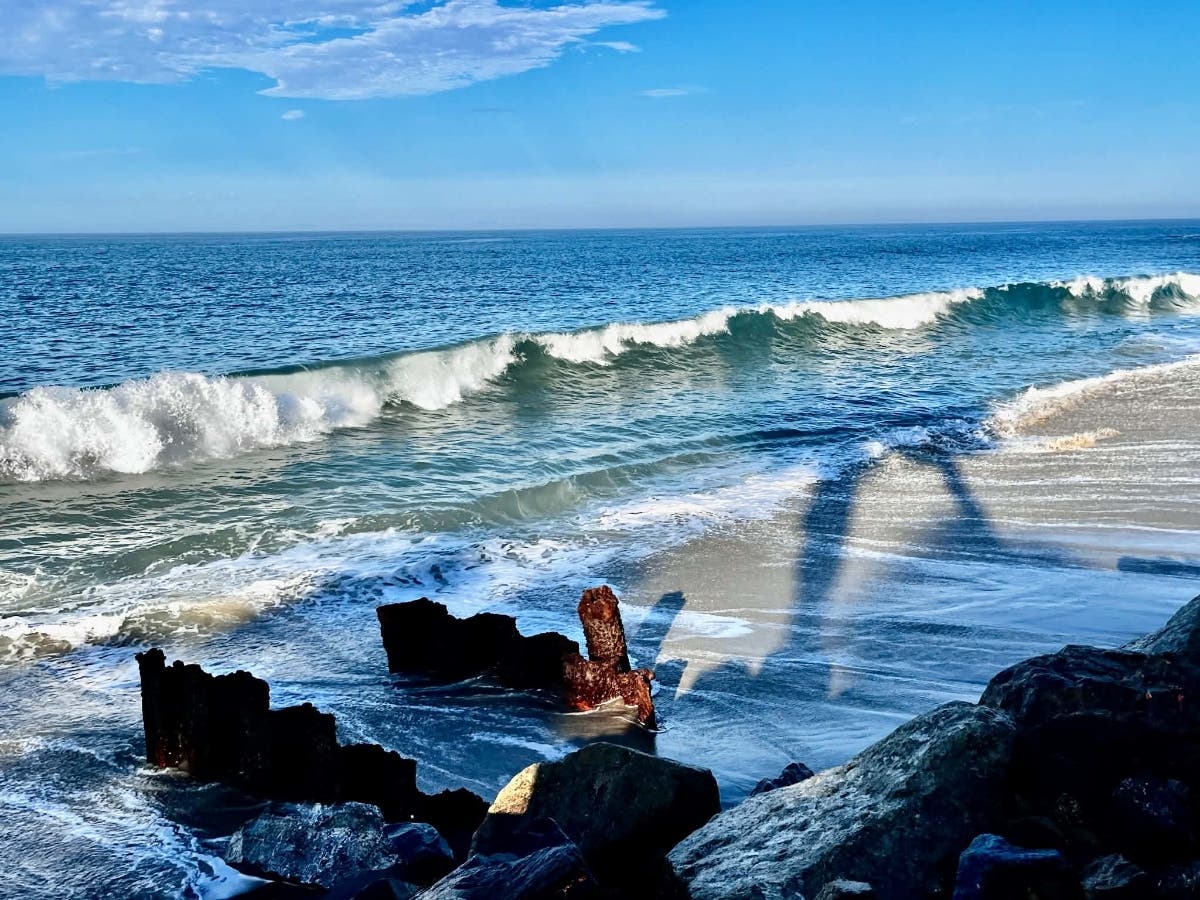
LAGUNA BEACH, CA — Southern California's battered coastline could face another test in the coming weeks from an ocean phenomenon capable of raising coastal sea levels for months — but don't expect to see a giant wave barreling toward Laguna Beach.
A coastally trapped Kelvin wave currently moving north along Mexico could reach the Orange County area in early October and raise coastal sea levels by roughly 6 to 12 inches, Dillon Amaya, Ph.D. and assistant professor of marine, earth and atmospheric sciences at North Carolina State University, told Patch Monday.
And after Hurricane Marie stripped away sand and damaged homes from Carlsbad to Malibu last week, Amaya said the erosion could leave parts of the coast more exposed to whatever comes next.
Find out what's happening in Laguna Beachfor free with the latest updates from Patch.
In Laguna Beach, the city's Marine Safety Department has been vigilantly standing guard over the waves in coordination with county partners and the National Weather Service.
"We've already been through one round of coastal damage this month, and we're using what we learned to get ahead of the next one," Chief of Marine Safety Kai Bond told Patch.
Find out what's happening in Laguna Beachfor free with the latest updates from Patch.
Bond said Laguna Beach lifeguards are tracking tide and swell forecasts daily, and working with Public Works to protect the most vulnerable stretches of shoreline.
Bond noted that the city will flag high-risk tide windows to the public before they arrive.
"Residents can help by staying informed and respecting the ocean," Bond said. "Check conditions before heading to the beach, stay off the rocks and away from the waterline during high tides, and if you live on the oceanfront, make a plan now."
Amaya said the recent erosion could leave places such as Laguna Beach more vulnerable to the effects of the Kelvin wave. “The beach is often acting as a ... buffer towards wave energy crashing along the coastline,” he added.
Particularly hard hit were Long Beach, Laguna Beach, Dana Point and Malibu, where several beaches were denuded and homes were red-tagged.
With steeper, shallower beaches, Amaya said, wave energy can interact with the coastline with greater force and more water can reach buildings, roads and other infrastructure that the beach would otherwise help protect.
“Certainly more beach erosion is on the table,” he said.
The warning comes little more than a week after waves generated by Hurricane Marie battered the Southern California coastline.
On Sept. 6, the National Weather Service reported waves overtopping the seawall and boardwalk in Long Beach, flooding 12 garages and repeatedly undercutting the boardwalk and houses. One home was damaged and required shoring, according to the agency. In Malibu, a massive sinkhole swallowed teh driveway at actor Nicolas Cage's home, and several homes in Dana Point are no longer safe to live in.
What Is A Kelvin Wave?
Despite its name, this isn't something out of Star Trek and it's definitely not the kind of wave anyone is going to surf. Instead, Amaya described it as a large-scale disturbance that raises the baseline sea-surface height of roughly the nearest 12 to 19 miles of ocean closest to the coast.
Normal breaking waves and swells continue moving on top of that elevated background sea level. That's why a Kelvin wave can matter on land even though somebody aboard a boat might notice it passing.
“If you raise background sea states, you increase the risk of things like high tide flooding or storm surge,” Amaya said.
The National Oceanic and Atmospheric Administration (NOAA)
describes coastally trapped Kelvin waves as a signature of El Niño. When the trade winds that normally blow westward along the equatorial Pacific weaken or reverse, oceanic Kelvin waves travel east toward Central and South America. After reaching the Americas, the disturbance can travel north along the North American coastline.
The “coastally trapped” part means the disturbance remains confined along the coast rather than propagating offshore.
When Will It Reach Southern California?
Amaya, who is tracking the current wave, told Patch Monday afternoon that it was around Puerto Vallarta on Mexico's Pacific coast. He estimated it would take another two or three days to enter the Gulf of California, about 11 days to follow the coastline around the gulf to Cabo San Lucas, another seven days to reach San Diego and approximately three more days to reach Los Angeles County.
That puts its expected arrival in the Los Angeles area in early October. There is some uncertainty because scientists must first establish exactly where the wave is, Amaya said, and passing storms or tropical cyclones could generate other coastal disturbances that interact with it.
But left largely undisturbed, these waves propagate at a relatively constant speed of about 6 mph, he said. “Once we know where it is, we have a fairly decent idea when it'll arrive at any given location,” Amaya said.
Why Another Few Inches Matter
Amaya said the current Kelvin wave could raise coastal sea levels by roughly 6 to 12 inches, depending, in part, on how its energy interacts with coastal and underwater features.
Six inches may not sound particularly threatening, but Amaya said a rule of thumb is that approximately every four inches of sea-level rise can double the flooding risk for low-lying coastal areas.
“Six inches may not sound like a lot, but it can absolutely be a big deal,” he said.
NOAA says coastally trapped Kelvin waves can produce sea-level changes of approximately 15 centimeters, or 6 inches, measurable by coastal tide gauges and satellites. The greatest concern isn't necessarily the Kelvin wave acting alone. Amaya said the combination of elevated sea level with a high tide, large swell or coastal storm would maximize the risk of coastal inundation.
“The Kelvin wave ... is just an amplifying factor to the background kind of sea state,” he said, adding that a storm arriving on top of the elevated sea level could produce “outsized impacts like coastal flooding.”
NOAA has made the same broader point about El Niño conditions: elevated West Coast sea levels can allow high tides and strong surf to ride higher and push farther inland than they otherwise would.
Effects Could Linger Into Winter
Perhaps more consequential than the wave's arrival is how long its effects could remain. Amaya said that after a Kelvin wave raises the background sea level, it can take roughly three to six months for the sea state to relax toward its previous level.
That means elevated sea levels from a wave arriving in early October could potentially persist into winter, when California experiences some of its highest astronomical tides.
And this isn't necessarily a one-time event. Amaya said another Kelvin wave passed earlier this year, in May and June, and El Niño can produce several of them. NOAA has said the effects of those would likely be minor compared with those expected this fall and winter.
“There will almost certainly be more,” Amaya said, adding, “This is not going to be a one-off thing.”
No, A Giant Wave Isn't Coming
For coastal residents, perhaps the most important thing to understand is what a Kelvin wave isn't.
“They shouldn't expect a tsunami,” Amaya said. “They shouldn't expect this big crashing sort of Day After Tomorrow kind of wave.”
Instead, it is a slow-moving, enormous-scale disturbance that raises the background sea level. Its effects become more consequential when combined with ordinary waves, swells, tides and weather. And Amaya cautioned against another misconception: a gigantic body of water isn't physically traveling from Mexico toward California.
“It's not a literal volume of water that is moving up the coast,” he said. What's propagating is the sea-level disturbance, not the same mass of water. “There's no mass transport here,” Amaya added. Kelvin waves can also affect the ocean beneath the surface.
Amaya said elevated coastal sea levels can inhibit the upwelling of colder, nutrient-rich water and push warm water deeper, potentially contributing to marine heat waves and changes in where marine species are found.
That could mean tropical fish appearing farther north than usual and changes in the movements of species including hammerhead sharks, manta rays, bluefin tuna and whales, he said. Last week, a whale shark, normally seen in tropical waters, was sighted off the coast of Malibu.
But for Southern California communities still recovering from Hurricane Marie, the immediate concern is what an elevated ocean could mean for a coastline that has already lost some of its natural protection.
Get more local news delivered straight to your inbox. Sign up for free Patch newsletters and alerts.