Community Corner
Advocates Welcome Supreme Court Ruling on Marriage Equality
'Simply put, love wins,' said Mike Thompson, executive director of the LGBT Community Center of the Desert


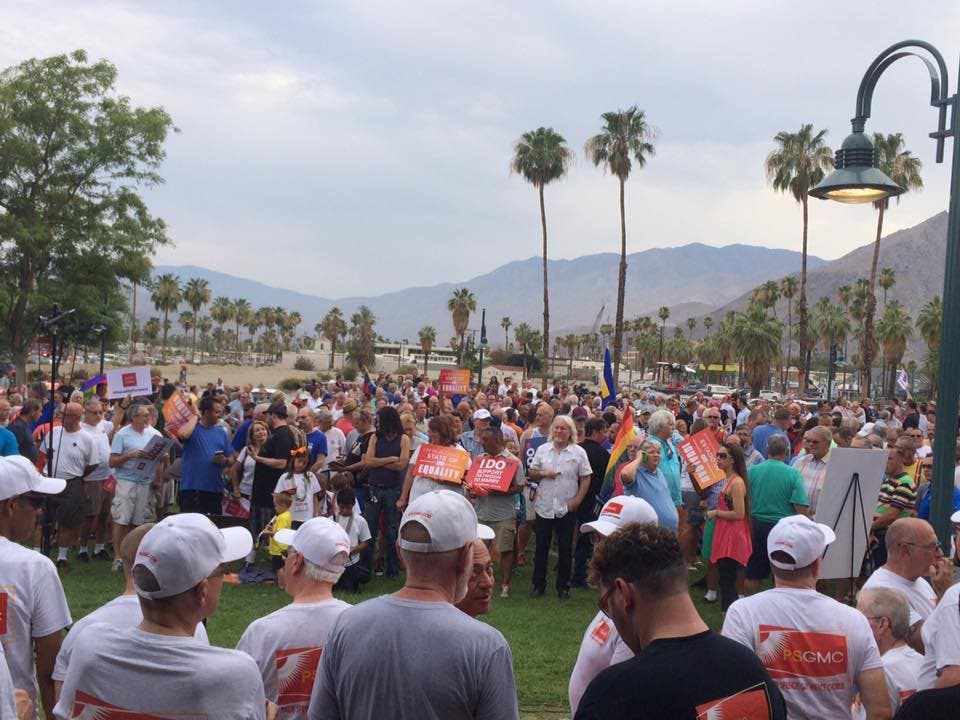
Photo courtesy of LGBT Community Center of the Desert
By City News Service
Advocates of same-sex marriage in the Coachella Valley expressed elation today, following the ruling by the U.S. Supreme Court establishing the right for gay and lesbian couples to legally wed in all 50 states.
Find out what's happening in Lake Elsinore-Wildomarfor free with the latest updates from Patch.
While such marriages were already legal in California, the nation’s highest court decided the 14th Amendment to the U.S. Constitution’s equal protection clause requires all states to permit same-sex marriages, and recognize those performed in other states where it was already legal.
“Simply put, love wins,” said Mike Thompson, executive director of the LGBT Community Center of the Desert in Palm Springs.
Find out what's happening in Lake Elsinore-Wildomarfor free with the latest updates from Patch.
Thompson has been part of the crusade to legalize same-sex marriage since 2004, and said he was overwhelmed by the prospect of final victory for supporters of marriage equality.
“There’s not a single emotion,” said Thompson, who recalled coming out in the late-1980s when even the idea of marriage was a far-fetched notion. “There’s certainly a range of emotion. Everything from celebration...I find myself a little beside myself.”
As recently as last October, the court declined to hear appeals of rulings allowing same-sex marriages in five states, suggesting tacit approval, but failing to offer the broad constitutional protection conferred by today’s ruling.
“This is, of course, a historic day,” said George Zander, field manager for Equality California’s desert cities chapter. “LGBT citizens are now citizens of this country like we’ve never been before.”
He added: “It’s a time for celebration. It’s an amazing, amazing day for all of us and actually for this entire country.”
A rally was scheduled for 5:30 p.m at Frances Stevens Park, 555 N. Palm Canyon Drive in Palm Springs.
Palm Springs City Councilwoman Ginny Foat, who will co-emcee the rally, said she was overcome with emotion.
“To see this kind of a historic change happening so quickly in this country is something that I didn’t think I’d ever see in my lifetime,” she said.
The cases considered by the U.S. Supreme Court involved four states -- Kentucky, Michigan, Ohio and Tennessee -- where same-sex marriages were banned. Those states were among the 14 remaining in the country that did not allow same- sex unions.
The court heard arguments in April.
In March 2000, California voters approved Prop. 22, which specified in state law that only marriages between a man and a woman are valid in California. But in May of 2008, the state Supreme Court ruled the law was unconstitutional because it discriminated against gays, and an estimated 18,000 same-sex couples got married in the ensuing months.
Opponents of same-sex marriage quickly got Prop. 8 on the November 2008 ballot to amend the state constitution, and it was approved by a margin of 52.5 percent to 47.5 percent.
In May 2009, the California Supreme Court upheld Prop. 8 but also ruled that the unions of roughly 18,000 same-sex couples who were wed in 2008 prior to its passage would remain valid.
Councilwoman Foat and her partner of 27 years were among those who married during that brief window.
“This is one I never thought I’d see, and a lot of people never thought they’d see,” Foat said.
Same-sex marriage supporters took their case to federal court, and U.S. District Judge Vaughn R. Walker ruled in August 2010 that Proposition 8 “both unconstitutionally burdens the exercise of the fundamental right to marry and creates an irrational classification on the basis of sexual orientation.”
Backers of Proposition 8 -- ProtectMarriage.com -- appealed to the 9th Circuit, because then-Gov. Arnold Schwarzenegger and then-Attorney General Jerry Brown declined to do so. The appellate court heard arguments in 2011 but put a decision on hold while it awaited a state Supreme Court ruling on the ability of Prop. 8 backers to press the case forward despite the state’s refusal to appeal.
The state Supreme Court decided that Prop. 8 supporters had legal standing, so the 9th Circuit moved ahead with its consideration of the case, hearing more arguments on a motion by Prop. 8 backers asking that Walker’s ruling be thrown out because the judge was in a long-term same-sex relationship that he had not disclosed.
A three-judge panel of the U.S. 9th Circuit Court of Appeals ruled in 2012 that the proposition’s primary impact was to “lessen the status and humandignity of gays and lesbians in California.”
“It stripped same-sex couples of the ability they previously possessed to obtain and use the designation of ‘marriage’ to describe their
relationships,” according to the court’s decision.
That ruling led to an appeal to the U.S. Supreme Court, which ruled in 2013 that Prop. 8 backers lacked legal standing to challenge the 9th Circuit’s ruling, clearing the way for same-sex marriage in California.
Get more local news delivered straight to your inbox. Sign up for free Patch newsletters and alerts.