Community Corner
Volunteers Need to Help Count Bald Eagles Mountains Near Lake Elsinore, Wildomar
U.S.F.S. hosting annual winter bald eagle counts in and near the San Bernardino and San Jacinto Mountains.


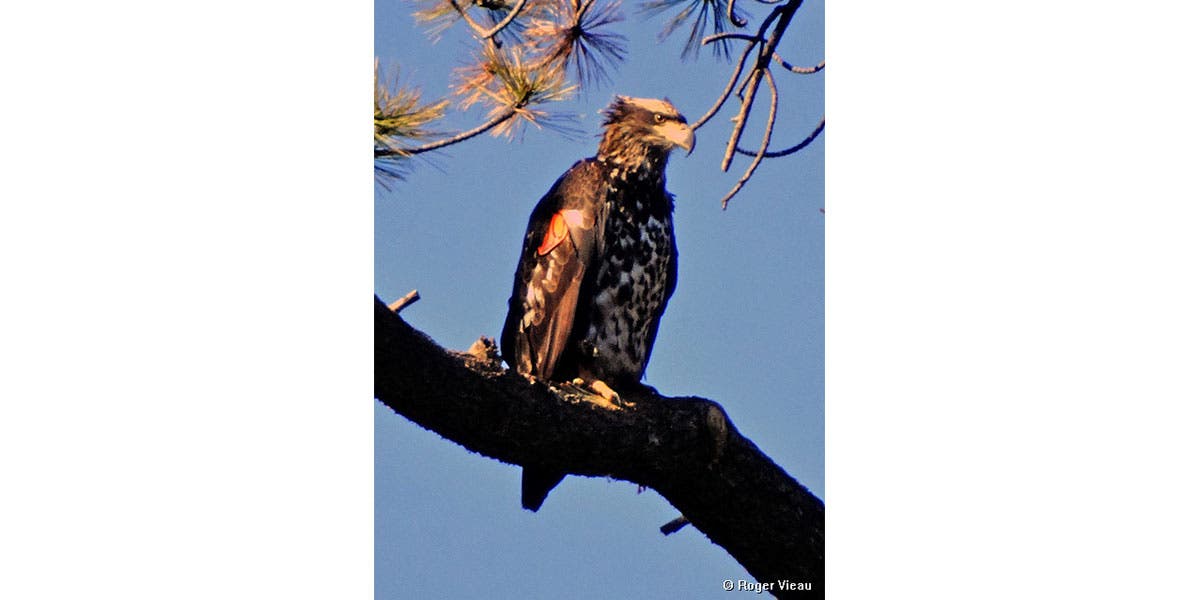
PHOTO: Juvenile bald eagle seen in Big Bear in February 2014, with tags indicating that it hatched on Catalina Island in 2012. Its name is Pakuu. CREDIT: Roger Vieau via the U.S. Forest Service.
The following is a news release from the U.S. Forest Service:
Volunteers are needed to help count bald eagles for the 36th season in the annual winter bald eagle counts in and near the San Bernardino and San Jacinto Mountains on Saturday December 13th, January 10th, February 14th, and March 14th.
Find out what's happening in Lake Elsinore-Wildomarfor free with the latest updates from Patch.
Concurrent Bald Eagle counts are held at Big Bear Lake, Lake Arrowhead, Lake Silverwood, Lake Perris, and Lake Hemet. Volunteers are stationed at vantage points around the lakes, where they watch for bald eagles during a 1-hour period on the count mornings. Volunteers record their observations on maps and data sheets. This is a wonderful opportunity to catch a glimpse of our breath-taking national symbol. Brief orientations are conducted prior to the count so volunteers know where to go and what to do.
“Through this method, the agencies and land managers have learned a lot about which areas are important to eagles and how the populations are doing. But we can’t do it without a lot of volunteers – we need their eyes to help us look,” said Forest Service biologist Robin Eliason.
Find out what's happening in Lake Elsinore-Wildomarfor free with the latest updates from Patch.
The bald eagle counts for this winter are scheduled for the following Saturday mornings: December 13th, January 10th, February 14th, and March 14th. No experience needed. Signing up ahead of time is unnecessary – just show up at the designated time and location, dress warmly, bring binoculars and a watch.
- Big Bear Lake area volunteers will meet at 8:00 a.m. at the Forest Service’s Big Bear Discovery Center on North Shore Drive for orientation. Contact Rari Marks (rariemarks@fs.fed.us or909-382-2600 x4075) for more information. Please call 909-382-2832 after 6:30am on the day of the count, to confirm cancellation due to winter weather conditions. Contact the Discovery Center (909-382-2790) for information about Eagle Celebrations. There will also be a free slideshow about bald eagles at 11:00 after the counts and on December 27th and January 17th.
- Lake Arrowhead/Lake Gregory volunteers will meet at 8:00 a.m. at the Skyforest Ranger Station for orientation. Contact Rari Marks (rariemarks@fs.fed.us or 909-382-2600 x4075) for more information. Please call 909-382-2832 after 6:30am on the day of the count, to confirm cancellation due to winter weather conditions.
- Silverwood Lake State Recreation Area volunteers should plan to meet at the Visitor Center at 8:00 a.m. for orientation. Contact Kathy Williams or Mark Wright for more information about volunteering or taking an eagle tour (760-389-2303 between 8:00 and 4:00; or email: khwilliams@parks.ca.gov).
- Lake Hemet volunteers should plan on meeting at the Lake Hemet Grocery Store at 8:30 a.m. for orientation. Contact Heidi Hoggan (hhoggan@fs.fed.us or 909-382-2945) for more information.
- Lake Perris State Recreation Area volunteers should plan to meet at the Lake Perris Regional Indian Museum at 8:00 for orientation. Contact the office for more information at 951-940-5600.
See websites for additional information about the San Bernardino National Forest (http://www.fs.usda.gov/sbnf/ ) and the California State Recreation Areas (http://www.parks.ca.gov/ ).
Background
The best time of year to see bald eagles in Southern California is during winter months when there is an influx of eagles. Migrating eagles typically begin arriving in the area in late November and leave in late March or early April.
Bald eagles are usually found close to water because their diet is primarily made up of fish and ducks. As winter approaches in those northern regions, lakes freeze over and waterfowl fly south. For bald eagles, that means that the food they eat has become scarce. Therefore, they head south looking for areas with abundant food supplies and end up wintering in sunny southern California!
During the winter, southern California bald eagles are typically found at many of the lakes, including Big Bear Lake, Baldwin Lake, Silverwood Lake, Lake Arrowhead, Green Valley Lake, Grass Valley Lake in the San Bernardino Mountains and Prado Dam, Lake Perris, Lake Hemet, Lake Skinner, Diamond Valley Lake, Lake Matthews, and the Salton Sea to the south.
Through radio-tracking bald eagles, biologists learned that some of the same individual eagles return to the San Bernardino Mountains year after year. We also determined that there is a lot of movement of eagles between the different mountain lakes and that the lakes do not have distinctive separate populations—the eagles regularly move between the mountain lakes.
Radio tracking and/or banding also revealed that the eagles that winter in the San Bernardino Mountains migrate to Southern California from Montana, Wyoming, Idaho, and Canada. Those regions are likely where most of our migratory bald eagles nest in spring and summer. Some of the San Bernardino Mountains’ eagles were tracked all the way to Alberta and the Northwest Territories in Canada - that is about 2,000 miles one-way! For more information regarding bald eagle migratory routes for these and other California eagles go to the University of Santa Cruz Predatory Bird Research Group’s web site at (http://www2.ucsc.edu/scpbrg/baeamigration.htm). While the evidence suggests a northern interior migration for most of the bald eagles, some of our southern California eagles have traveled fewer miles, moving over from the Channel Islands.
Breeding populations of bald eagles in Southern California were wiped out by the late 1950s. Until reintroduction efforts began in the 1980s on Catalina Island, the southern-most nest site known in California was in Lake County. Since 2003, several pairs of bald eagles have decided that our southern California neighborhoods were too nice to leave – they built nests and have successfully raised families. Nesting bald eagles are now found at Lake Hemet, Lake Skinner, Lake Matthews, and Big Bear Lake. As the populations continue to grow, more bald eagles are in our future.
Pointing to the comeback of bald eagles in southern California is the story of “02”. This female eagle hatched at San Francisco Zoo in 2000 and was released on Catalina Island as part of the reintroduction efforts. In 2004, she arrived at Lake Hemet (identified by her orange wing tags “02”) and decided to take up year-round residence with the male bald eagle that was already there. Together, the pair has raised successful nests over since then.
In 2012, the first successful bald eagle nesting ever recorded in the San Bernardino Mountains happened in Big Bear Lake! To protect that nest site and help ensure a successful nesting attempt this year, the Forest Service has closed the area to all public entry. This includes Gray’s Peak Trail and Grout Bay Day Use area as well as the undeveloped forest area around the nest tree. The closure will remain in effect until the chicks leave the nest or the nest fails.
As bald eagles raise families in southern California, it is now possible to see bald eagles year-round (not just during winter migrations). Because of the influx of migrating bald eagles during the winter, the easiest time to see eagles is still between December and March.
The bald eagle is a success story of the federal Endangered Species Act – through protection under that law; its populations have recovered from the brink of extinction. Captive breeding programs, reintroduction efforts, the banning of DDT and public education have all helped in the recovery of this species. There are over 10,000 breeding pairs in the United States and they now breed again in all 49 of the continental United States (they have never bred in Hawaii).
Because of the population rebound, bald eagles are no longer in jeopardy of going extinct. While bald eagles are no longer protected under federal Endangered Species Act, they still have full protection under the Bald Eagle Protection Act and under the State of California’s Endangered Species Act. These laws make it illegal to harm or harass bald eagles. It is also illegal to possess bald eagle parts, even a feather.
Catching a glimpse of our breath-taking national symbol is relatively easy during winter months. There are some fantastic opportunities for excellent close-up photographs too. Just look in the tallest trees around the lake near open water for perching eagles. On the other hand, if the lake is partly frozen, look for eagles perched on the ice near small groups of ducks using the open water.
If you want to look for eagles in the Big Bear area, stop by the Forest Service’s Big Bear Discovery Center (on North Shore Drive, 1-1/2 miles west of Stanfield Cutoff) and pick up a handout on eagles. Also, join us for one of our free public talks – call the Big Bear Discovery Center (909-382-2790) for dates and times.
If you are in Garner Valley and want to see the resident pair, stop by the Forest Service’s Lake Hemet Day Use Area and just look across the lake. The birds are often flying overhead anglers and or sitting in trees above the picnic area.
Remember that human presence may distract or disturb the eagles - so, try to limit your movements and do not make loud noises when they are nearby. If possible, remain in your car while looking at eagles - the car acts as a blind. Stay a respectful distance of at least 200-300’ away from perched bald eagles. Do not get closer than ¼ mile away nesting bald eagles – trying to get a closer look may result in eagles becoming agitated and knocking eggs or chicks out to the nest. It is illegal to harm or harass bald eagles. Please do your part to help protect our national bird!
Get more local news delivered straight to your inbox. Sign up for free Patch newsletters and alerts.