Community Corner
World's Oldest Oak Is Spared From Developers' Bulldozers In Riverside County
The plant is believed to be at least 13,000 years old. An agreement was reached Tuesday to save it.


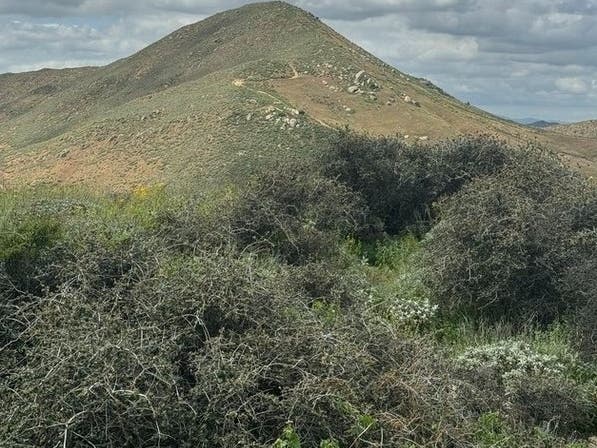
JURUPA VALLEY, CA — Conservation groups and Southern California developers reached an agreement Tuesday to help safeguard the world’s oldest known living oak — a plant that is at least 13,000 years old and is located in Riverside County.
The agreement will permanently protect 54.7 acres of open space near an ancient Palmer’s oak in Jurupa Valley and expand the buffer around the shrub from 450 to 1,000 feet, allowing a residential, industrial and commercial development project to move forward while adding necessary protections for the ancient plant.
Affectionately dubbed the "Jurupa Oak", the plant is a sprawling shrub that’s nearly 80 feet in length. It is the oldest-known living plant in California and the third-oldest known living plant on Earth.
Find out what's happening in Lake Elsinore-Wildomarfor free with the latest updates from Patch.
In 2009, researchers from two University of California campuses — Davis and Riverside — discovered Palmer's oak persisting in a spot overlooking what is now the city of Jurupa Valley.
Palmer's oak usually grows in small populations, some of which are actually "clones" of a single plant. The Palmer's oak above Jurupa Valley is one such clone and the researchers believe it is at least 13,000 years old.
Find out what's happening in Lake Elsinore-Wildomarfor free with the latest updates from Patch.
The oak is presumed to be a relic of a formerly larger range of the species that has largely disappeared over thousands of years in the area following the end of the Pleistocene epoch that spanned some 2.58 million to 11,700 years ago, according to the researchers, who summarized their findings in "A Pleistocene Clone of Palmer's Oak Persisting in Southern California."
The oak is native to California and is not listed as endangered or threatened, but perhaps no other specimen is as beloved as the Quercus palmeri living in the hills above Jurupa Valley.
"I’m relieved that we can steer development away from an oak that’s so special it can’t be found anywhere else in the world,” said Aruna Prabhala, a senior attorney at the Center for Biological Diversity. “Our goal was to minimize risk to the Jurupa Oak and this agreement does exactly that while also making it easier for hillside animals in the region to roam and thrive. This ancient oak is an example of the rich natural heritage protected by California’s environmental laws, and how those laws help us protect our natural heritage for future generations.”
In addition to saving the plant, Tuesday's agreement reduces the footprint of the development project and allows environmental groups or California Native American Tribes to purchase another 54.3 acres to conserve even more open space in the area around the tree. The agreement also sets standards to minimize the project’s environmental harms such as minimized lighting, proper fencing to protect the oak and using native plants along the wildlife corridor.
The agreement came after the Center for Biological Diversity, California Native Plant Society, Endangered Habitats League and Friends of Riverside’s Hills sued the city of Jurupa Valley for approving the development that called for more than 1,500 new homes, commercial construction, elementary schools, parks, an equestrian center, and light industry in the area.
The plaintiffs alleged the approval ignored the potential harms to the Palmer’s oak and surrounding environment and, as a result, violated the California Environmental Quality Act.
“Preserving the unique Palmer’s oak and the hillside that has allowed it to survive all these millennia was our primary goal,” said Len Nunney of Friends of Riverside’s Hills. “And by adding additional conserved natural open space previously slated for development and a wildlife corridor linking the area to more than 350 additional acres of conserved land goes a long way to preserving habitat extensive enough to support a viable ecosystem.”
As part of Tuesday’s agreement, the environmental groups agreed to not challenge the development project.
Get more local news delivered straight to your inbox. Sign up for free Patch newsletters and alerts.