Politics & Government
His Pet Project: Let Californians Own Ferrets
La Mesa's Pat Wright thinks it's wrong to bar cute polecat cousins from homes.
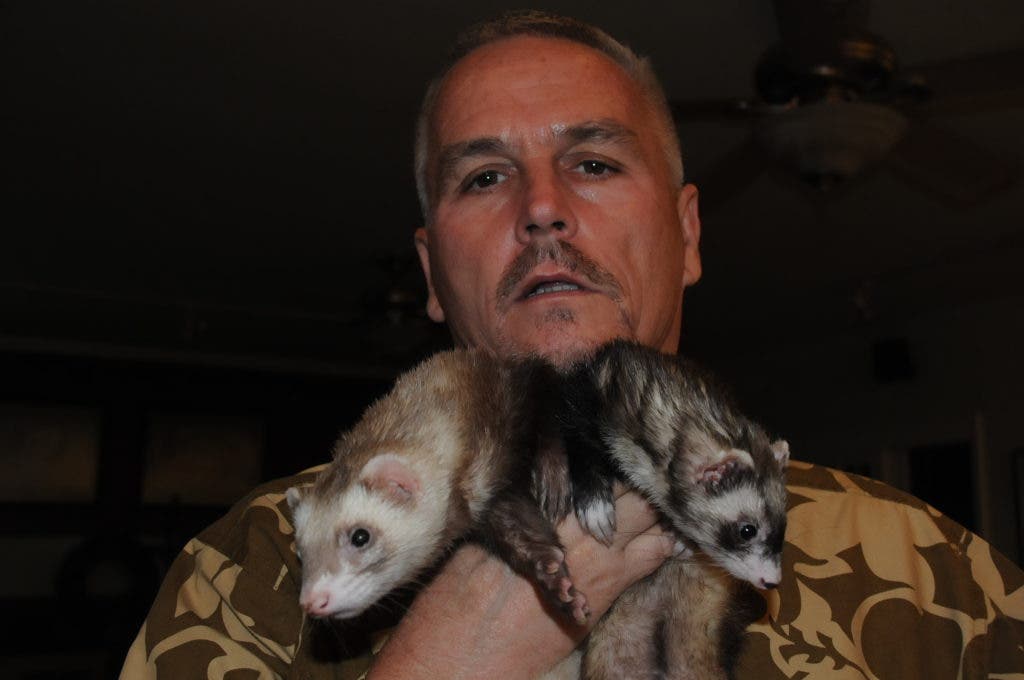


Pat Wright seems pretty low-key for an animal-rights activist. Or maybe we should say a pet-owners-rights activist. "I sometimes describe myself as a cross between Martha Stewart and Joan Embery," Wright says.
His particular passion: ferrets. You know, those slinky, domesticated little relatives of the polecat. Or maybe you don't know. Ever seen one in a California pet shop? Ever met anyone in the state who keeps one at home?
Pretty unlikely, since they've been banned as pets here since 1933 under the Fish and Game Code. The only other state with such a ban is Hawaii, although some cities and counties around the country prohibit or severely restrict ferret ownership.
Find out what's happening in La Mesa-Mount Helixfor free with the latest updates from Patch.
Why are the furry mammals verboten? The state Department of Fish and Game maintains they pose a threat to humans and wildlife. Wright says that's based on old, flawed research—and he intends to prove it.
The 51-year-old freelance e-mail marketer is a San Diego native who grew up in Cardiff and Encinitas, lived all over San Diego County and has called La Mesa home since 2005. He first encountered ferrets about 25 years ago when deciding on the kind of animal he wanted to raise. When a friend introduced him to a ferret, it was love at first squeak. "Kind of like going to Del Mar for the first time and experiencing the first race," he says.
Find out what's happening in La Mesa-Mount Helixfor free with the latest updates from Patch.
His comparison to Martha Stewart is fitting. His nicely appointed hillside home is worthy of a write-up in her magazine. And, like M. Diddy herself (as Stewart was called in lockup), he's served hard time. All because a ferret he was handling scratched a 4-year-old girl in Balboa Park back in 2001.
The girl was petting the ferret in Wright's hand, he says. She tried to pull the ferret away, Wright pulled it back, and the girl got scratched. Her parents filed a police complaint.
A few days later, Wright says, he was astounded to hear shouting outside his home, followed by pounding on his front door. He grabbed a knife for protection against what he thought was an attacker. Seconds later, officers from the San Diego Police Department, animal control and Department of Fish and Game broke down his door. Armed with a warrant, and suspecting ferret-keeping, they overpowered Wright and hustled him to the Otay Mesa county jail—the George F. Bailey Detention Facility.
The charges? Brandishing a weapon against a police officer, concealing an animal subject to rabies and possession of a wild animal without a permit. He ultimately served 17 days of a 45-day sentence.
"When I heard the door crash in, I grabbed the knife," he says. "Not the best judgment, but under the circumstances understandable."
The incident only fired up Wright's determination to press his quest to legalize ferrets as pets in California. In 2005, he started legalizeferrets.org. The site helped raise about $13,000 from ferret owners and supporters around the country to fund an environmental impact report that could pave the way to legalization.
The EIR is the basis of a new push to get California officeholders to make ferret ownership legal in the state. The recently completed report by an adjunct professor at California State University Sacramento is part of a media kit Wright's group is distributing to incumbents and candidates statewide.
His site discusses ways friends of ferrets can reach the politicos who could make their dream a reality. He also lent his support to like-minded ferret fans who attended the 2010 Legalize Ferrets Revival Sept. 25 in Concord, CA.
At an undisclosed location, Wright introduces me to three ferrets. The curious little critters give me a quick sniff test, decide I'm OK, and then squiggle into some horseplay with the Wrights' three dogs. The canines happily oblige, and the game continues for a few minutes—an eternity for the ferrets.
"They have a very short attention span," Wright says.
Sure enough, after a short while, the ferrets seem ready for a nap—something they do for up to 18 hours a day. Ferrets get attached to their owners and crave their attention, possibly even more so than cats or dogs, Wright says. They have "accidents" fairly often, emit odors even if their anal scent glands are removed, and have shorter lifespans than cats and dogs. Which may explain why ferrets aren't ideal for everyone.
Foes of ferret legalization say Wright is all wrong. They claim ferrets are prone to biting children, could spread rabies and, if they escaped into the wild, would rapidly multiply and pose a threat to other animals. All of which, Wright says, is rubbish.
"There has never been a documented case of ferrets spreading rabies ... anywhere in the U.S.," he says. "The Centers for Disease Control rates them as the safest pet except for guinea pigs."
What bothers Wright most about all the previous media coverage he's received about his campaign to legalize ferrets? The jokes, he replies. The darn jokes.
He says he's serious about his mission and wants the press, politicians, pet owners and people of California to know he's serious. He urges them to join the crusade.
Wright reserves special animosity for the governor, who originally seemed to support legalization, insisted on the environmental impact report and then backed away.
Says Wright: "All the ferrets in California can't do as much damage as one of Schwarzenegger's Hummers."