Community Corner
Tsunami in the Sky: How a Texas-Style Wall Cloud Washed Over Us
Acorn Fever followed as the porch thermometer read 46, our first really cool snap of this autumn.
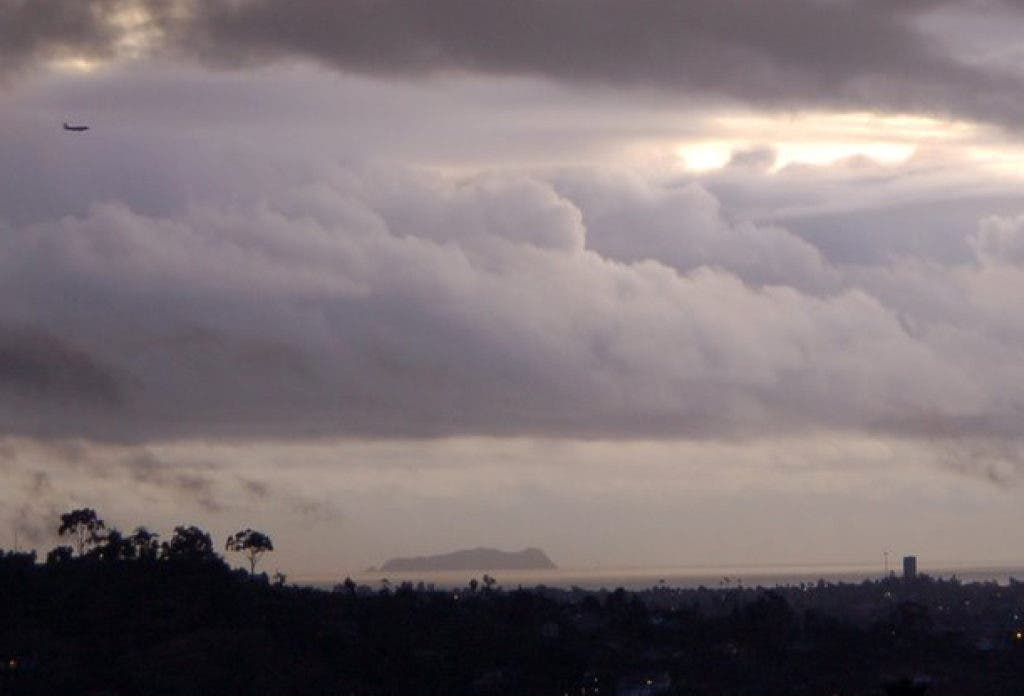


Photo ops returned over the weekend.
These gray-and-white images show the Friday sunset after the rains of the day; the others are of Saturday’s dawn, all taken by my wife, Karen. In 20 years living in the Mount Helix/La Mesa area, there must be 300-400 such images, captured between November and March, no two alike.
Some are culls, some culminations, the skies bearing their variety of gifts fashioned by local coordinates, time of day and seasonal plane of the planet.
Find out what's happening in La Mesa-Mount Helixfor free with the latest updates from Patch.
We saw something else Friday afternoon about 4, a weather feature that I knew well from Texas and Oklahoma but had never seen here. In Texas, we called it a wall cloud—a low, rolling, very black cloud that arrived a minute or so ahead of the thunderstorm.
If I had to choose, incidentally, a place to be frozen in time, it would be five minutes ahead of a thunderstorm. I actually rehearsed that one morning 35-odd years ago. I was driving from Abilene, my hometown, toward the community of Rising Star, 40 miles away, for reasons that now escape memory, except to say it may have had something to do with chicken-fried steak.
Find out what's happening in La Mesa-Mount Helixfor free with the latest updates from Patch.
The thunderstorm that morning was not a major one, not intense enough to generate a wall cloud. But it was following me, as I drove east-northeast on state Highway 36.
I couldn’t tell how far ahead of the storm I was. I pulled off and stopped on the shoulder and got out. The air was warm, with a bit of a breeze, but no noise. Behind me was the cloud, looming, the way they do, even the small storms. I watched for about five minutes, then felt a stillness arriving. What breeze there was, was neutralized.
Then from the direction of the storm came the faintest hint of cool air, up under the stillness. Then thunder, very faint but distinct, as if from an orchestral instrument. Lovely. Thrilling. Heavenly. At least to a Texan.
I got back in the car, drove for five minutes, 65 mph, stopped again, watched and listened. The sequence repeated. Twice more I did this, green pastures out there, cows, fences, weather approaching, a weekday West Texas morning.
The storm caught up, pouring out rain, lightning and thunder outside the cozy innards of a café at Rising Star, where I sat with a hot cup of coffee, jotting a note about heaven.
So where was I? Oh, yes, Friday afternoon at 4, a wall cloud hustling up the Highway 94 valley between La Mesa and Spring Valley. There were two main bands on Friday, one beginning at 10:30 a.m.—10 minutes of very heavy rain, then general light rain into the afternoon.
We were in our nook, off the kitchen, when out the west windows we saw a truly dark storm cloud in the west, coming in hard from the ocean. I checked my watch: 4 p.m. Dixie, our puppy, was due to go out, and so we did, she nosing around, tending to business, while I watched the cloud and gauged distances. We didn’t have long. It was such fun, running back inside.
In the nook, drops streaked the windows almost immediately. Then out of nowhere came the wall cloud.
It was not the classic Texas wall cloud but a gray, nebulized burst, like a tsunami wave from a spray can, filling the valley from north to south and roaring east at an astonishing speed. Even inside, the instinct was to brace for impact, but the thing sped past without incident, and behind it followed an immediately gentler sky and substantial but unremarkable rain.
I hope someone else saw it, and maybe got a photo. After it passed, the temperature dropped quickly, from the low 50s into the 40s. I decided it must have been the actual passage of the cold front, all the way from the Gulf of Alaska, that had created this weather.
The thermometer on the porch read 46, our first really cool snap of this autumn, which reminded me of something. Acorn Fever. We didn’t have any Acorn Fever this fall.
Acorn Fever, of course, is our own unique weather feature here in Southern California. Typically it strikes in September, with a cool snap lasting a day or two, long enough to trigger the urge to pull out sweatshirts, rake leaves, start a fire in the fireplace, make pots of chili and stew, and go to Julian for apple cider.
The next day, many people go to work in fall woolens, with the car heater on, only to have the temperature rise into the high 80s by noon. By 3 p.m., emergency crews are called out and find individual piles of winter clothing, collapsed into a puddle of sweat where once stood a human being.
For 30 years, I have always issued an Acorn Fever warning, when conditions looked right. This fall, however, there were no conditions. And now, in November, La Mesa gets a wall cloud. Strange. Maybe it has something to do with the Mayan calendar.