Community Corner
Orinda Creekside Destination Rises Amid Hidden Fight
CreekHaus promises more energy for a sleepy corner of Orinda, but is also reigniting battles over public access to the project's namesake.


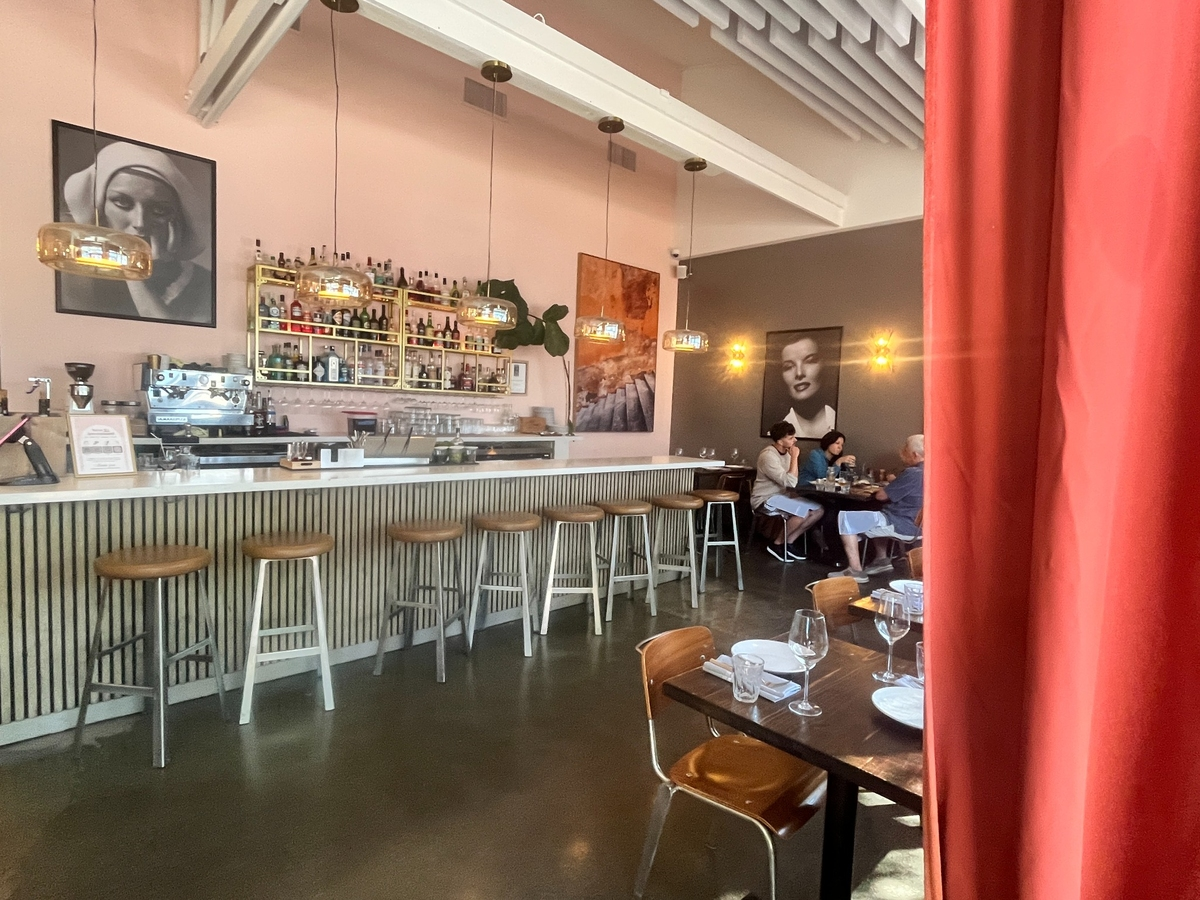
LAMORINDA, CA — CreekHaus, one of Orinda’s largest downtown redevelopment projects in recent years, is approaching completion, bringing cafés, restaurants, beer gardens, cocktail lounges, event venues, and communal gathering spaces to Orinda Village.
But as construction moves toward opening day, the developers have ignited unease over whether the project will preserve or restrict public access to San Pablo Creek, the waterway that runs alongside the project and gives CreekHaus its name.
The redevelopment is transforming a long-vacant former Bank of America property into a hospitality venue designed to anchor broader efforts to revitalize an aging shopping center in downtown Orinda.
Find out what's happening in Lamorindafor free with the latest updates from Patch.
The project sits in the Village Square, which includes McCullough’s department store, Orinda Books, a coffee shop, the Hollyhock events and gift store, and Orinda Prints & Archiving on the upper level. Downstairs, the center includes an assortment of businesses, including a barber and frame shop.
CreekHaus also sits next to the Orinda Post Office, a low-slung two-story building, and near a sprawling, shuttered Rite Aid.
Find out what's happening in Lamorindafor free with the latest updates from Patch.
.JPG)
The Orinda Post Office, left, and CreekHaus development.
City leaders, developers, and local businesses view CreekHaus as a major economic investment expected to draw visitors, increase foot traffic, energize that corner of Orinda, and generate new revenue for the city.
Shop owners, many Orinda residents, and city officials hope CreekHaus will bring more customers to the weathered shopping center, generate income for businesses, and give new life to a prominent corner that has long needed reinvestment.
.JPG)
Public amenity, privately owned
San Pablo Creek is a roughly 20-mile waterway that originates near Orinda and flows through the East Bay. Heavily modified in the past, the creek has drawn years of restoration work from local groups, particularly Friends of Orinda Creeks, whose members have sought to turn the downtown segment into a public amenity rather than a hidden drainage corridor.
The creek provides wildlife habitat, flood control, and a rare pocket of quiet in a downtown area shaped by parking lots, aging commercial buildings, and nearby traffic.
Friends of Orinda Creeks say they are not opposing CreekHaus. In fact, members say they welcome downtown investment and see the potential for CreekHaus to become a lively gathering place where diners could enjoy food and drinks from a terrace overlooking a restored urban creek.
The concern, they say, is whether the project will cut off the public from the very natural resource it celebrates.
“We’re not against the development,” Michael Bowen, a member of Friends of Orinda Creeks, told Patch during discussions about the project.
"Imagine getting a glass of wine and seeing the creek view. And it’s an urban creek restoration project,” Bowen said. “So that’s perfect.”
The concern, he said, is that CreekHaus will privatize the very body of water that it draws its name from.
.JPG)
Bowen said the creek group formed around the idea that, like many communities, Orinda had long treated its waterways as inconveniences rather than assets.
Creeks across California, including in Napa, Santa Rosa, and other cities, were channelized by engineers in the 1950s and 1960s, he said, often leaving residents disconnected from the water running through their own towns.
Bowen said Friends of Orinda Creeks studied creek revitalization efforts in Napa, Ashland, and San Luis Obispo, where communities worked to reclaim waterways as public amenities instead of viewing them as liabilities.
He said CreekHaus could fit perfectly into that broader shift.
But Bowen said he sees a disconnect between the creek-facing image promoted around the development and what has happened on the ground during construction.
Parts of the area behind CreekHaus are now fenced off, and warning signs stand around the rear construction zone where the creek runs between the shopping center parking area and the highway.
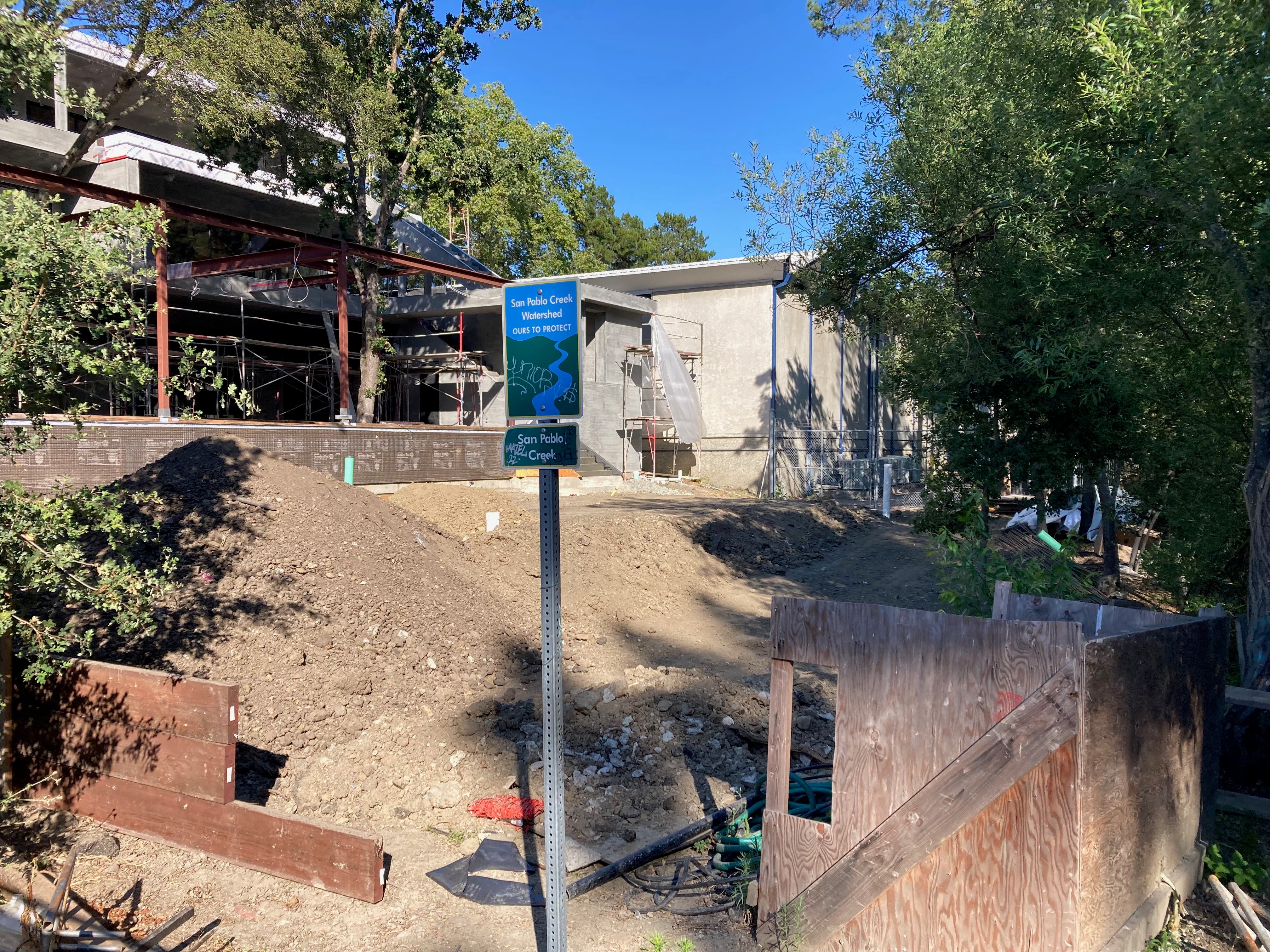
Photograph of the CreekHaus site courtesy of Michael Bowen. Fencing now surrounds the site.
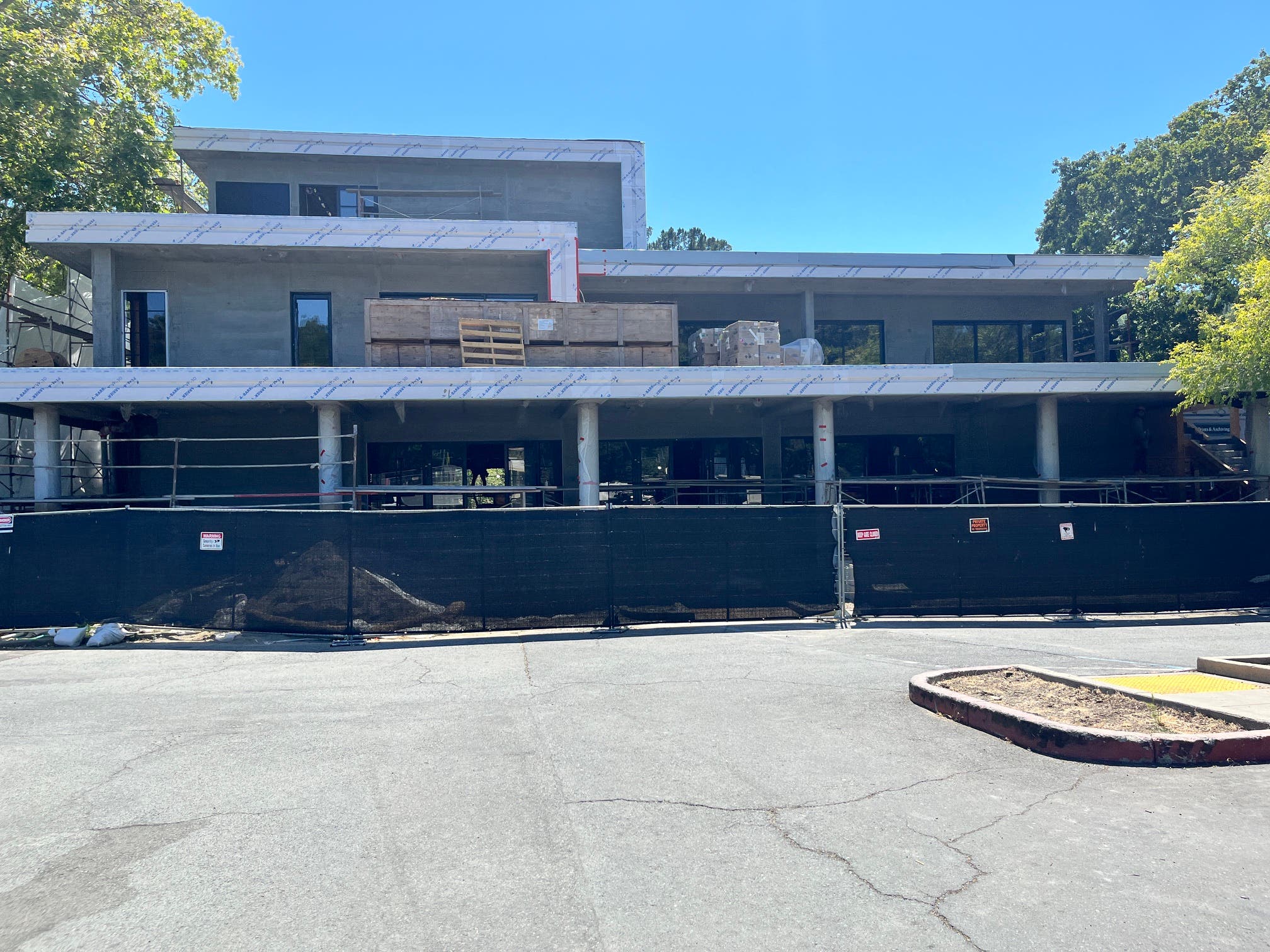
The CreekHaus development on June 16, 2026
Paymun accounting director, Stacey Tuminelli, said in an email that the company recognizes the importance of the creek corridor to the community. "As the project moves toward completion, we will continue to evaluate ways the project can positively contribute to the surrounding environment and broader community."
However, she said the construction fencing currently in place was installed in connection with an active construction site and public safety requirements.
Old tensions resurface
Currently, the site is a noisy, dusty hive of cement, scaffolding, and steel, with construction work advancing near the creek corridor.
But the access concerns are not new. Friends of Orinda Creeks had grown frustrated after construction fencing blocked access to riparian plantings beside San Pablo Creek, including behind the former Bank of America building that is now being redeveloped, the Lamorinda Weekly previously reported.
Bank of America closed its Orinda branch, and the building sat vacant for several years before Orinda Way LLC, owned by Paymun, bought the property, according to the weekly.
Bahadour “Ben” Zarrin of Paymun planned to redevelop the site with three restaurants downstairs and offices above, including Paymun’s offices.
The plans won approval from the City of Orinda, and the project then needed building permits from Contra Costa County. Lamorinda Weekly reported that construction was expected to be completed around the end of 2025.
Friends of Orinda Creeks said at the time that fencing tied into an existing fence next to U.S. Post Office property effectively prevented them from irrigating riparian plants they had planted along the creek. That continues to be a point of contention.
.JPG)
A view of the building, left, where Paymun offices are located and, to the right, the Orinda Post Office stands. CreekHaus stands to the right of the post office. The creek runs behind all three sites.
The newspaper reported confusion over whether the fence on the Post Office parcel could be removed.
Zarrin at the time cited concerns about teenagers smoking, drinking, and leaving broken bottles behind the property. He also said drug paraphernalia had been found in a back corner of the site.
Zarrin also told Lamorinda Weekly that he had safety concerns about some creek-restoration features, including a stairway he believed Friends of Orinda Creeks had built near 25 Orinda Way. The building houses Paymun Inc., but the company does not own it.
Orinda Assistant Planner Darin Hughes, who had taken an interest in San Pablo Creek restoration, said at the time that the city played no real role in the dispute because the land beside the creek was private property and the city did not hold easements there.
Hughes told Lamorinda Weekly he hoped Friends of Orinda Creeks and private property owners along the creek could maintain amicable relationships.
The group, however, fears that access shut off during construction will not be restored once CreekHaus opens.
The most accessible portions to the creek and amenities are near Paymun offices, where a shaded building blends into the wooded area around the waterway.
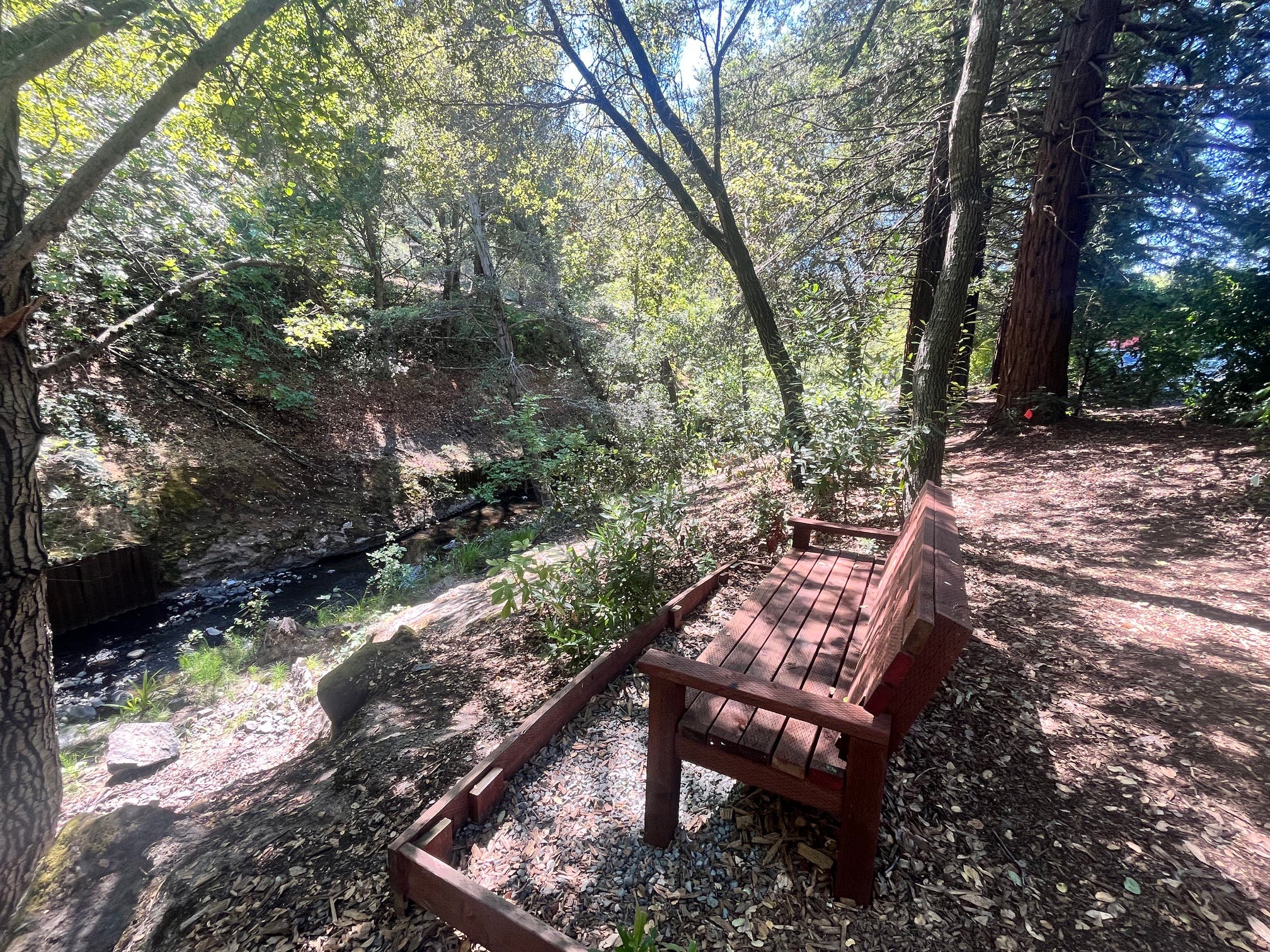
A bench donated and installed by Friends of the Orinda Creeks that sits behind the building housing the Paymun offices.
The planting and many improvements happened before Zarrin purchased the property.
Bowen said Eagle Scouts and creek volunteers helped improve access over the years, including a short staircase with a handrail, plantings, a bench, and the other amenities near the creek.
But the issue for Friends of the Orinda Creeks is not whether the development should proceed.
The shopping center is aging, and CreekHaus could attract more people, support nearby businesses, and generate revenue for the city.
The question is more basic: If the creek is a natural resource, shouldn't the public be able to enjoy it?
Complicated management
Orinda City Manager Linda Smith said the city holds flood-management easements along the creek. She also said Chevron offered to dedicate an adjacent creek segment to Orinda, giving the city up to 10 years to decide whether to accept ownership.
Smith said the city maintains legal easement rights for flood management, although ownership of adjacent property remains with private landowners.
Those property rights complicate the issue. The city has easement rights along the creek for flood-management purposes, and private property owners hold title to adjacent land.
The city’s rights may allow access for specific public functions, such as flood control, but that does not automatically resolve broader questions about public recreation or everyday creek access.
The city’s downtown plan also depicts a future creekside trail, but advocates say officials have not yet adopted the policies needed to turn that vision into reality.
City officials are taking a hands-off approach, treating access disputes as civil matters while also supporting a major business development that could bring new money into downtown Orinda.
The unease also lands in a city where development often raises larger questions about identity, growth, parking, and whether Orinda should remain more rural in character or become more like neighboring Lafayette.
In the meantime, the sweeping transformation of the former bank building inches forward each day.
For supporters, the project could deliver the kind of energy Orinda Village has lacked for years.
For creek advocates, it presents a test of whether revitalization can include the public waterway behind the buildings, or whether the creek will become a private backdrop for a project built around its name.
Get more local news delivered straight to your inbox. Sign up for free Patch newsletters and alerts.