Neighbor News
The Livermore Lab's paucity of science funding
Despite contributions to the scientific literature, the lab's science budget remains underfunded in relation to its nuclear weapons program.
Science and its associated sub disciplines, have tangible benefits to society that are obvious, even to those who are not scientifically inclined. Since its genesis in the enlightenment as a modern methodology, it has more than doubled the human life span, landed a man on the moon, and has given the average western citizen a lifestyle that had previously been reserved for despotic Roman emperors. It is unsurprising then, that its resulting technological progress is viewed by many as a panacea for the world's social ills.
However, these same developments can have the potential to cause irreversible harm to humans and the environment. Advances in nuclear weapons technology have made the possibility of a global nuclear exchange, and subsequent extinction of humans and most animal and plant life on the planet, a very real threat. At several points during the Cold War, equipment failure and false alarms nearly sparked the initiation of armed conflict between the U.S. and Soviet Union, which was often avoided by only chance at the last moment.[1] And though the Cold War has ended, the continued proliferation of nuclear weapons poses a grave existential threat to human existence. Our current administration is now engaged in a game of brinksmanship with North Korea, which as a rogue totalitarian state, feels compelled to use the threat of nuclear retaliation as leverage. Current estimates of North Korea’s nuclear capabilities show that California is within the range of their longest range ICBM’s, and North Korea is in the process of developing bombs small enough to fit on a warhead.[2]
But, even without the threat of nuclear war, the environmental degradation caused by the testing of such weapons is substantial. In particular, testing at the Lawrence Livermore Lab's site 300 has caused extensive contamination of the area’s soil, groundwater, and surface water, and has the potential to increase rates of cancer among Tracy and Livermore residents. The contamination is so bad, that cleanup efforts at site 300, an EPA superfund location, are projected to last until the end of the 21st century. However, due to a recent proposal, the lab’s nuclear weapons division plans to expand open air bomb testing by a factor of ten. It’s hard to say exactly how much additional damage this will cause to the superfund location’s environment, but more than 120 known toxins and carcinogens have been listed among the particulates that will be released into the surrounding area as the result of the blasts.
Find out what's happening in Livermorefor free with the latest updates from Patch.
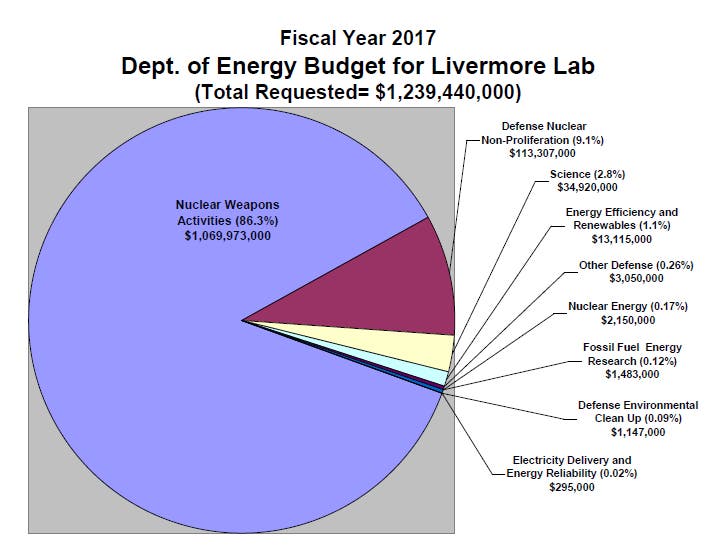
Due to the controversy surrounding the lab's nuclear weapons program, it is easy to forget that there is a lot of positive work that's done by Livermore Lab Staff. Positive work, which nonetheless, remains underfunded in a manner that highlights how mismatched the government’s priorities are in respect to this issue. Right now, the Livermore Lab’s primary source of funding comes from the Department of Energy, which in addition to handling issues pertaining to safety and energy, sponsors research in the physical sciences. To put how unbalanced their funding is in perspective, the 2017 budget request for the Livermore Lab indicates that only a small percentage (2.8%) goes towards scientific research not associated with nuclear weapons development. The overwhelming majority (86.3%) goes towards nuclear weapons activities; which include testing, and development.
Despite the relative paucity of general science funding when compared to nuclear weapons development, the scientific contributions of the lab are fairly substantial, and have included work spanning from the atmospheric and energy sciences, to work in engineering and nanotechnology. Staff members at the laboratory have been the recipients of numerous awards, including a group Nobel Prize awarded to more than 40 Livermore Lab employees for their work done on climate change.
Find out what's happening in Livermorefor free with the latest updates from Patch.
The sheer breadth of the scientific work at the LLNL is far too large for me to give any succinct or coherent overview of its impact on the scientific literature. Instead, in this article, I’ll be giving a few examples of contemporary scientific work to emphasize why this work is important, and why it should be the lab’s main priority.
Take for instance, the lab’s major contributions in mapping out the human genome, which as a consequence, allowed for the discovery of base gene variants associated with increased risk of diseases like diabetes, leukemia, and atherosclerosis.[3] The Livermore Laboratory was one of three United States laboratories associated with the Joint Genome Institute, which is listed as one of the twenty international contributors who helped with the completion of the human genome (consisting of approximately 3 billion base pairs) in 2000.[4] The mapping and creation of a global genetic database has been useful in allowing biomedical researchers to identify specific genes and allelic variations associated with certain diseases. This has given medical practitioners a greater ability to inform patients of potential risk factors based on genotype variants associated with diseases, and laid some of the necessary groundwork for human gene editing using CRISPR-Cas9 tools.[5]
Also, as I have already mentioned, the LLNL has done substantial work in the area of Climate science, and understanding anthropomorphic climate change. This May, researchers associated with the Livermore Lab and MIT have published a study repudiating the current administrator for the EPA Scott Pruitt’s claim that satellite data has indicated a “leveling off of warming”.[6] As a discipline, climate science has, in addition to evolutionary biology, been widely contested by some Republicans, including our current administration, which has repealed many of the environmental protections put in place by the Obama administration.[7] This "skepticism" is reflected by the views of the general population, about 50% of which either don't believe the climate is changing, or don't believe the change is caused by humans.[8] This makes studies counteracting misinformation, like the one mentioned, and the plethora of studies that the lab has done to increase our understanding of anthropomorphic climate change, all the more important.
Additionally, as a part of the lab's computer science program, there has been significant work done in the area of computation. Advancements in parallel computing have lead to the development of ever increasingly more powerful supercomputers, whose use has aided in climate modeling, predictive modeling for condensed matter physics, and galaxy formation, in addition to its practical application in the fields of mechanical and electrical engineering.[9] Just recently, the LLNL's increasingly powerful computers have allowed for the study of phase transitions in matter, including zirconium, and the compressive freezing of water. The latter has applications in astronomy towards modeling large terrestrial planets, whose gravity would cause liquid oceans to solidify under the immense pressure, but, would also have the potential to harbor bacterial life, who have been observed surviving under similar pressures.[10]
As I already mentioned, these examples of scientific work are only small samples of the total scientific work that's done at the lab. It would be impossible for me to list everything that goes on there. However, these examples serve to highlight the discrepancy that exists in funding between that which is useful, and that which is actively harmful at the lab.
With its current arsenal, the United States already has enough nuclear firepower to destroy the world many times over. Yet routine development and testing of ever increasingly more powerful and deadly bombs persists at the Livermore Lab, and many other testing sites across the country, despite the hazards posed to surrounding communities.
It is my hope that the Livermore Lab becomes a center of research that deals exclusively with non-military issues like the Lawrence Berkeley Lab did after 1970. Of course, such a change would require tremendous pressure from a politically active local community. Which is why I would like to urge others who agree with me on this issue to write to their local representatives, and get involved in any other way they can envisage. Recent events have shown, for better or worse, that a galvanized citizenry can make a substantial impact on the future of this country.
[1] “5 Cold War Close Calls” By Evan Andrews, October 16 2013, History.com, http://www.history.com/news/hi...
[2] “North Korea’s Nuclear Programme: How Advanced is it?’ BBC, August 10 2017, http://www.bbc.com/news/world-...
[3] “Bio Celebrates 50th Anniversary” Lawrence Livermore Laboratory, News, https://www.llnl.gov/news/bio-...
[4] “The Human Genome Project Completion: Frequently asked Questions” National Human Genome institute, https://www.genome.gov/1100694...
[5] Institute of Medicine (US) Committee on Resource Sharing in Biomedical Research; Berns KI, Bond EC, Manning FJ, editors. Resource Sharing in Biomedical Research. Washington (DC): National Academies Press (US); 1996. 7, The Human Genome Center: Lawrence Livermore National Laboratory. Available from: https://www.ncbi.nlm.nih.gov/b...
[6] Tropospheric Warming over the Last Two Decades” Published May 24 2017, doi:10.1038/s41598-017-02520-7
[7] “No Shame: How the Trump Administration Granted Big Oil’s Wishlist” Oliver Milman, The Guardian, Dec 17 2017, https://www.theguardian.com/us...
[8] “Public Views on Climate Change and Climate Scientists” Pew Research Center, By Cary Funk and Brian Kennedy, http://www.pewinternet.org/201...
[9] “Introduction to Parallel Computing”, Blaise Barney, Lawrence Livermore National Laboratory
[10] “Sudden Changes in Ultrahigh Pressure” Research Highlights, Allen Chen