Neighbor News
Long Beach Amateur Archaeologist Makes a California Discovery that Could Rewrite the Story of Paleolithic Art
What began as a single observation has expanded into a worldwide study. His work will be published in "Who's Who in Indian Relics."
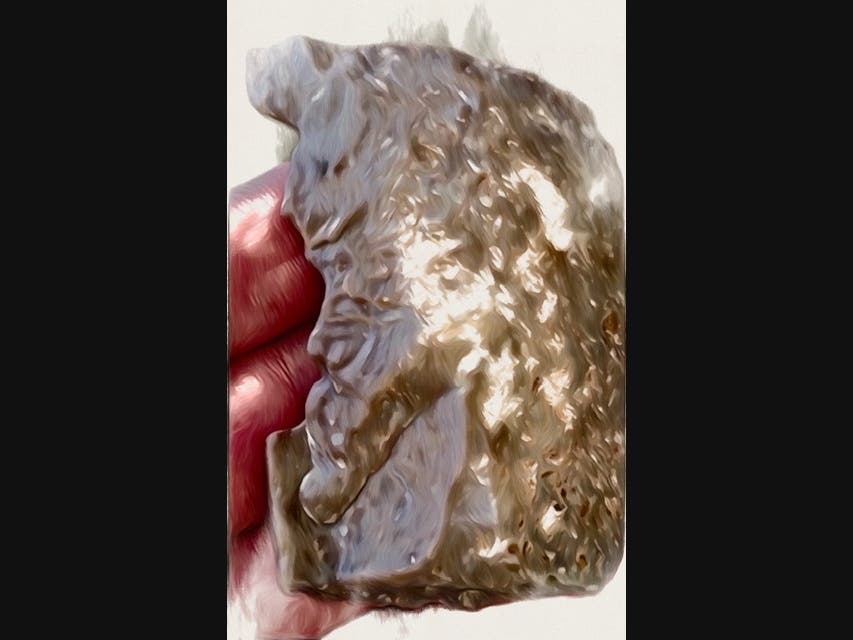


Independent researcherRichardDempsey, a Long Beach, California native,made a discovery in California's Mojave Desert that has grown into one of the most ambitious archaeological investigations of the past decade.
What began as a single observation in October 2020 has since expanded into a worldwide study. Later this month, his work will be publishd in Who’s Who in Indian Relics featuring a ten-page spread.
While surveying Paleolithic sites along the ancient shoreline of Pleistocene Lake Manix,Dempsey noticed something that generations of collectors, archaeologists, and geologists had overlooked. Certain flaked stone artifacts consistently displayed recognizable images of young and old human faces alongside juvenile and mature mammoths. More remarkably, the same visual patterns appeared repeatedly on artifacts made from completely different materials and recovered from widely separated locations.
Find out what's happening in Long Beachfor free with the latest updates from Patch.
Over the past five years,Dempseyhas assembled thousands of examples made from chert, jasper, quartz crystal, rose quartz, citrine, obsidian, volcanic glass, meteorites, fossil coral, bone, antler, and other materials. The artifacts originate from North America, South America, Europe, Asia, Africa, and Australia. According toDempsey, the recurring imagery follows a remarkably consistent pattern regardless of geography or material.
He calls these artifacts “Paleo Story Stones.”
Find out what's happening in Long Beachfor free with the latest updates from Patch.
Unlike conventional projectile points or scrapers, these objects were intentionally shaped around their outer edges to create symbolic imagery. Many also display fine engraving, grooving, and smoothing thatDempseyargues were previously unrecognized elements of flaked stone Paleolithic craftsmanship.
His work has attracted the attention of archaeologist Dr. Michael Gramly, former curator at the Buffalo Museum of Science, who has documented Story Stones in his recent publication Guide to Palaeolithic Artifacts and Features of the Americas.
Dempsey's research also led to another unexpected discovery. Glass long marketed commercially as “Andara” was found to include naturally occurring volcanic glass that had been intentionally worked into Paleo Story Stones. Scientific X-ray fluorescence testing performed through Stephen F. Austin State University confirmed that these archaeological specimens are made of naturally occurring volcanic glass rather than modern man-made industrial slag.
“This scientific data proves the material is an extraordinary, natural geological stone, previously overlooked in the scientific community. It’s time for the institutional narrative to catch up to the physical evidence," Dempsey stated.
His work suggests that Paleolithic peoples may have shared a symbolic artistic tradition spanning much of the globe for hundreds of thousands, perhaps even millions, of years. Rather than viewing early humans primarily as toolmakers, the evidence raises the possibility that they were also accomplished artists, storytellers, and symbolic thinkers who encoded recurring imagery into the very tools and offerings they created.
Dempsey aims to bridge the gap between independent discovery and institutional acceptance, offering a rare window into the artistic and symbolic minds of America's earliest inhabitants.
For more information visitpaleostorystones.com.