Kids & Family
Comet ISON Ready for its Thanksgiving Date with Destiny
Comet ISON will have a close encounter with the sun on Thanksgiving Day, an encounter likely to forever alter the comet.

Written by Andrew Fraknoi, Foothill College Astronomy Professor
When it was discovered in 2012 as a new comet coming from deep space, some observers predicted Comet ISON would become so bright in our skies it would be the "Comet of the Century." Wiser heads knew, as comet hunter David Levy likes to say, "Comets are like cats. They have tails and they do precisely what they want!"
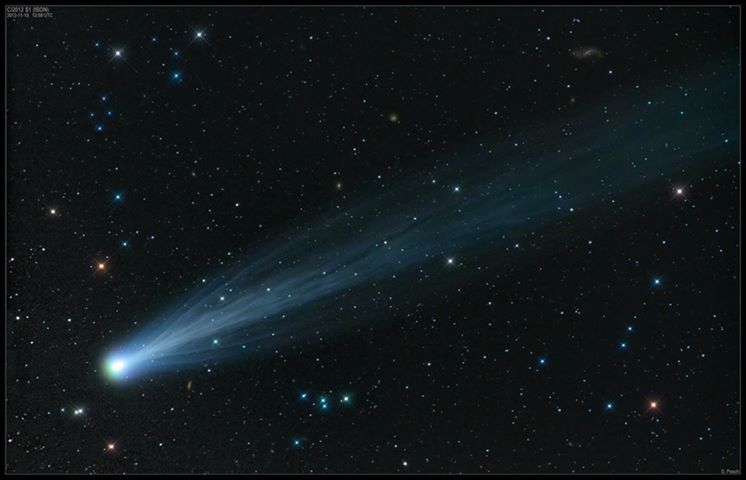
For a while, the comet seemed disappointing. But this week, on its way in to a close encounter with the Sun, Comet ISON started putting on a somewhat better show (as you can see in the image, taken by the skillful UK astro-photographer Damian Peach). The comet now has two nice tails, one made of dust, the other of gas, pointing in the direction away from the Sun.
The comet is currently visible in the pre-dawn sky, but only barely and only when it's really dark. It's better with binoculars or telescopes. The excitement, however, is just beginning. Comet ISON is what astronomers call a "sungrazer" -- a comet that comes indecently close to our Sun. It just so happens, the closest encounter -- only about 3/4 of a million miles from the Sun's surface -- will be on Thanksgiving Day 2013.
The solid "nucleus" of this comet -- a chunk of frozen ices and rock -- is now estimated to be somewhere between 1/4 and 3/4 of a mile across. The Sun's heat could vaporize much of its ice and rock and the Sun's gravity could tear it apart into smaller chunks. Past sungrazing comets have had one or both of these things happen. So it could emerge from its date with the Sun one smaller but strongly evaporating comet, or as several comets spread out over a wider area, or as nothing more than a subtle trail of gas and dust.
If Comet ISON survives Thanksgiving, it will swing away from the Sun and emerge into our dark skies going northward from the plane of our solar system. Should there be enough of it left to make a show, that show will be visible to us in December and January. Around January 8th, for example, it will be near the north star, remaining in our view all night long. (But by then it will likely be much fainter.)
If your want bulletins on Comet ISON or need more technical information, see the "Current Status" page at NASA’s Comet ISON Campaign and then look around on that site.
[If you search the web for Comet ISON information, beware of the nutty websites predicting a collision with Earth or some other reason for the end of the world. The closest the comet will get to Earth is about 40 million miles on Dec. 26th. That's far enough that we can all sleep soundly at night.]
Editor's note: Andrew Fraknoi frequently writes about space on his Facebook page.
Get more local news delivered straight to your inbox. Sign up for free Patch newsletters and alerts.