Neighbor News
Local Photographer Challenges Trump's Image of Muslims
Photography exhibit and gallery talk.
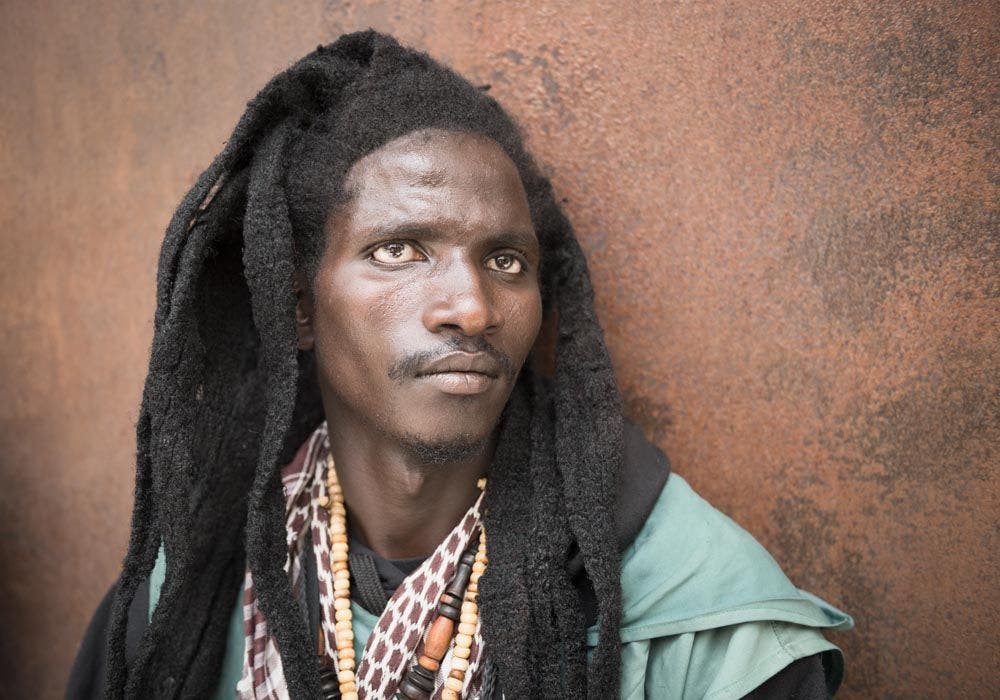
Photographer Ron Herman is challenging President Trump's image of Muslims in his current exhibit, Messengers of Peace. The exhibit showcases images from Senegal, a country where the Muslim majority peacefully coexists with the Christian minority. Most Senegalese belong to one of four Sufi Muslim brotherhoods, a mystical sect of Islam. Foothill College Photography Professor Ron Herman’s images focus on the Muridiyya, Senegal’s most influential brotherhood, which blends African customs with traditional Islamic practices. Their doctrine consists of pacifism, prayer and work. Herman’s images offer a counter narrative to the one-dimensional portrayal of Muslims that dominates mainstream media in the West.
The exhibit is the result of a Fulbright scholarship that Herman received in 2016 to research religious diversity in West Africa. He was based at the West African Research Center in Dakar, Senegal, but traveled throughout the country over a 4-week period studying the Muridiyya and other Sufi Muslim brotherhoods. The photographs will be on display at the Krause Center for Innovation (KCI) Gallery, Foothill College, February 23 – March 30, 2017. He will give a gallery talk and discuss the images on display on March 8, from 12-1 PM in the KCI Gallery, Foothill College.
Over the past five decades, immigration has dramatically changed the demographic of the United States. Today, we encounter people of different ethnic backgrounds and religious traditions in our neighborhoods. “Some people may feel threatened by diversity, or even hostile to it, resulting in the mistreatment of others,” Herman said.
Find out what's happening in Los Altosfor free with the latest updates from Patch.
A 2014 Pew poll found that Muslims were the most disliked religious group in the United States. Hate crimes against Muslims occur at an alarming rate and are reported to have spiked in the weeks and months since the November election. Although a minority of voters supported Donald Trump, he won the votes of a sizable segment of the population with his hate-fueled rhetoric and campaign promises targeting Muslims.
“Islam is the third largest religion in the United States after Christianity and Judaism, and the fastest-growing religion in the world; however most Americans don’t know very much about it. For many of us, our perceptions are based solely on what we see on television or read in the news. Unfortunately what we have been seeing and reading since 9/11 has focused almost entirely on acts of terror committed by extremist fringe groups, and largely excluded any depictions of the peaceful Muslim majority. This imagery, that we have grown accustomed to over the past 15 years, represents only a tiny sliver of a large and diverse tapestry that makes up the world’s Muslim population. “
Find out what's happening in Los Altosfor free with the latest updates from Patch.
“Islam is extremely diverse and has a long history in the United States. Most Americans would be shocked to learn that many African slaves brought to the United States hundreds of years ago were Muslim. Muslims in America isn’t a new thing, although it is often perceived that way. Many people would be shocked to know that less than 20% of the world’s Muslims live in the Middle East. That isn’t something you would learn from watching mainstream media’ but there are large Muslim populations in Indonesia, China, India, North Africa, Russia and elsewhere.“
“I’m a photographer. I’m an artist. I’m not a religious studies professor or an expert on Islam. The purpose of my exhibit isn’t to teach people about religion. Instead, I’m trying to expose people to a side of Islam that they have most likely never seen before, in the hopes that it will encourage tolerance during what is, in my view, a very dark time in our nation’s history. My photographs depict one more piece of that mixed tapestry, much of which hasn’t been shown to us before.”
Silicon Valley is one of the most diverse regions in the United States. More than 30% of its population is foreign-born, and close to two-thirds of its residents under the age of 18 are the children of immigrants. Nearly 250,000 Muslims–one of the highest concentrations of Muslims in the country–live, study, volunteer, work and contribute to the economies and communities of the Bay Area.
Many Westerners associate Islam with terrorism, largely due to distorted representations in mainstream media. Islamophobia existed before the terrorist attacks of September 11, 2001, but it has grown significantly in the years since. Today Muslims in America are experiencing an unprecedented level of discrimination, threats, and violence
“Because of the demographics of the local area and to better prepare ourselves to be engaged citizens in our ever-changing global society, it is important that we all work toward intercultural understanding,” Herman said.
In the course he teaches, Photography of Multicultural America, Herman addresses the power of the photographic image. “How we treat people is largely based on how we see them,” he said, “and photography is the most popular form of representation in contemporary society.”
“We have a very narrow view of Islam, one that has been distorted by mainstream media. We need to expand the range of visual representation of this massive religion and its diverse practitioners. The peaceful doctrine of the Muridiyya, and a subsect known as the Baye Fall, was something I felt people should be exposed to. The Baye Fall’s distinctive long dreadlocks, patchwork clothing and large leather belts are symbolic of their strong worth ethic and dedication to their religion. I hope that viewer’s see a side of Islam that is different from what we are normally exposed to in the United States, and that they leave questioning the single story of the Muslim world that we have been told by mainstream media, “Herman said.
“I hope my photographs help to challenge common stereotypes and misperceptions of Muslims, Herman said, “and that they contribute, even in a small way, to us celebrating diversity and treating each other with kindness.”
Lunchtime Gallery Talk
March 8, 12:00-1:00 pm
Krause Center for Innovation (KCI) Gallery-Lower Level, Foothill College
Ron Herman will discuss the photographs in the exhibition
Krause Center for Innovation (KCI) Gallery- Lower Level
Foothill College, Bldg 4000
12345 El Monte Road, Los Altos Hills, CA 94022
Gallery Hours: Mon - Thurs: 8:00 am - 7:30 pm; Fri: 8:00 am - 6:30 pm; Sat: 9:00 am - 4:00 pm; Closed Sun.
Use Parking Lot 4. Parking is $3.00. Use quarters or $1 bills only. Disabled Parking in Lot 4-B
Map / Directions