Arts & Entertainment
'Meet Einstein' Teaches Light and Gravity to Toddlers
Mariela Kleiner, who was inspired by her daughter's curiosity about science, has appeared at Linden Tree Books and is headed to Spain on book tour.

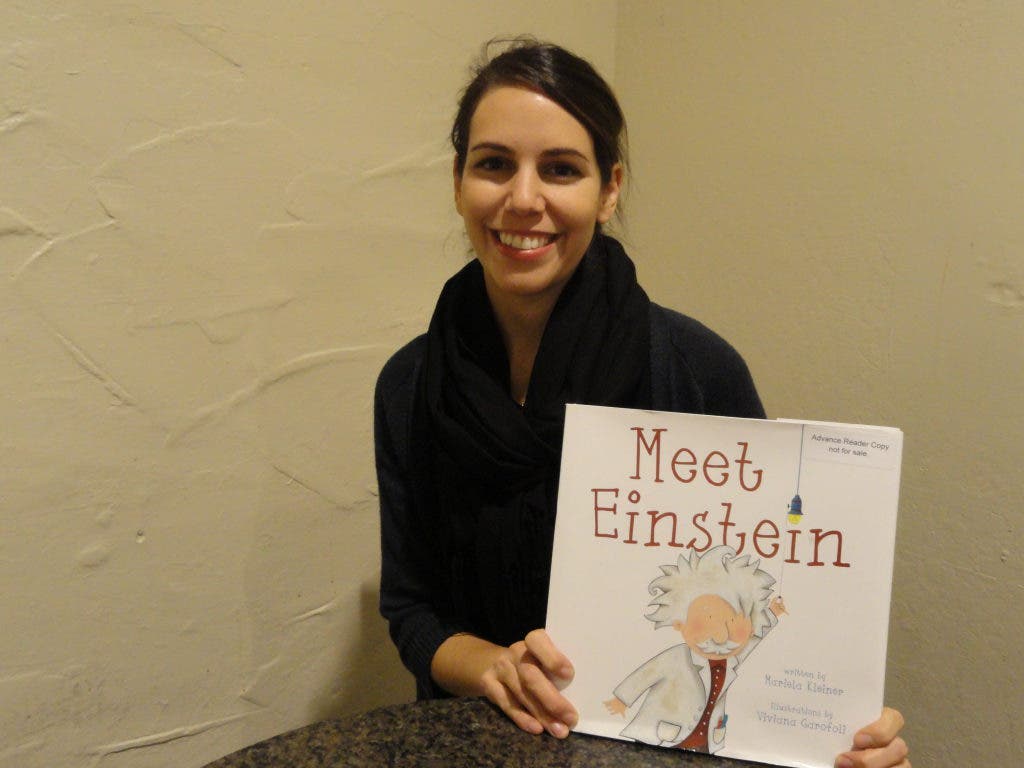

When Mariela Kleiner asked her 2-year old daughter, Hailey, what book she wanted read as a bedtime story, she made a surprising choice: Albert Einstein’s Relativity.Hailey was persistent, so Kleiner, 32, a longtime Palo Alto resident, decided to break down the story of one of history’s greatest scientists and his theories. The result grew into a book aimed at toddlers, Meet Einstein, published in March by Meet Press. “I tried to think of how my daughter could relate,” said Kleiner, a stay-at-home mom of two who previously never set out to be a writer. “I thought of everyday situations like spilled milk. Does your milk go floating into space?” Kleiner has read her book to children at several local bookstores, such as Books, Inc. and the Linden Tree in Los Altos. Now she is about to embark on a two-month book tour of the new Spanish-language version of the book in Spain with her husband, a local science teacher, and two children. "This is what kids are curious about at that age," said Jill Curcio, co-owner of Linden Tree Books & Music. "They find out about gravity if they run down the hill and fall—all these fundamental physics questions are what they're wondering about." Curcio said Linden Tree brought in a "Mad Scientist" when Kleiner spoke, and kids all got to partake in a science activity. "It was fun stuff. And I've read that 80 percent of all physics we know we learn by age 2, so this is the perfect time."Kleiner’s book simplifies complex concepts of gravity and light, explaining with whimsical words and artist Viviana Garofoli’s illustrations the science that surrounds them. “Gravity keeps the Earth near the sun, so that the sun can come up every morning ...,” Kleiner writes on a page portraying a vibrant sun rising over a villa.It also lays out exactly what it means to be a scientist—a great inquisitor, by Kleiner’s definition. “Scientists like to ask lots of questions about why things happen and how things work,” reads the text by wide-eyed children, question-marks afloat over their heads. The book begins with questions for parents to pose to their children, such as, “Where do you see light every day? How many different colors of light can you find?” Its inner-covers are laced with colorful science supplies, such as “Binoculars: so I can see things that are really far away,” and “Explorer Hat: to keep the sun away ... and look cool.”There are not many simplistic science books for children right now, said Kleiner, who said she plans to pen a future series introducing children to science. “Science at school has become about memorizing,” said Kleiner. “I want kids to realize [from an early age] that they’re also scientists, and start connecting the dots.”She would like to continue working with Garofoli, who she discovered by chance when peering through children’s books in search of an illustrator. Coincidentally, Garofoli lives in Argentina, the country from which Kleiner moved as a child 22 years ago. So far, Kleiner has noticed that toddlers who listen to her readings begin testing the book’s theories directly afterward, such as demonstrating gravity by jumping up and down. At a time when many children aspire to be superheroes and princesses, she is thrilled to hear some of her young readers say that they want to be scientists when they grow up. “Kids are so curious, just like scientists,” said Kleiner. “Even if you leave them alone, they’ll start collecting flowers and plants.”
Get more local news delivered straight to your inbox. Sign up for free Patch newsletters and alerts.