Business & Tech
Q&A: Hakone Foundation CEO Lon Saavedra
The Los Altos resident runs the oldest Japanese gardens in the Western Hemisphere. More than 300 people gathered in Saratoga Sunday for the garden's fifth Lunar New Year celebration.




Lon Saavedra is CEO of the Saratoga-based Hakone Foundation, which operates Hakone Gardens, the Japanese estate gardens loved for generations in the South Bay and used for the 2005 film "Memoirs of a Geisha."
There is a strong Los Altos and Los Altos Hills connection to Hakone. Saavedra, a Los Altos resident, has been serving in this capacity since 2000. The nonprofit group was run by the City of Saratoga through a commission prior to Saavedra taking over it. The funding for the group came from the David Lucile and Packard Foundation, based in Los Altos, to launch the independent foundation. Hakone's board chair is Connie Young Yu of Los Altos Hills, whose family once owned Hakone Gardens.
Find out what's happening in Los Altosfor free with the latest updates from Patch.
On Sunday, more than 300 people gathered at the historic compound for the fifth Lunar New Year celebration, the Year of the Snake.
Saratoga Patch: What's your background?
Find out what's happening in Los Altosfor free with the latest updates from Patch.
Lon Saavedra: I was a director for the Western region for the Smithsonian. We had an office in Los Altos through the '90s and, at that time, there was a change in the administration. George W. Bush really slashed the Smithsonian's funding so they closed the office. We still have ties to the Smithsonian. We did an event between Hakone and the Smithsonian two years ago, which was very successful.
Patch: How is Hakone Gardens doing?
Saavedra: We've been very pleased. We lost the foundation 12 years ago and then in 2004 the National Trust For Historic Preservation in Washington, D.C. put us as one of the 12 historic sites of top priority for funding. So we've been able to raise a number of corporate and major foundation funds for restoration.
Patch: What's the name of the National Trust For Historic Preservation program that's benefiting Hakone?
Saavedra: Save America's Treasures. Some of the other sites that were selected were Eleanor Roosevelt's Val-Kill Cottage and Playhouse in Hyde Park, NY. There was also Thomas Edison and Henry Ford's winter estates down in Fort Myers, in Florida. We were one of the 12. That really gave us some good visibility and funding opportunity for restoration.
Patch: Tell us about the restoration work that has gone on at Hakone?
Saavedra: We've done several million dollars worth of restoration since that time. Two years later Hakone was selected as one of the premier sites for the three-time award-winning Oscar movie Memoirs of a Geisha, that was filmed here. That was a real break-through success.
Patch: How are the gardens being restored?
Saavedra: We have forged a relationship with one of the major landscape architectural associations in Japan called Ogata Koi, considered one of the top landscape architectural firms in Japan. They've come here several times and they'll be coming here later this year to help us continue to do restoration. We continue to need to do a lot of historic restoration. Several of these buildings were built without nails so the kind of restoration we do needs experts from Japan so the materials are unique and the craftsmanship remains original.
Patch: What's the historic significance of Hakone?
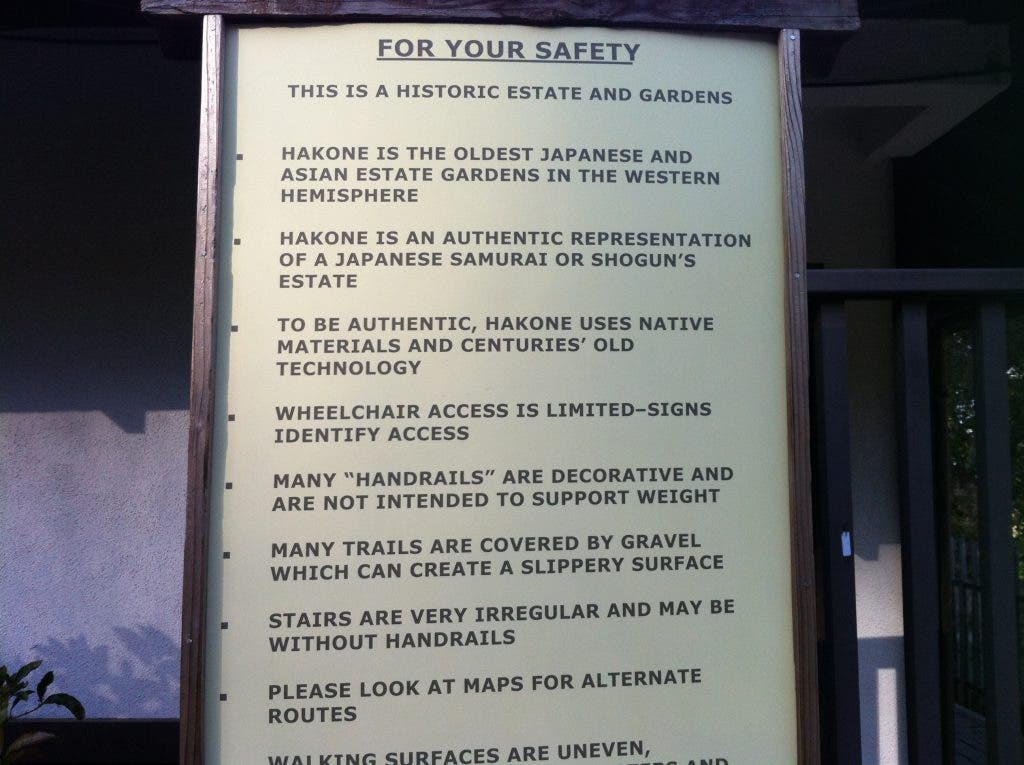
Saavedra: Hakone is the oldest Japanese and Asian estate gardens in the Western Hemisphere as designated by the National Trust For Historic Preservation. We received historic designation status in 2004. That has helped us tremendously.
Patch: How many visitors come to Hakone each year?
Saavedra: We've had about a 10 percent increase in visitors every year. About 70,000 people visited the gardens in 2012. It continues to grow.
Patch: How does the Hakone Foundation survive?
Saavedra: Both by the support of visitors and events. We're really becoming a premier wedding site through the spring, summer and early fall. We're a very popular site for these events and for business retreats. We've had Apple and Google here many times and a number of other high-tech companies. It's one of our major income streams. We're also quite popular for memorial services.
Patch: What are some of the needs facing Hakone?
Saavedra: Eventually we want to be a year-round destination site. We have plans to build a visitor center so we can really accommodate more people. The largest building where we can host events is the Cultural Exchange Center building. It was built 20 years ago, in 1992, and it was assembled in Kyoto, disassembled and shipped across the ocean and reassembled here. It's an Edo period tea merchant's home, shop and museum. The Edo period is from 1603 to 1857. It's a very unique period in Japanese history. We can have up to 80 people inside for different events.
Patch: So you want to build a visitor center?
Saavedra: Yes, we want to build a visitor center to accommodate up to 200 people. We would build it in the old parking lot, where the turnstiles and the bathrooms are now located. We have preliminary plans to move forward on an international visitor center.
Patch: Do you need more community support?
Saavedra: Yes, we would love to have the community more involved in terms of family events. We've had bar mitzvahs, birthday, graduation, anniversary parties and family gatherings, but we still want the community to know more about us in this area, especially all of Silicon Valley so they can use as a resource. So many people still don't know about us. We need higher visibility.
Patch: How many employees and volunteers do you have?
Saavedra: We have about a dozen employees and we have several volunteers. Our new board chair is Chinese-American, whose family actually owned Hakone from 1961 through 1966, Connie Young Yu, of Los Altos Hills. On March 25, Hakone will be having its Persian New Year celebration. We just started this tradition. Hakone is an international venue. We're trying to bridge the Eastern and Western hemispheres. We're really trying to welcome people from all cultures. On the Sunday following Mother's Day, May 19, Hakone will have its annual Japanese spring festival done in conjunction with the consul general of Japan.
Patch: What's the most popular part of Hakone?
Saavedra: The spring time is unbelievable. The wisteria is blooming, the cherry blossoms. The bamboo garden. It depends on the time of the year. In the winter time, we have the largest set of Camellia on the mountain side. It's a botanical symphony of colors. There's always something blooming no matter what time of the year it is. We're open every day of the year except Christmas and New Year's.
For more news about people you know in Los Altos and Los Altos Hills, get our daily newsletter.
Follow us on Twitter and like us on Facebook (you'll be glad you did).
Get more local news delivered straight to your inbox. Sign up for free Patch newsletters and alerts.