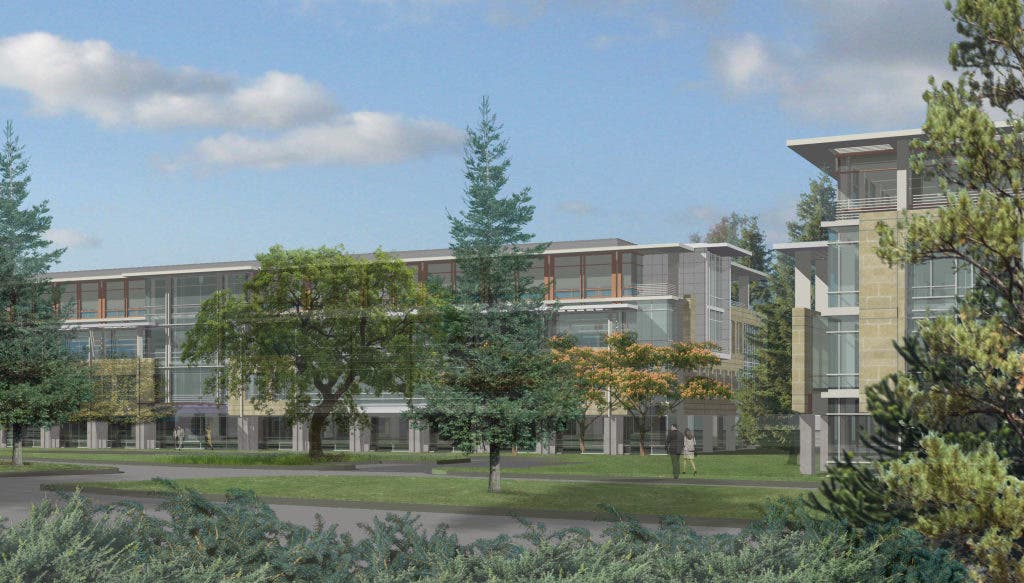
I was driving into town the other day and I saw the two orange construction machines that were holding up some boxes, or whatever, to show people how high the proposed Albright Way structures would be, east of Winchester Boulevard and Highway 85. The project is incorrectly, but popularly known as the Netflix expansion.
As well, I recently heard that these buildings would be very similar to the new medical building on the corner of Los Gatos Boulevard and Highway 85, except the proposed development would have four similarly sized buildings. I slowed down and tried to imagine that, four new huge boxes sitting there and I shook my head. More of the view of our hills would be significantly blocked.
I make no secret of my resistance to urbanization and development in Los Gatos. But, you know what, we really aren’t simply talking about sight lines here. Once, I made the observation that it seemed to me back when I spent my summers picking fruit and working in the orchards, the heat just didn’t seem to be so bothersome, so heavy and intensive. I supposed maybe it was a matter of my getting older.
Find out what's happening in Los Gatosfor free with the latest updates from Patch.
I forget exactly who, but a nearby young woman started expounding on “urban heat dynamics” and what she said really made good sense. She noted that in the suburban and urban environments, you have the thick surfacing of the asphalt streets, then the cement sidewalks and curbs and then the stucco and brick wall coverings of the buildings, they are all heat banks, storing the sun’s warmth until way after sunset, and radiating it back into the air long into the night.
The tight, low-growing lawns and landscaping shrubs don’t provide that much surface area to infuse much moisture into the air, as well as the carbon dioxide scrubbing/oxygen producing photosynthesis, which all plants provide. Large trees and tall grasses would be very much more advisable in such constrained environments. It turns the young lady was getting her master’s degree in urban planning at San Jose State University. It was nice to have some scientific backup to my personal sensibilities regarding the region’s climatic changes. I wanted to say, “There! You see? It’s not just me.”
Find out what's happening in Los Gatosfor free with the latest updates from Patch.
The young lady went on to talk about how strangling the living organism, the earth’s dirt, with its worms and mealy bugs, its fungus and so forth, was further complicated in the urban canyons between skyscrapers. She explained the nearby bodies of water were made less productive by urbanization, and the redoubled strain put on the eco-system by air conditioning efforts to compensate for the increased heat, but it was all getting way too complicated for me. I was getting lost in her morass of selective information. But it all sounded pretty good to me, the non-development guy. It was just too much information, too quick, too detailed.
I have found a pretty good summary of the stuff she was talking about online, at Wikipedia, “Urban Heat Island.” There is about as much information on the subject as I’ll ever need to know, right there.
I was listening to some folks talking about the Albright project the other day, with a lot of “North 40” grumbling mixed in, and I mentioned this “Urban Heat Island” stuff. One of the more cynical in the group frowned at me as he reminded me of our Los Gatos Civic Center, with so much of its office space below ground. He noted that they got it right once, but never followed through.