Schools
Is Your Child's Classroom Sitting on a Fault Line?
Two mountain schools are within the Alquist-Priolo fault and near liquefaction and landslide areas.




The majority of Los Gatos public schools are located within a quarter mile of a fault line, and at least two could be in serious trouble should a large earthquake occur, according to new data released by a watchdog journalism group.
A 19-month investigation by California Watch unveiled Thursday uncovered holes in the state's enforcement of seismic safety regulations for public schools.
California began regulating school architecture for seismic safety in 1933 with the Field Act, but data taken from the Division of the State Architect’s Office shows 20,000 school projects statewide never got final safety certifications. In the crunch to get schools built within the last few decades, state architects have been lax on enforcement, California Watch reported.
Find out what's happening in Los Gatosfor free with the latest updates from Patch.
A separate inventory completed nine years ago found 7,500 seismically risky school buildings in the state. Yet, California Watch reports that only two schools have been able to access a $200 million fund for upgrades.
The Mountain Schools
In Los Gatos, the schools in the most topographically dangerous areas are Lakeside Elementary and Loma Prieta Elementary schools.
Find out what's happening in Los Gatosfor free with the latest updates from Patch.
While officials with Loma Prieta Joint Union School District weren't able to respond by posting time, Lakeside Joint School District Chief Business Officer Susan Ady said the U.S. Geological Survey last summer installed a seismometer in the school's main building, where the district is also headquartered. The device is part of the Northern California seismic network to help school personnel receive real-time seismic activity information and take precautionary measures.
Ady also said as a part of Lakeside's modernization and construction bond measure in 1998, the district conducted two geologic and seismic hazards assessments. One was conducted by a certified engineering geologist and reviewed by a seismic engineer employed by Kleinfelder Inc. in 1998. Another was a geotechnical investigation by Lowney Associates, a geotechnical engineering service, in 1999.
She said both reports identified the proximity of the schools to faults and made recommendations as to seismic and structural improvements in the district's modernization of its main building and two portables, as well as the construction of its community center, completed in 2002. The district's main building, which also serves as the main school, was built in 1967.
All reports and recommendations were reviewed by the Division of the State Architect (DSA), the chief regulator of construction standards for public schools.
The modernization project was approved by the state architects in 1999, and the new building project was approved in 2001. All seismic and geologic needs were mitigated and approved by DSA, according to its requirements, Ady said, adding that an in-depth seismic review of the district's buildings has also been conducted by a licensed structural engineer and is available for public viewing at district headquarters.
The Loma Prieta and Lakeside schools are within a quarter-mile radius from a fault line and within the Alquist-Priolo fault.
The schools are subject to the Alquist-Priolo Earthquake Fault Zoning Act, which requires that campuses built since 1972 be set back 50 feet from the fault. They are also located in landslide and liquefaction areas, respectively.
Los Gatos Union School District Schools
Down on more stable ground are the five campuses of the Los Gatos Union School District. According to the data, Blossom Hill and Louise Van Meter elementary schools are within a quarter of a mile of a fault line; Lexington Elementary is in a landslide area, and Raymond J. Fisher Middle School is in a liquefaction area, which means it's in an area that can turn soil into quicksand in a violent earthquake. Daves Avenue Elementary doesn't have any indicators of concern.
School officials say while they can't do much about where the schools are located, they can ensure their buildings meet codes and comply with standards imposed by the state architects.
According to Leslie Paulides, the assistant superintendent of business services, four of the five schools have been modernized within the last 10 years and are undergoing additional upgrades, thanks to Measure E money approved by voters last June.
The district has hired Kramer Project Development Company, Inc. for all construction projects, she said.
The district is constructing a two-story, 10-classroom building at Raymond J. Fisher Middle School and upgrades at Louise Van Meter Elementary, both within a quarter of a mile of a fault zone.
The district is also in the process of modernizing its fifth school, Lexington Elementary, which is located in a landslide zone.
Paulides explained that geological tech studies were conducted before all construction projects were initiated on all school sites following their recommendations for grade-beam foundation upgrades and any other requirements to meet or exceed code.
The district has also hired Meehleis Modular Buildings Inc. to do so-called "modular" construction, which uses steel frame construction or pre-made components that resemble giant Legos.
Asked if the schools would withstand a 9.0-magnitude earthquake, such as the violent March 11 temblor that devastated Japan, Paulides said the campuses are built to withstand "whatever is possible to occur."
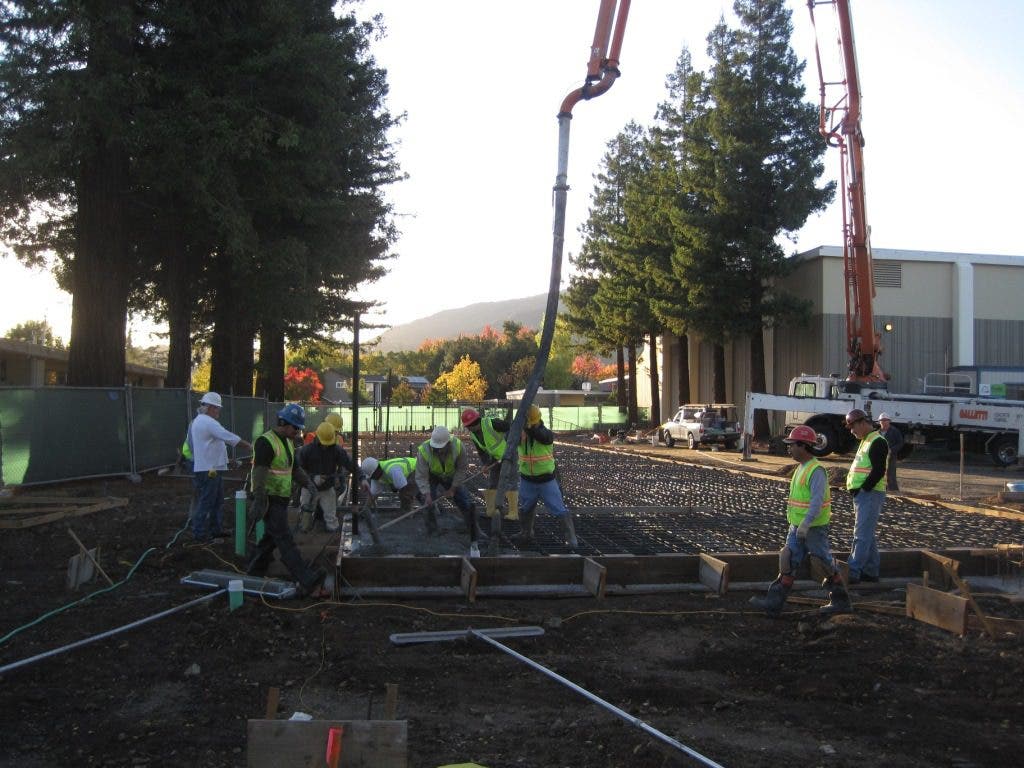
Paulides noted also that the Monte Vista-Shannon fault is also within a quarter mile of the five sites, and the district added extra reinforcement to the schools' foundations, making them thicker, such as the foundation poured for the new building at Fisher Middle School.
Meanwhile, Lexington's renovation project has been delayed a year following the requirement from geo tech reports last year to do more testing, she said.
The district is expected to receive the final geological reports on the Lexington site, including a peer-review, by the end of April. The California Geological Survey will then review the findings, all of which will dictate how the district builds on the site, she said.
Dr. Cynthia Simms, interim superintendent of the Los Gatos Union School District, said student and staff safety is taken seriously and that the district's director of facilities, Jason Pedersen, has given all school principals emergency-preparedness kits containing additional information on how to respond to a natural disaster.
Los Gatos High School and district headquarters
According to the California Watch data, Los Gatos High School and the Los Gatos-Saratoga Union High School District headquarters are also located within a quarter mile of a fault line and within a quarter mile of landslide and liquefaction areas.
Superintendent Cary Matsuoka said the 1,700-student campus was remodeled extensively with a 1998 general obligation bond. Most of the buildings on campus have been completely upgraded, he said.
Matsuoka said the DSA holds the district to an extremely high standard on school construction. The district office has also been remodeled and meets earthquake standards, he said.
Earthquake Evacuation Drills
Los Gatos school officials also said they run earthquake evacuation drills every year and have procedures in place to communicate with parents quickly should disaster strike.
Matsuoka said the high school can phone and email all parents within one minute. "Our schools are well practiced," Matsuoka said. "In the event of a real emergency, 95 percent of our kids have cellphones, so the communication will happen through all kinds of channels."
Paulides said at the kindergarten-through-eighth-grade level, the students participate in earthquake evacuation drills more than once a year. All principals know what to do in case the "big one" strikes and understand the triangle of safety controversy, something to which they don't adhere.
"We don't believe in that," Paulides said about the earthquake survival suggestions that have circulated the Internet but are disputed by the American Red Cross. On Thursday, coincidentally, students at Daves Avenue Elementary School in Monte Sereno participated in an earthquake evacuation drill that had the students ducking and covering themselves under their desks and not sitting next to them, as the triangle of safety theory suggests is the best way to avoid being squished by falling objects.
The district has also supplied its schools with enough food and water for all students and staff for a 72-hour period, Paulides added.
This story was produced using data provided to Patch by California Watch, the state's largest investigative reporting team and part of the Center for Investigative Reporting. Read more about Patch's collaboration with California Watch.
Get more local news delivered straight to your inbox. Sign up for free Patch newsletters and alerts.