Community Corner
Home on the California Range In Year 2100? 'Climate-Smart' Must Be Key To Land Use
"Maintaining rangelands can help mitigate the effects of climate change and drought," scientist says.


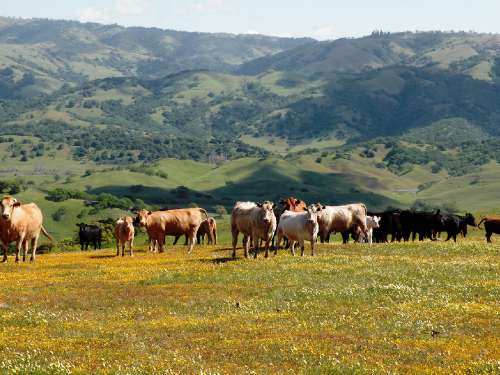
Image: Cattle in California rangelands, Coyote Ridge, Santa Clara Valley, 2009; Photographer: Stuart B. Weisse. Courtesy of USGS.
--
News submitted from the U.S. Geological Survey:
Find out what's happening in Los Gatosfor free with the latest updates from Patch.
Grassland habitats on rangelands in California’s Central Valley and surrounding foothills could decline by as much as 37 percent by 2100 due to changes in land use and climate, according to new scientific projections by the U.S. Geological Survey.
The peer reviewed, scientific paper was published recently in the journal Landscape Ecology. In addition to habitat loss, the study shows that increased development of rangelands for urban use exacerbates the ongoing issues surrounding rainwater runoff. When this issue is combined with periods of drought, the area will suffer from reduced opportunities for groundwater recharge, especially on deep soils.
Find out what's happening in Los Gatosfor free with the latest updates from Patch.
“Results from this study reinforce the role of open rangelands in capturing water and reducing runoff,” said Dr. Kristin Byrd, the study’s lead author and a physical scientist with the USGS. “Maintaining rangelands can help mitigate the effects of climate change and drought.”
Rangelands are the largest land cover by area in California, covering more than one-half of the state. Though more commonly known for livestock grazing, rangelands provide multiple benefits, including “ecosystem services” such as habitats for fish and wildlife and carbon sequestration. Rangelands also provide opportunities for surface and subsurface water collection and storage.
To better understand the potential detrimental effects of climate change and land use change on rangeland ecosystem services, scientists worked with ranchers and land managers to develop 6 scenarios for the Central Valley and surrounding foothills. The model scenarios were consistent with three Intergovernmental Panel on Climate Change emission scenarios. To date, there are few studies that examine the combined effects of climate and land use change on rangelands.
“Results show the importance of accounting for recharge areas, which provide opportunities for water storage in dry years, in climate-smart land use planning efforts. Given projections for agriculture, more modeling is needed on feedbacks between agricultural expansion on rangelands and water supply,” said Lorraine Flint, co-author and research hydrologist with the USGS.
An outreach program for landowners and land managers has been developed by Defenders of Wildlife and the California Rangeland Conservation Coalition to communicate how results can be applied to conservation and land management decisions.
The complete research paper, “Integrated climate and land use change scenarios for California rangeland ecosystem services: wildlife habitat, soil carbon, and water supply,” by Kristin Byrd and others was recently released online in the journal “Landscape Ecology.” Research for the study was funded by the California Landscape Conservation Cooperative and the USGS Land Carbon Project.
Also on Patch:
- Get Creative When Dyeing Easter Eggs
- Starbucks Celebrates Anniversary with ‘Birthday Cake Frappuccino’
- Silicon Valley Cabbie, Roommate Held Without Bail In Rape of Unconscious Woman Picked Up In Los Altos Hills
- Suspect In SJPD Officer-Involved Shooting Killed By Police Gunfire
- Casino Bus Caught Fire Thursday Night On Hwy 101
Get more local news delivered straight to your inbox. Sign up for free Patch newsletters and alerts.