Community Corner
Malibu Business Owners: When Customers Ask AI Where to Go, Are You in the Answer?
Malibu businesses are losing customers to AI recommendations. Here's how to make sure you're the one being recommended.

This is a paid post contributed by a Patch Community Partner. The views expressed in this post are the author's own, and the information presented has not been verified by Patch.
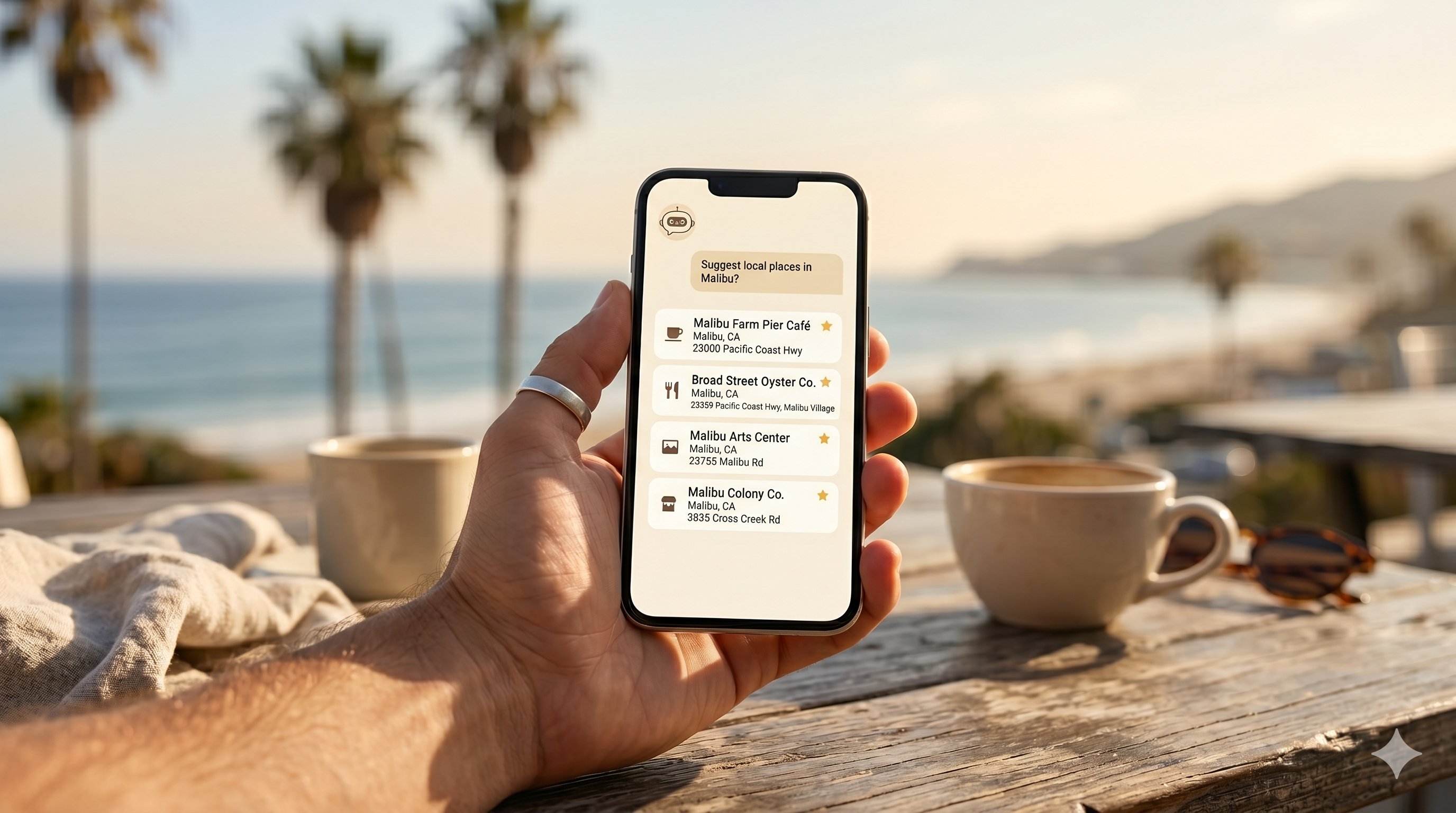
If you run a business in Malibu, the way your next customer finds you has quietly changed. Fewer people are scrolling a page of blue links. More are simply asking — typing "best oceanfront restaurant in Malibu" or "who does luxury home remodels near Malibu" into ChatGPT, Google's AI Overviews, or Perplexity — and trusting the short list that comes back.
Those tools don't recommend everyone. They recommend the businesses they can clearly understand. If your website isn't built to be read by machines as well as by people, you can be the best in town and still never make the list.
Search in Malibu Has a New Front Door
For two decades, getting found meant ranking on a page of links and hoping someone clicked yours. That page still exists — but for a growing share of searches, it's no longer the first thing people see. The answer is.
From ten blue links to a single AI answer
When someone asks Google's AI Overview, ChatGPT, or Perplexity a question, they don't get ten options to weigh. They get a short, confident recommendation — often two or three names, sometimes one. The businesses named capture the attention; everyone else isn't on page two, they're simply not mentioned at all. There is no "below the fold" in an AI answer. You're either in it or you're invisible.
Why high-intent local searches change first
This shift lands hardest on exactly the searches that matter most to a Malibu business — the ones with buying intent. "Best oceanfront restaurant in Malibu," "luxury home remodel near Malibu," "private chef Malibu," "med spa Malibu": these are people ready to spend, and they're increasingly asking an AI to narrow the field for them. The customer who used to compare a handful of sites now trusts the machine to pre-select. If your business isn't part of how that machine understands the local market, the decision gets made without you ever being in the running.
What AI Engines Actually Read Before They Recommend You
An AI engine doesn't "see" your website the way a visitor does. It can't be charmed by a gorgeous hero image or a slick scroll animation. It reads — pulling meaning from text, structure, and signals scattered across the web — and then decides whether it understands your business well enough to put it in front of someone. Four things shape that decision.
Clear, structured content — not just a beautiful site
A stunning design that says little in plain language is, to an AI, a near-empty page. These systems reward content that states plainly what you do, who you serve, and where — in real sentences, not just imagery and adjectives. A Malibu wellness studio whose site actually says "we offer infrared sauna and lymphatic massage in Malibu" will be understood; one that leans on mood photography and the word "elevate" will not.
Entity signals — who, what, and where, in machine-readable terms
AI engines think in entities: your business name, your location, your category, your services, and how they connect. The clearer those connections, the more confidently a model can match you to a query. This is where structured data and clean on-page signals do the heavy lifting — quietly translating your site into terms a machine can file correctly. It's the core of what building AI search visibility actually involves.
Consistency across the web
Models cross-check. If your name, address, and phone number read one way on your site, another on Google, and a third on an old directory, that contradiction breeds doubt — and a doubtful model leaves you out. Consistent details and genuine reviews across the places an AI looks all reinforce that you are who you say you are.
Question-and-answer content that mirrors how people ask
People talk to AI in full questions: "Where can I get a private chef in Malibu for a dinner party?" Sites that answer real questions in plain language — often in a clear FAQ format — give engines ready-made, quotable answers. The closer your content sits to the way customers actually phrase things, the more likely a model is to lift your answer straight into its recommendation.
The Cost of Being Invisible to the Machines That Recommend
It's easy to assume that if you rank well on Google, you're covered. That assumption is increasingly expensive — because the AI answer and the search ranking are no longer the same thing.
You can rank on Google and still be absent from the AI answer
Traditional ranking rewards links, authority, and keywords. AI recommendations reward clarity, structure, and understanding. A business can sit comfortably on page one and still be skipped entirely when a model assembles its short list — because the model couldn't confidently parse what that business does or who it serves. The page that wins the click and the page that wins the recommendation are judged by different criteria, and plenty of well-ranked Malibu sites quietly lose the second contest without ever knowing it happened.
In a high-value market, every missed recommendation is a lost high-ticket customer
Malibu isn't a volume market — it's a value one. The searches are fewer, but each one can carry real money behind it: a remodel, a private event, a season of services, a property sale. When a customer with that kind of intent asks an AI for a recommendation and your name isn't in the answer, you don't just lose a click — you lose a high-ticket customer to whichever competitor the machine understood better, and you never even see the opportunity that didn't arrive. Invisibility in AI search has no analytics line. It's the quietest kind of lost business there is.
What an AI-Visible Malibu Business Looks Like
The fix isn't a flashier website — it's a more legible one. An AI-visible Malibu business reads clearly to a person and to a machine at the same time. Its pages say, in plain language, exactly what it offers, who it's for, and where it operates. Its services are spelled out in real sentences rather than buried in imagery. Its name, address, and hours match everywhere they appear. And its most common customer questions are answered directly on the site, in the words people actually use to ask them.
Underneath that clarity sits the technical layer most visitors never see: structured data that labels each piece of information so an engine can file it correctly, clean and fast pages that crawlers can read without tripping, and consistent signals tying the business to Malibu and to its specialty. None of it is glamorous, and that's the point — it's plumbing, not paint. Pulling those pieces together is the heart of a real AI search visibility strategy: making sure that when a model is asked who to recommend in Malibu, it has every reason to say your name.
Malibu AI Search, Answered
What is GEO (generative engine optimization), and how is it different from SEO?
GEO is the practice of structuring your website and online information so AI engines — like ChatGPT, Google's AI Overviews, and Perplexity — can understand and recommend your business. Traditional SEO works to rank your page in a list of links; GEO works to get your business named inside the AI's answer. They overlap, but GEO puts more weight on clarity, structured data, and content that directly answers real questions.
Why does my Malibu business show up on Google but not in ChatGPT or AI Overviews?
Ranking on Google and being chosen by an AI are judged differently. Google rewards links, authority, and keywords; an AI recommends businesses it can clearly understand and confidently describe. If your site's content and structure don't spell out what you do, who you serve, and where, a model may skip you even when you rank well in traditional search.
Do I need a brand-new website to get found by AI search?
Usually not. Most businesses can become AI-visible by improving what they already have — clarifying the content, adding structured data, fixing inconsistent business details, and answering common customer questions directly on the site. A full rebuild is only necessary when the existing site is too slow or technically broken for crawlers to read.
How long does it take to start appearing in AI answers?
It varies. Once the improvements are in place, AI engines need time to re-crawl your site and update what they know about your business, which can take anywhere from a few weeks to a few months. Consistency matters more than speed — the clearer and more consistent your signals stay over time, the more reliably you appear.
This post is an advertorial piece contributed by a Patch Community Partner, a local brand partner. To learn more, click here.