Politics & Government
Ballona Wetlands Bird: The Light-Footed Clapper Rail
This endangered water bird builds a fantastic nest in tidal wetland. We will likely have them at Ballona with the state's restoration plan.


Author's note: I wrote this article a year before release of the Ballona Wetlands Restoration Project Environmental Impact Report, which has since better informed the prospects for this species' return to Ballona. -DK
The light-footed clapper rail (Rallus longirostris levipes, now called Ridgway's rail, I believe) no longer exists in the Ballona Wetlands Ecological Reserve, but its return has long been a dream of those dedicated to tidally restoring Ballona lands filled in during Marina construction in the 1950-60s. The light-footed clapper rail is found exclusively in tidal wetlands between Santa Barbara and northern Baja California. It nests primarily in dense cordgrass, a reed-like plant that thrives in subtidal areas, where open sea water remains even at low tide.
Due to regional tidal wetland loss and degradation, the species’ population declined, prompting its “endangered” listing in 1970. Clapper rails do not exist in Ballona today because there is no subtidal area supporting cordgrass, and thus no place for the birds to nest. We will change that with the proposed Full Tidal Restoration plan recently released in the Department of Fish and Wildlife's Draft Environmental Impact Report (DEIR) for the Ballona Restoration Project (https://nrm.dfg.ca.gov/FileHan....). A few loud, misguided voices are fighting against the Department's plan, and would sentence the clapper rail to extinction in the process.
Find out what's happening in Marina Del Reyfor free with the latest updates from Patch.
The famous wetland biologist Joy Zedler wrote in 1982, “If there are also local species extinctions (such as [cordgrass] and associated clapper rails), closed lagoons may become less useful for the preservation of endangered species. For all of these reasons, managers and biologists have agreed that tidally flushed wetlands are preferable to frequently or persistently closed lagoons.”(1) True then, and still true today.

The clapper rail’s most fascinating characteristic is how it builds a unique floating nest adapted to rising and falling tides (see the diagram). This winged wonder weaves dead cordgrass stems between and around growing stems to form a platform nest that rises and falls with the flood and ebb tides, just as floating Marina docks slide up and down concrete pillars. The bird bends and intertwines the tips of the surrounding stems to form a canopy above the nest which holds the nest in place during high spring tides and protects it from flying predators. The proposed Ballona Full Tidal Restoration plan will provide large stands of dense, cordgrass at the optimum tidal elevation to support clapper rail nests. As we've seen at other tidal restoration sites along the coast, the birds will come, if you build it.
Find out what's happening in Marina Del Reyfor free with the latest updates from Patch.
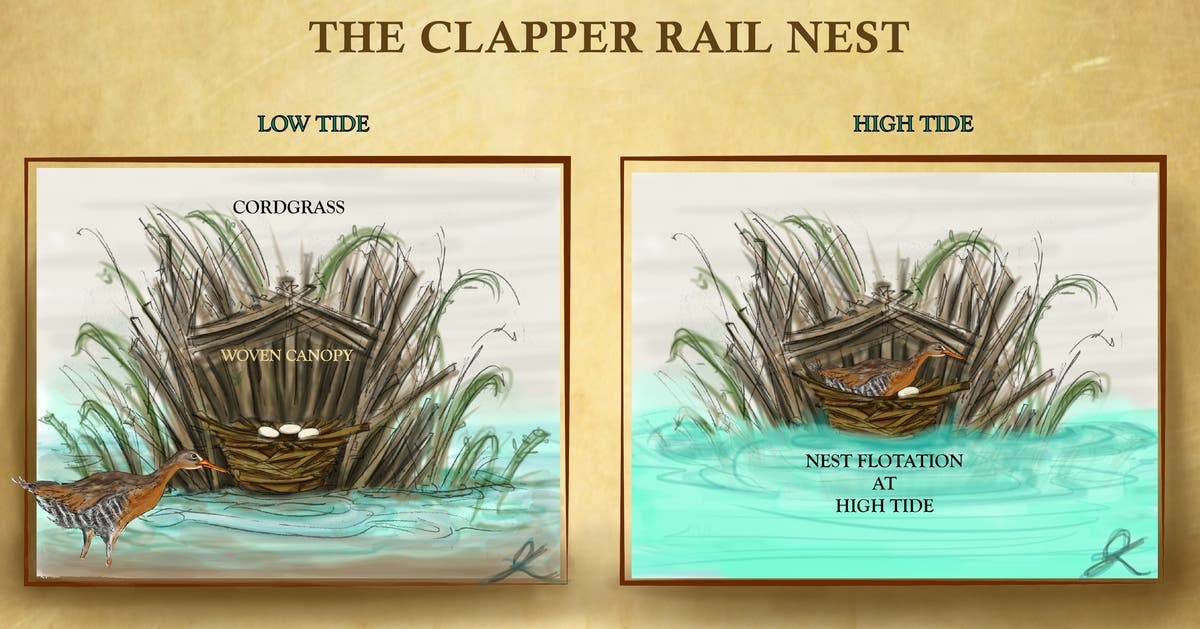
The clapper rail is a poor flyer, and moves about on foot under cover of the cordgrass and other vegetation. When it does venture out, you’ll most likely see it in the early morning scurrying about looking for snails, crabs, insects and other food in tidal debris at the wetland’s edge. Its "kek kek kek kek" call sounds like clapping hands.
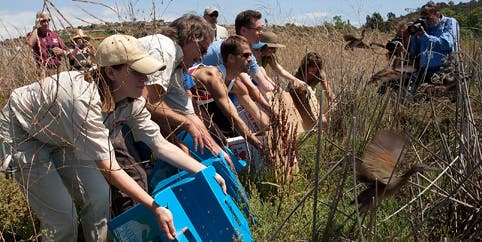
You won’t see the light-footed clapper rail at Ballona, at least not yet, but travel to Upper Newport Bay or one of the tidal lagoons to the south, and with some luck and a good pair of binoculars you might just catch a glimpse of Ballona’s future tenant.
To help make a new home at Ballona for the clapper rail, make your voice heard now by e-mailing BWERcomments@wildlife.ca.gov. Simply state that the EIR should be approved and that Alternative No. 1, the Natural Creek plan, should be the preferred alternative.
Enjoy your Ballona Wetlands, and keep a vision of its future! Go to www.ballonafriends.org to get more involved in your Ballona Wetlands.
Deference to avian biologists who might use Comments to clarify recent taxonomic changes for this species. Ridgway's Rail appears to have supplanted the Light-Footed common name, but I'll leave it to you experts to sort that out! :)
(1) Zedler, 1982. The ecology of southern California coastal salt marshes: A community profile. Performed for National Coastal Ecosystems team, Biological Services Program, Fish and Wildlife Service, U.S. Department of the Interior, Washington, D,C. 20240
(2) Zembal, R., S.M. Hoffman, and J.R. Bradley. 1997. Light-footed clapper rail management and population assessement, 1996. Bird and Mammal Conservation Program Report, 97-08. Final Report to the California Department of Fish and Game, Sacramento, CA.
(3) Hayes, L. 2005. Light-footed clapper rail nesting data, 1997-2004. Data provided by Loren Hayes, U.S. Fish and Wildlife Service, Carlsbad, CA, August 1, 2004.