Politics & Government
Ballona Lagoon: The Ballona Wetlands' Ancient Tidal Channel
Thanks to conservation advocacy in the 1980s, a prehistoric remnant of the once 2000-acre Ballona Wetlands survives


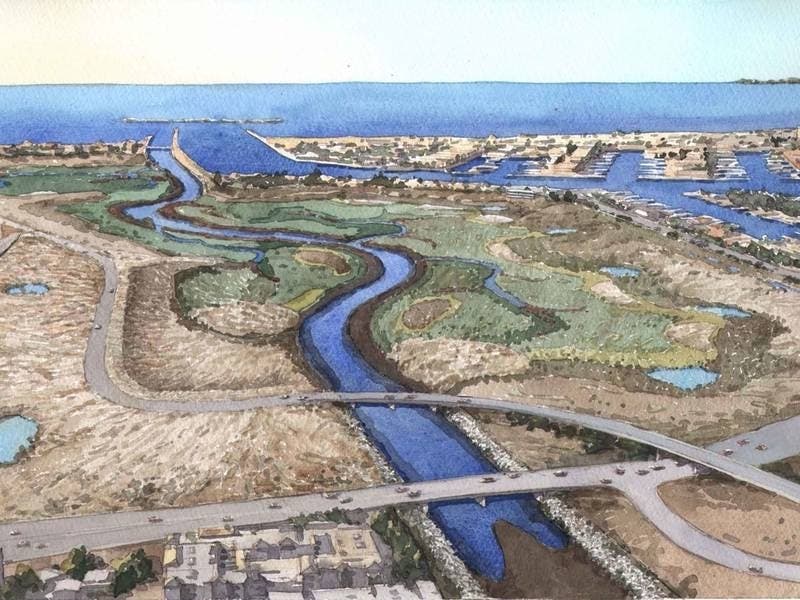
Above: The Ballona Lagoon, a remnant of Ballona Creek’s prehistoric river channel.
As we all cautiously emerge from this sci-fi horror film that is COVID-19, we look forward to walking places we may have avoided over the past two months. Just before the pandemic exploded, I visited the Ballona Lagoon.
Everyone knows the Ballona Lagoon. Although we might not know its name or history, we’ve all walked, pedaled or driven over it at one time or another. When we get the “all clear” message after this pandemic, the Ballona Lagoon will be one of my first destinations.
Find out what's happening in Marina Del Reyfor free with the latest updates from Patch.
Most folks know the Ballona Lagoon as “that big canal” that connects the smaller Venice Canals to the Marina Del Rey main channel.
The first I ever heard of the Ballona Lagoon was from the late Iylene Weiss, a former resident of the Venice Strand neighborhood and lifelong champion for the Lagoon’s restoration. Iylene and her neighbors founded the Ballona Lagoon Marine Preserve and led a 10-year effort to restore the 16-acre waterway, having recognized early on that the Lagoon was a remnant of the Ballona Wetlands, much of which had been filled in by development since the early 1900s. The restoration included dredging the channel near its Marina inlet to remove accumulated sediment and enhance tidal flushing.
Find out what's happening in Marina Del Reyfor free with the latest updates from Patch.

Above: The Ballona Lagoon trail on the Marina Strand is a popular walking path for area residents and visitors.

Above: The sheer size of the Lagoon documents its prehistoric life as the lower channel of a river capable of very large flood flows.

Above: Today the Ballona Lagoon's southern end stops at the Playa Del Rey ball fields, but pre-1900 it flowed out to the sea at Toes Beach.
Prehistorically, the Ballona Lagoon was the end of the Ballona Creek channel, but always held seawater because each winter the creek scoured its channel bottom to an elevation below sea level. During large winter storms, the creek could scour the inlet channel at the beach down to ten feet below sea level. Over the summer and fall, ocean waves gradually filled in the channel mouth at the beach to an elevation of around 0-2 feet, until the next winter's rains again scoured down the beach inlet.

Above: This 1876 map of the Ballona Wetlands shows the Ballona Lagoon as the main channel at the mouth of Ballona Creek. Winter rainfall runoff scoured the channel deep and open to the sea. Summer surf would gradually fill in the tidal inlet at the beach until the next winter’s rains scoured it out again.
On the map above, the left callout points to where the channel makes a 90 degree bend to the southeast, a bend that is visible to this day at Hurricane Street (see photo below). Over 1000 years ago, Ballona Creek’s estuary likely flowed straight into the ocean where Hurricane Street is today.

Above: This 90 degree bend in the Ballona Lagoon marks where ancient Ballona Creek’s channel flowed straight out to the ocean. Longshore sand transport and formation of a “sand spit” (today's strand beach) gradually moved the estuary opening southeastward all the way to Playa Del Rey.
Since prevailing swells and waves strike Venice Beach at an angle, beach sand gradually moves southward, like a slow-motion sand river. This “longshore transport” caused the Ballona Creek channel mouth to slowly migrate downcoast toward Playa Del Rey, as a “sand spit” formed seaward of it. Windblown sand built up the sand spit into dunes, on top of which the Marina Strand neighborhood is built. This type of coastal landform evolution is typical and observable all along the California coastline today.

Above: Representation of geologic history showing migration of the Ballona Wetlands estuary mouth southeastward, as a sand spit formed seaward of it. From Altshul et al., 2007.

Above: The northern half of the Ballona Wetlands, long before Marina Del Rey was developed. The 90 degree bend of the Ballona Lagoon at Hurricane Street can be seen at bottom center.
The City of Los Angeles restored the Ballona Lagoon banks in 2011, adding dog fencing, removing weeds and planting native dune plants. One particularly rare native plant, the Orcutt’s Yellow Pincushion, had survived years of development. The City collected seeds from these survivors and planted them all along the dune sands next to Pacific Avenue. According to monitoring performed after the restoration, the pincushion population increased from 26,500 in 2010 to 107,500 in 2012.

Above: Fencing keeps dogs out of the sensitive dune habitat between Pacific Avenue and the Lagoon, a Rare Plant Preserve where several rare species are found, including the Orcutt’s Yellow Pincushion flower.
Throughout the early and mid-1900s, oil production scarred the Venice strands and Lagoon. My grandmother kept a bottle of turpentine and a rag on the back doorstep of her Venice apartment at 3rd and Rose, so my sister and I could get the oil tar off our feet after a day at the beach back in the 1960s.

Tide gates in the Ballona Lagoon at the Marina channel and at Washington Blvd. regulate the flow of incoming tides and outflowing stormwater, so streets do not flood.

Above: Tide gates regulate water levels where the Ballona Lagoon feeds the Venice Canals, at Washington Blvd.
In the early 1900s, Abbot Kinney developed the Venice canals and dredged one of Ballona Wetlands' tidal creeks to convey tidewater to his development from the Ballona Lagoon. Poor hydrologic design hampered water quality in the canals until modern tide gates and a little dredging ensured sufficient flushing flows.

Above: The Venice Canals go underground at North Venice Blvd., where they are relegated to storm drain duty beneath Canal Street.
Enjoy your Ballona Lagoon and Ballona Wetlands!
References:
Iylene Weiss; Activist Worked to Save Ballona Lagoon. Los Angeles Times. May 15, 1997. https://www.latimes.com/archives/la-xpm-1997-05-15-mn-58850-story.html
Restoration Plan to Help Revive Ballona Lagoon. Los Angeles Times. January 23, 1996. https://www.latimes.com/archives/la-xpm-1996-01-23-me-27774-story.html
Chang, H.H. 2014. Fluvial Study for Ballona Creek Estuary. Chang Consultants.
J.H. Altshul, et al. 2007. Life at the nexus of the wetlands and coastal prairie, west Los Angeles. Proceedings of the Society for California Archaeology, Volume 20, 2007, pp. 34–42
Ballona Lagoon Enhancement Plan. California Coastal Commission. Coastal Development Permit 5-08-294 and amemdments, August 13, 2010.
Author’s note of transparency:
Dr. David W. Kay served on the Board of Directors of the non-profit Friends of Ballona Wetlands from 2007 until 2015, and served as Board President in 2012-13. He presently serves on the Board of Ballona Discovery Park in Playa Vista.
Since 1984, David has been employed by Southern California Edison Company, exclusively in the company’s environmental services organizations. His many responsibilities included restoration of the 440-acre San Dieguito Wetlands near Del Mar. He is presently Senior Manager for Project Environmental Licensing at the company. David earned bachelor and masters degrees in biology and a doctorate in environmental science.
David is a staunch advocate for the state of California’s plans to restore the Ballona Wetlands Ecological Reserve.
See Dr. Kay’s Patch contributor profile here.