Politics & Government
Ballona Wetlands Restoration: Our Long Road Trip Together, Part One
A Five-Part Series Explaining the Ballona EIR Matter in Plain English - Part One: Our Planning Foundation


Few of us have ever taken a road trip without a destination in mind. Those rare adventures left great memories, but usually ended sooner than expected, short of gas, food and cash, and far from where we thought we were headed. As less adventurous, sensible adults, we decide upon a destination up front, map out a route, including options for weather or other constraints, check off many ways and means to travel the preferred path, and then make the trip.
If you set a goal, develop and carry out a plan for getting there, you have a good chance of reaching your destination. If you don’t have a plan, or even an end goal, you’ll likely end up anywhere, far from where you truly want to be.
Decades of discussion about restoring the Ballona Wetlands focused on the mechanisms of the work or how much land to buy, sidelining conversation about the desired goals. For the road trip analogy, this is like focusing on whether to travel by car or bus, or what brand and size of car to drive without first considering a destination, or even the roads available to get there. This disconnect is understandable, given inflexible positions taken by some due to long-standing beliefs, political interests and litigation history. It’s complicated.
Find out what's happening in Marina Del Reyfor free with the latest updates from Patch.
Fortunately, California has a time-tested law and rules that separate all this chaff from the wheat for project development. The California Environmental Quality Act (CEQA) forces us to pick a road trip destination first, and a reason to go there, plan various routes to travel, and detail the manner by which we will reach that journey’s end. Not by design, but due to years of court decisions mandating a careful, open public process, CEQA can make the journey take much longer than we’d like. But, CEQA ensures an end result that while rarely pleasing everyone, is fair to all concerned. Most importantly, it enables justifiable projects to actually happen in an environmentally protective way, rather than getting caught in an endless loop of disagreement.
Regional Goals Must be Clearly Stated, But Don’t Require Unanimous Consensus
Find out what's happening in Marina Del Reyfor free with the latest updates from Patch.
The first step for the Ballona Wetlands Restoration was to establish regional goals within the 577-acre state-owned land now designated as ecological reserve. Many Ballona goals already enjoy unanimous support, such as public open space forever protected from development, protected wildlife habitat, well-regulated public access and educational opportunities.
Other goals lack consensus, and may never be accepted by some. Should the restoration favor aquatic organisms with much open, blue water? Or, favor terrestrial animals with landscape dominated by marsh and upland (dry land) habitat? Or, should the restoration balance the two, with a mix of the many sub-habitats in between? Shall the restoration be built by conventional means (motorized excavation and grading, followed by re-vegetation) or be hand-built by community members in a minimally invasive, low impact way? Shall existing and restored wetland be connected to the Ballona Creek waterway, the Marina Del Rey channel or directly to the ocean? Shall the little league fields be allowed to remain on the state-owned reserve land and should other uses unrelated to open space habitat enjoyment be allowed?
Who gets to decide the destination of our road trip, the route we’ll take and the car we’ll drive? We’ll all be passengers and we’re chipping in for gas, so don’t we have a say about where we’re all headed and how we’ll get there? The answer is, “it depends”.
Under CEQA, a project is defined by its proponent, or developer. In the case of a shoe factory project, that proponent may be a shoe company that owns the land, purchased for that purpose in an area zoned for manufacturing. The company establishes the project goal: to build a shoe factory. Their plans may be for a large factory, but could also include a medium-sized one. The company might not seriously consider a small factory; perhaps because of economics (a small factory might not be competitive). The proponent is not required to advance plans that don’t meet their goals, and the public cannot force them to (generally speaking), unless the proposed alternative plans cause significant, adverse environmental impacts that cannot be reduced or offset (mitigated) in some way which the developer agrees to accept. The developer may abandon the project if they cannot, or don’t choose to mitigate the impacts, but they can’t be forced to advance a project that does not satisfy their purpose and meet their goals. So, the shoe company will build its factory if it can economically mitigate all significant environmental impacts, or it won’t build at all. It cannot be forced to build an noncompetitive small factory. Like it or not, that’s the law of the state, and it’s consistent with other familiar tenets of American governance, such as property rights.
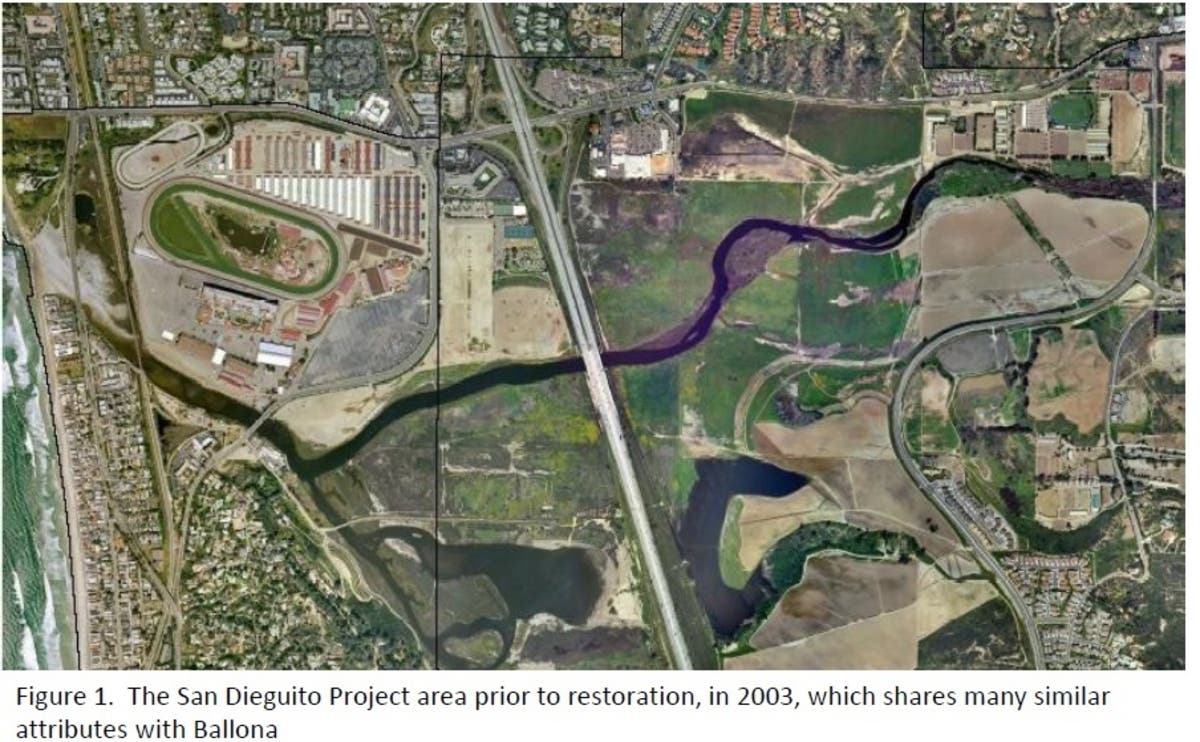
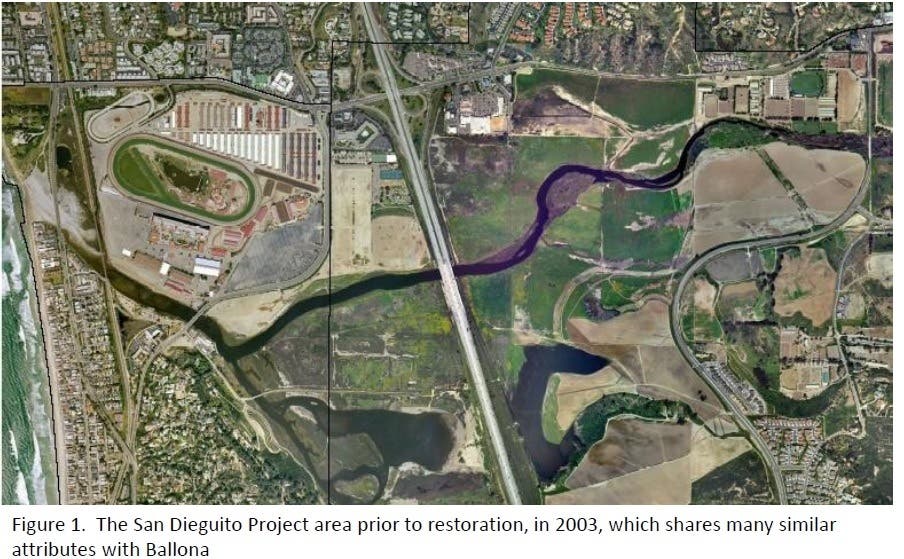
A good lessons-learned example for the Ballona Wetlands is the San Dieguito Wetlands Restoration near Del Mar, where the primary goal was to create and restore tidal wetland habitat to enhance ocean fish reproduction. Since the project was driven by California Coastal Commission (CCC) permit requirements, the CCC added additional goals, such as a design that must be self-maintaining and always open to the tide, as well as very prescriptive goals for wetland and upland habitat composition and performance (Figure 1).
Absent such prescriptive design requirements, the project proponent for Ballona - the State of California – is free to set its own project goals. Represented by the Department of Fish and Wildlife (the state’s land owner) and through a series of public workshops held since 2004 that incorporated the advice of an expert scientific advisory panel, California decided that Ballona shall be restored, and that an abundance of high quality, productive wetland and upland habitats shall be created, enhanced or preserved, accessible by regulated public access.
Those are the regional goals of a Ballona restoration as stated by the proponents, and unless their goals otherwise conflict with state or federal law or policy, that is the destination of our road trip. I believe all those concerned with Ballona agree upon those overarching, regional goals, and are willing to make the journey. Disagreements remain about how to get there, however, and there will be much arguing about those details. That’s OK. That’s part of our process.
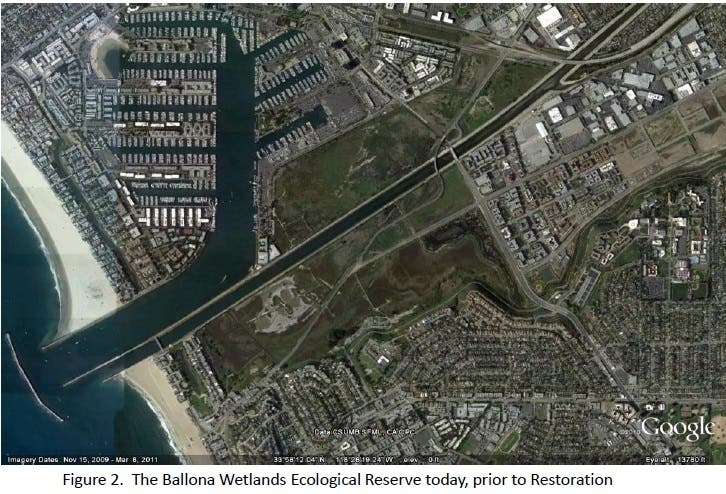
As the land owner and project manager designated by any number of laws, policies and regulations, our Department of Fish and Wildlife has already established these regional goals for Ballona’s 577 acres (Figure 2). Their decision is not revolutionary, but ordinary and familiar. Indeed, state agencies have already completed over 1800 projects at a cost of $1.5 billion, many of them restorations of state-owned tidal lands up and down our state coastline, because we have ordered that be done through our laws and regulations (Public Resources Code §31200 et seq.).
Ballona will be one of the last remaining tidal marshlands to be preserved and restored by a state government structure created in 1976 expressly to accomplish those public goals. Los Angeles regional taxpayers contributed funding for all of those other statewide projects. Now it’s the rest of California’s turn to fund Ballona, and we’ve already invested $140 million for the land purchase and ecological reserve designation.
So, we collectively decided long ago to protect, restore and enhance our remaining coastal wetlands. That’s the road trip destination for Ballona. As passengers, we will have a say about what road to take to get there; what kind of car to drive, how fast to go, and other details. That part of the process has just begun. We’ll discuss that in Part Two next Sunday, so stay tuned.
About the author:
Dr. David W. Kay earned Bachelors, Masters and Doctorate degrees in biology and environmental science from UCLA and CSUN, and has worked professionally in environmental management at Southern California Edison for 33 years. He served on the Board of Directors of the non-profit Friends of Ballona Wetlands from 2007-13, and as its Board President from 2012-13. In 2006-12, he managed the comprehensive restoration of the 440-acre San Dieguito Wetlands complex in northern San Diego County on lands historically infilled by an airfield, waste treatment lagoons and agriculture. Dr. Kay lives in Playa Vista.