Politics & Government
Traffic Impacts of the Ballona Wetlands Restoration
For most folks, traffic snarls are their greatest worry. The state's plan prevents traffic impacts through clever design and construction.

Most of us don’t have time to read the 1242-page Draft Environmental Impact Report (DEIR) for the Ballona Wetlands Restoration Project, but we all “hear things on the street.” One of the most common worries relates to traffic impacts from construction. Many folks have heard or believe that Alternative No. 1, the Full Tidal restoration and proposed project, will cause thousands of heavy haul truck trips on area roadways, as tons of fill dirt are excavated to recreate wetlands where they once existed. Chapter 3.12 of the DEIR, Transportation and Traffic, explains these fears away.
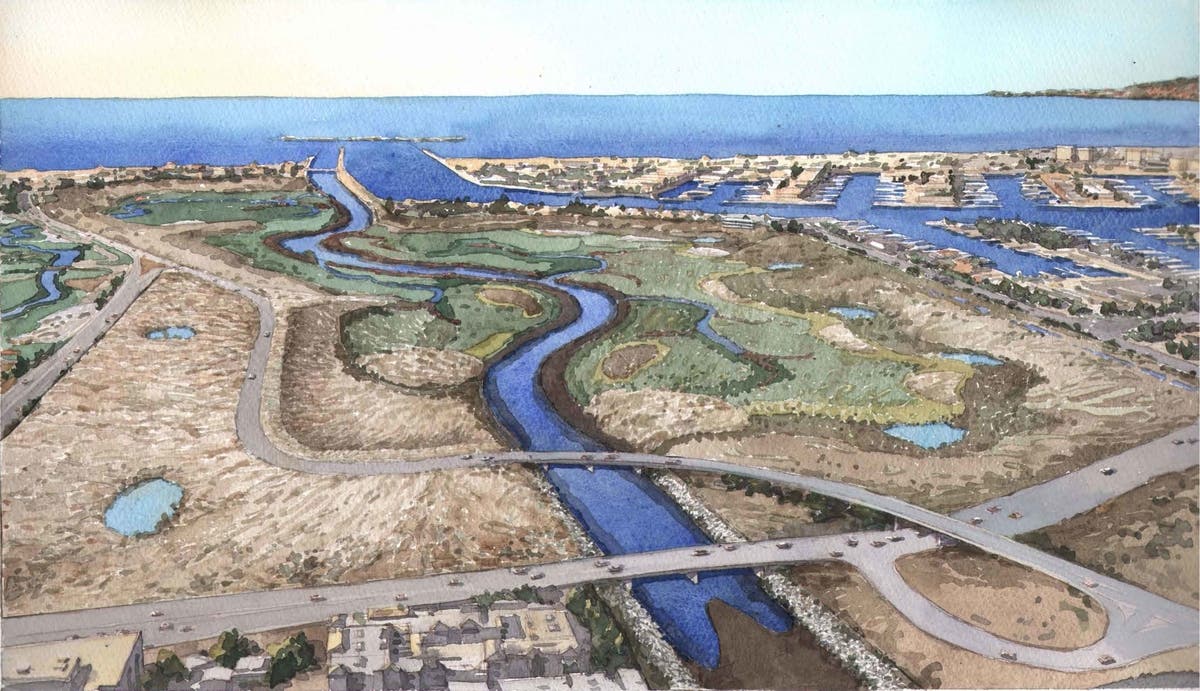
The Alternative No. 1 Plan employs very simple methods commonly used on other restoration projects elsewhere to keep dirt hauling within the project footprint and off public streets. At Ballona, three temporary truck bridges will be constructed to accomplish this – one over Lincoln Boulevard (shown in the picture below), another over Culver Boulevard and the third across Ballona Creek. These bridges will enable trucks to carry dirt from its excavation point to its final resting place, all within the project footprint. The temporary bridges would be built late at night, to minimize traffic impacts, over 3-4 weeks. Once the project is completed, the Lincoln and Ballona bridges would be made permanent for public trails, which are part of the project, and for ranger patrol and maintenance vehicles.
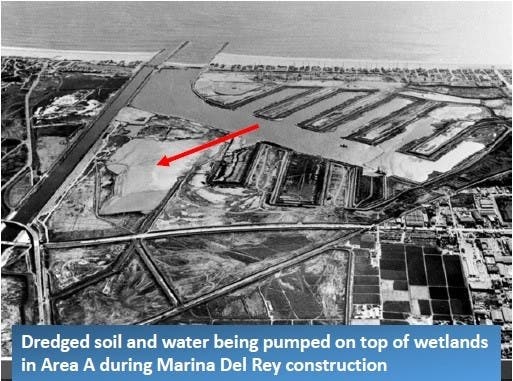
About 2.4 million cubic yards of dirt needs to be excavated from the 200-acre area filled in when Marina Del Rey was built in order to recreate the tidal wetlands that once existed there. See the old black and white photo below showing the area now known as Area A being filled with dredged "goo" back in the 1950s. Marina Del Rey construction dumped enough muddy goo on top of tidal wetlands there to fill up Dodger Stadium. It’s 17 feet thick in some places. Let’s resolve to correct that well-meaning but horrific last-century mistake by restoring the ocean tides to Area A, as they once were.
Find out what's happening in Marina Del Reyfor free with the latest updates from Patch.
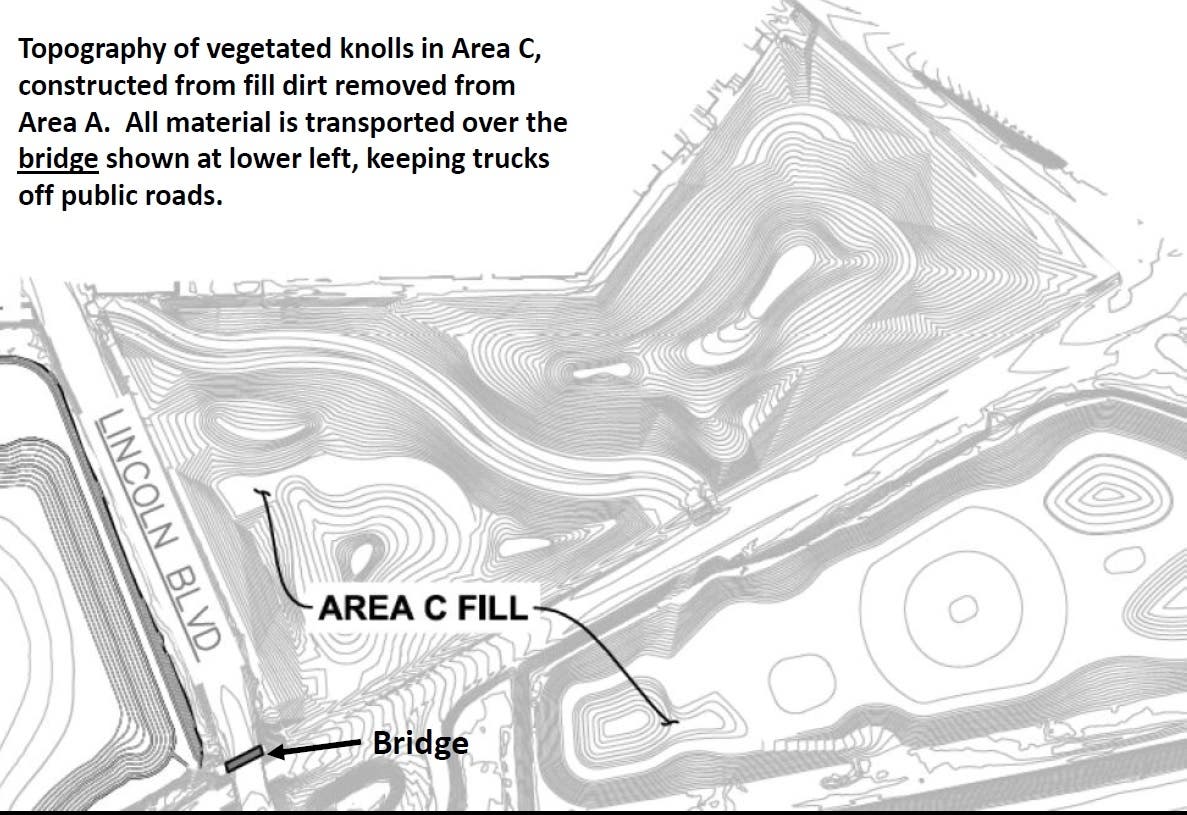
Fill dirt will be dug from Area A and moved over the bridges to several locations where new upland habitat will be created (uplands are generally areas above 5 feet elevation). Using this excavated fill dirt, low rolling knolls vegetated with native shrubs and flowering plants will be sculpted in Area C, near the 90 freeway acceleration roadway (between Mindanao and Culver, shown in the above topographic plan). Public trails will be built around these knolls, and throughout the 600-acre Ecological Reserve (see trails map below from the DEIR).
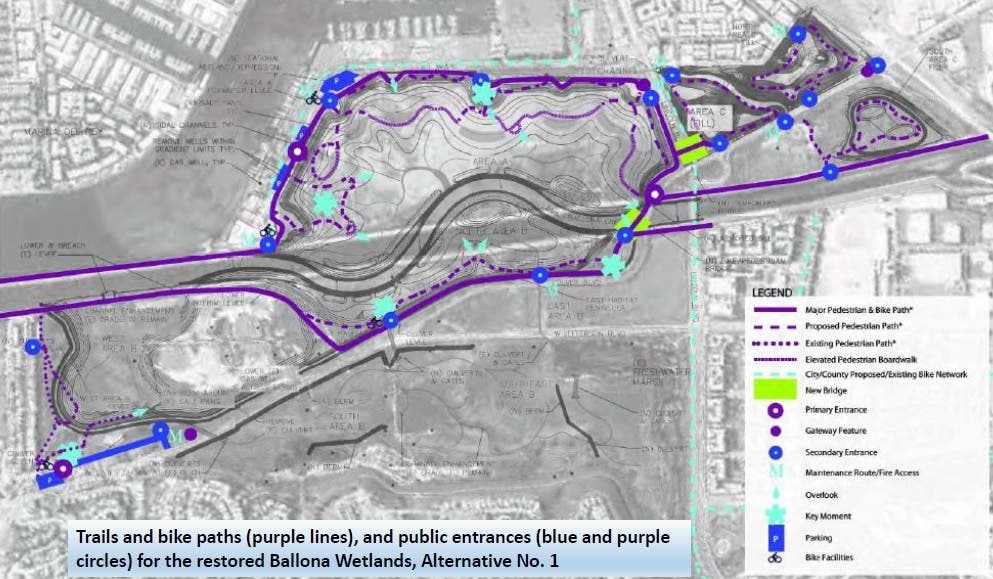
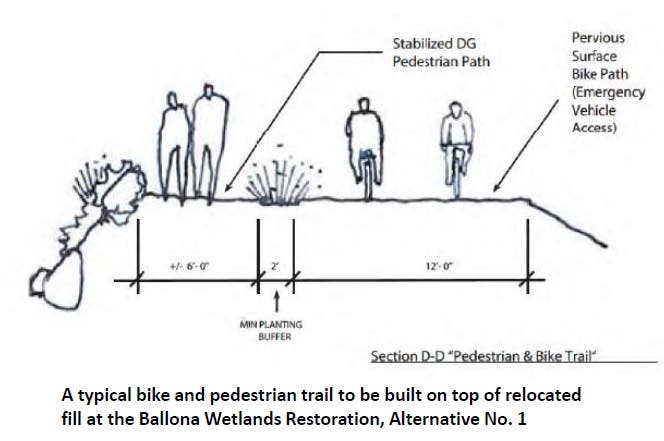
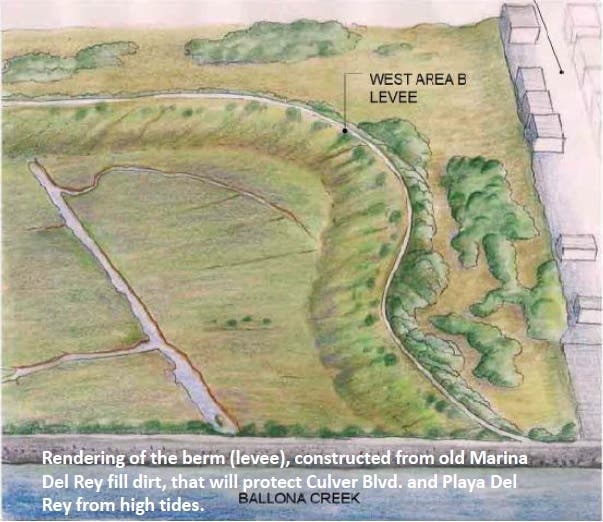
South of Ballona Creek, vegetated upland berms or levees, also supporting trails and bike paths, will be constructed from this fill dirt excavated from Area A, again without trucks ever leaving the construction site. The berms will be built adjacent and parallel to Culver Boulevard west of Lincoln, and then bend northward toward the Marina Main Channel (see artist rendering below). The dunes habitat in that area so lovingly restored by volunteers over many years will be preserved.
Find out what's happening in Marina Del Reyfor free with the latest updates from Patch.
These berms will allow the full high tide to enter both the existing and newly reconstructed wetland areas, while protecting Culver Boulevard and Playa Del Rey streets from tidal flooding. Presently, that high tide flood protection is provided by mechanical gates on the Ballona Creek channel - gates that restrict the full high tide from reaching existing wetlands south of Ballona Creek - and which are vulnerable to mechanical breakdown. Berms would provide fail-safe flood protection to lower Playa Del Rey and eliminate the tide gate restriction which has strangled that remaining wetland habitat, hindering the natural twice-daily ocean water exchange that once nourished a marsh much more vibrant than we see today.
Depending on the detailed final construction plan (which will not be developed or approved until the project goes before the California Coastal Commission), between 10,000 and 110,000 cubic yards of excavated fill dirt may need to be transported offsite for disposal. This represents a maximum of 4.5 percent of all the dirt that needs to be moved.
The DEIR map below shows that trucks carrying this “surplus” dirt will enter Lincoln Boulevard northbound, using a specially constructed acceleration lane, then turn right on Mindanao to enter the 90 freeway and leave the area (no truck left turns are allowed). Empty trucks coming to the site will arrive via Lincoln from the south, entering the site via a special deceleration lane (again, no left turns by trucks). Construction traffic will be limited to daytime hours and will exclude the evening peak traffic period, a customary restriction of construction projects in populated areas. Most of this earth moving activity will occur during the first year of project construction.
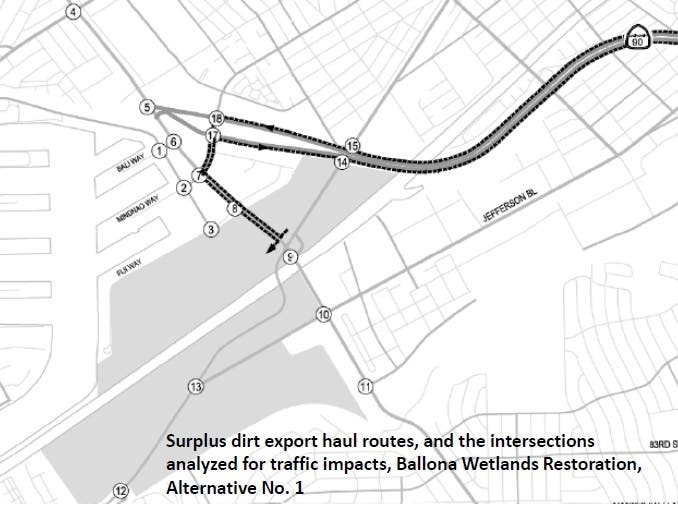
Based on a mathematical analysis of vehicle traffic at 18 area intersections (most shown circled in the map above), the DEIR found that construction truck traffic from the Ballona Restoration will not significantly affect area traffic patterns. This means the existing vehicle traffic today, as measured by your waiting time in minutes at any of these 18 intersections, would not be made worse by project construction traffic.
--------------------
Nothing worthwhile is instant, and no project the scale of the Ballona Restoration can be executed without some temporary inconvenience here and there. However, the end reward to our Community - a 600-acre public open space park area, teeming with fish and wildlife and accessible by walking paths and bike lanes - is definitely worth it!
Exercise good citizenship and register your support! Send an e-mail to Councilman Mike Bonin at mike.bonin@lacity.org simply state you “support approval of the state's Alternative No. 1 plan to restore full tidal wetlands at Ballona.”
To get more involved in the Ballona Wetlands, visit Friends of Ballona Wetlands at ballonafriends.org. Also, visit the website of the Coalition of L.A.'s premiere environmental non-profit organizations which support full tidal restoration at Ballona.
Enjoy your Ballona Wetlands!