Health & Fitness
Bike Lanes on El Camino: Safer for Everyone
El Camino Real can be made safer for everyone by installing bike lanes, which would reduce traffic congestion as well. Here's how.
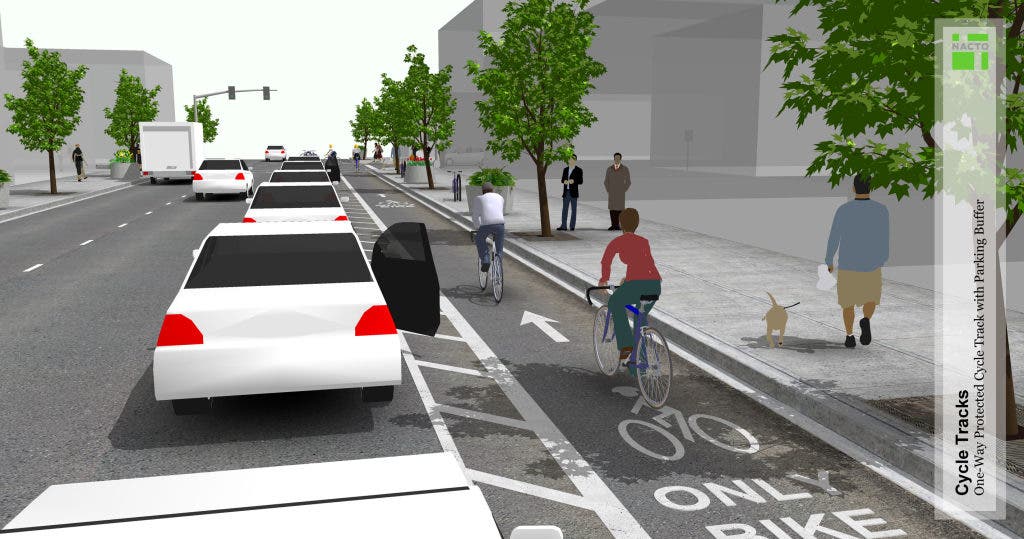


Residents have very legitimate concerns about bicycle safety on El Camino. Bicycling on El Camino is not suitable for everyone, simply because traffic volumes and speeds are relatively high. If you don't feel safe bicycling on El Camino, then don't do it!
Some residents feel that bicycling on El Camino is inherently dangerous and that alternative north-south routes should be improved instead. El Camino was designed only for driving cars, some say, and it should stay that way. Others are concerned that bike lanes would require removing vehicle parking or vehicle lanes, thus worsening already bad traffic congestion.
Find out what's happening in Menlo Park-Athertonfor free with the latest updates from Patch.
Not installing bike lanes on El Camino and only improving alternative north-south routes is a bad idea. Alternate north-south routes include Alma/Mills, University Dr, Laurel St, Middlefield Rd, and Alameda de las Pulgas. These routes help many bicyclists avoid El Camino and indeed they should be further improved with signage, bike lanes, and sharrows.
However, none of these alternative routes allows bicyclists to access the many businesses located along El Camino Real. It is not possible to get to most businesses by bicycle without riding on El Camino. Some businesses (Safeway, for example) can be accessed via alternative routes, but these routes require long (for bicyclists) and inconvenient detours. To get to Safeway from the Caltrain Station, for example, it's just 0.3 miles using El Camino, but 1.3 miles using the shortest alternative route (Santa Cruz + University Dr + Middle Ave).
Find out what's happening in Menlo Park-Athertonfor free with the latest updates from Patch.
The same is true for most destinations in Menlo Park and other cities - it's simply more convenient to drive than to bike, because unsafe street designs force bicyclists to choose longer routes. The negative consequences of having safe, convenient routes for driving but not for bicycling are many: unnecessary traffic congestion, more air pollution, unhealthy sedentary lifestyles, higher health care costs, higher transportation costs, and more traffic-related injuries and deaths.
Any street with bike lanes is safer, for everyone, than without bike lanes (except low-speed, low-volume residential streets) as long as the bike lanes are designed according to state guidelines. Bike lanes clearly indicate to both bicyclists and motorists where on the street bicyclists must ride for maximum safety. Without bike lanes, the bicyclist has to figure out it on their own, and the result is often unpredictable, unsafe behavior - riding too close to parked cars and swerving in and out of the vehicle lane.
Bike lanes improve safety for motorists. Bike lanes slow vehicle traffic slightly because the right-hand vehicle lane is narrower with them - on El Camino, this lane would be 11 ft wide instead of 16 ft wide. Also, bike lanes increase the number of bicyclists on the street because more people feel that the street is safe enough to bike on, which further reduces vehicle speeds because motorists naturally drive more slowly and more carefully. The result is fewer vehicle crashes and fewer motorist injuries.
Bike lanes also improve convenience for motorists, because more people decide to bike for some trips when their route includes bike lanes. This means fewer vehicles on the street, and less traffic congestion. "But there are so few bicyclists - can it really make a difference?", you might say. Yes, of course it can, and it already does - 9% of Menlo Park residents bike to work every day, according to the U.S. Census Bureau. That's about 1,500 people. Imagine if there were even 1,000 more cars on our streets every work day - traffic congestion would be even worse than it is.
Some residents believe that it's simply impossible to make El Camino safe for bicycling, and that placing bike lanes there would endanger bicyclists. This is simply false. There are many 4-lane and even 6-lane streets with bike lanes in the Bay Area, including on Willow Rd and University Ave east of Highway 101.
People have always ridden bikes on El Camino (since bikes were invented, of course!) because it's fast, direct, and convenient. No amount of improving alternative routes is going to change this. Bicycling is an increasingly popular mode of transportation (especially in Menlo Park), and more and more people are bicycling on El Camino - because it's useful. And since there is enough space on El Camino to add bike lanes without removing vehicle parking or vehicle lanes (Fehr & Peers concluded this in their recent analysis - see http://www.menlopark.org/departments/pln/ecr-d/fsp-memos/ecr-d_fsp-memos_a.pdf), adding bike lanes won't inconvenience anyone.
El Camino bike lanes would not only improve safety for everyone, they would also reduce traffic congestion while allowing more residents to safely bike for more trips and save money at the same time. Bike lanes are a long-overdue improvement that's supported by the Bicycle Commission, Planning Commission, Caltrans, and Fehr & Peers (the consultant hired by Menlo Park to analyze the feasibility of bike lanes on El Camino and other streets).
The sooner bike lanes are installed on El Camino, the sooner Menlo Park residents and visitors alike can enjoy the many benefits they'll provide.