Health & Fitness
Improve El Camino Real with Bike Lanes
El Camino Real with 4 vehicle lanes, and bicycle lanes, is the best choice to improve safety for everyone and reduce traffic congestion in downtown Menlo Park.

The 2007 - 2008 Menlo Park El Camino Real/Downtown Vision Plan crafted a set of 12 goals for improving Menlo Park's downtown through a comprehensive series of community workshops, walking tours, guest speakers, an Oversight and Outreach Committee, and review by the Planning Commission and City Council.
The goal of the El Camino Real/Downtown Specific Plan, scheduled for final review by City Council on Tuesday, June 5, is to develop vacant and underutilized parcels along El Camino Real and downtown while maintaining Menlo Park's unique village character, improving conditions for walking, bicycling, and parking, and increasing shopping and dining opportunities for residents.
Find out what's happening in Menlo Park-Athertonfor free with the latest updates from Patch.
Althought the Specific Plan proposes many changes to downtown land uses, parking policies, and street desgins, this article focuses solely on the future of our main downtown street - El Camino Real. A smart re-design of this street will attract more retail business and provide a more pleasant environment for walking and bicycling while improving safety for everyone and reducing traffic congestion.
The City Council should modify the El Camino Real/Downtown Specific Plan to:
Find out what's happening in Menlo Park-Athertonfor free with the latest updates from Patch.
1. Retain sidewalk curb extensions ("bulb-outs") on El Camino Real as included in the original version of the plan.
2. Identify the 4 Lanes with Parking and Bicycle Lanes as the preferred design configuration for El Camino Real in the short-term, to be implemented when the street is restriped.
3. Identify the 4 Lanes with Bicycle Lanes and No Parking as the preferred configuration for El Camino Real in the long-term, to be implemented in phases after the impact of vehicle parking removal on businesses can be assessed.
Following Planning Commission and City Council review of the Specific Plan in Summer/Fall 2011, a consulting team led by Fehr & Peers was directed to provide additional analysis on proposed revisions to the plan. In the Task A: El Camino Real Street Sections Revisions memo, they reviewed various designconfigurations for El Camino Real, including with or without sidewalk curb extensions, with 4 vehicle lanes (current configuration), expanded to 6 vehicle lanes, and with or without bicycle lanes.
In this analysis, Fehr & Peers concluded:
- Curb extensions should be retained in the plan because they improve pedestrian safety by improving visibility of pedestrians by motorists and reducing the crossing distance for pedestrians and exposure to vehicle traffic.
- Curb extensions do not conflict with bicycle lanes.
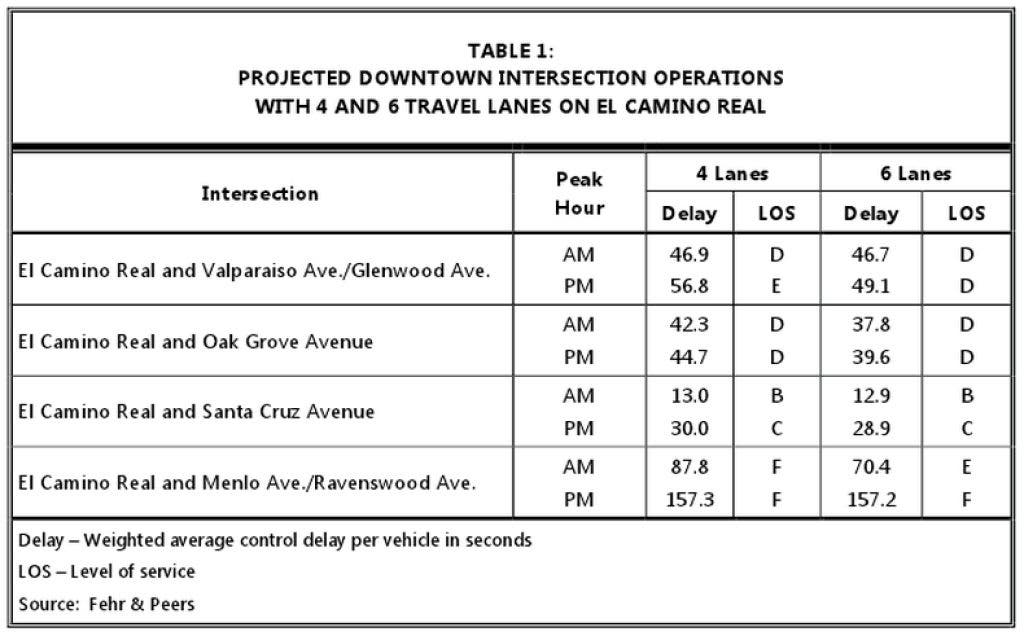
- Removing vehicle parking on El Camino to provide 6 vehicle lanes (3 in each direction) would reduce travel delay for motorists by only a very small amount: between 0 and 17 seconds during peak traffic periods, depending on the intersection (see table included as an image with this article).
- A 6-lane El Camino would result in higher traffic volumes due to traffic diverting from parallel roadways, and that this induced demand would result in traffic operations that "would likely mimic the four-lane alternative".
- A 6-lane El Camino would suffer from reduced retail opportunities due to an unpleasant pedestrian environment - higher traffic volumes and speeds immediately adjacent to narrower sidewalks.
- Bicycle lanes can and should be installed on El Camino adjacent to the parallel vehicle parking to improve safety. This can be done without modifying the location of the sidewalks or central medians.
- Safer "buffered" bicycle lanes (where bicycles are separated from passing vehicles by an additional 3-ft buffer zone) could be installed on El Camino by removing vehicle parking. A benefit would be the ability to narrow the roadway and widen the sidewalks by 5 ft.
Additional reasons for retaining sidewalk curb extensions in the plan and choosing a "4 vehicle lanes with bicycle lanes" configuration for El Camino include:
- Wider sidewalks and curb extensions are proven design features that have improved the retail environments on Santa Cruz Avenue in Menlo Park and University Avenue in Palo Alto. These high-quality pedestrian environments are critical to the ongoing commercial success of these business districts.
- A mode shift from single-occupant vehicles to alternative modes is occurring in Menlo Park and the Bay Area as a whole as a result of improved transportation infrastructure and demographic changes. In 2000, 24% of Menlo Park residents did not drive alone to work but instead used some alternative mode of transportation. By 2008-2010 (the most recently available data), this figure had jumped to 35% [1]. Carpooling, taking transit, bicycling, walking, and working at home all increased. An El Camino improved for walking and bicycling provides what Menlo Park residents are demanding through their transportation choices, and will help further reduce vehicle trips and traffic congestion.
- Adding bicycle lanes to El Camino in downtown Menlo Park would be an extremely minor change to the street. It would not reduce the number of vehicle travel lanes, nor remove any vehicle parking spaces. This is because the roadway is wide enough to accommodate bicycle lanes (see the cross-section drawings of El Camino included as an image in this article).
- A 6-lane El Camino conflicts with goals identified in both Menlo Park's General Plan and the El Camino Real/Downtown Vision Plan. From the General Plan, these goals include "Promote the use of alternatives to the single occupant automobile" (Goal II-C), "Promote the safe use of bicycles and a commute alternative and for recreation" (Goal II-D), and "Promote walking as a commute alternative and for short trips" (Goal II-E). From the El Camino Real/Downtown Vision Plan, these goals include "Maintain a village character unique to Menlo Park" (Goal 1), "Provide greater east-west town-wide connectivity" (Goal 2), "Improve circulation and streetscape conditions on El Camino Real" (Goal 3), "Expand shopping, dining, and neighborhood services to ensure a vibrant downtown" (Goal 8), and "Provide an integrated, safe, and well-designed pedestrian and bicycle network" (Goal 11).
- Streets with fewer vehicle lanes are safer than streets with more vehicle lanes, resulting in fewer vehicle crashes, and fewer motorist, bicyclist, and pedestrian injuries and fatalities. A 1999 Florida Department of Transportation (FDOT) study showed that motorist fatalities on 6-lane urban divided highways were 30% more frequent than on 4-lane urban divided highways (this is accounting for increased traffic volumes), that bicycle fatalities were 60% more frequent, and that pedestrian fatalities were 150% more frequent.
- Streets with narrower roadways are safer than streets with wider roadways. A Colorado study showed that accident rates were very low for streets less than 30 ft wide, and that accident rates increase exponentially with increasing roadway width greater than 35 ft [2]. The 4 Lanes with Bicycle Lanes and No Parking configuration for El Camino described by the consulting team would allow the curb-to-curb dimension of El Camino to be narrowed from 35 ft to 30 ft on each side of the street.
References
[1] Table S0801, Commuting Characteristics by Sex, 2008-2010 American Community Survery 3-Year Estimates, U.S. Census Bureau.
[2] Peter Swift, Dan Painter, and Matthew Goldstein, "Residential Street Typology and Injury Accident Frequency", Proceedings of the Congress for the New Urbanism, Denver, June 1997.