Health & Fitness
County Paramedics hone life-saving skills at Kaiser Permanente Santa Clara
Emergency Department doctor's "Airway Management Laboratory" enhances community safety

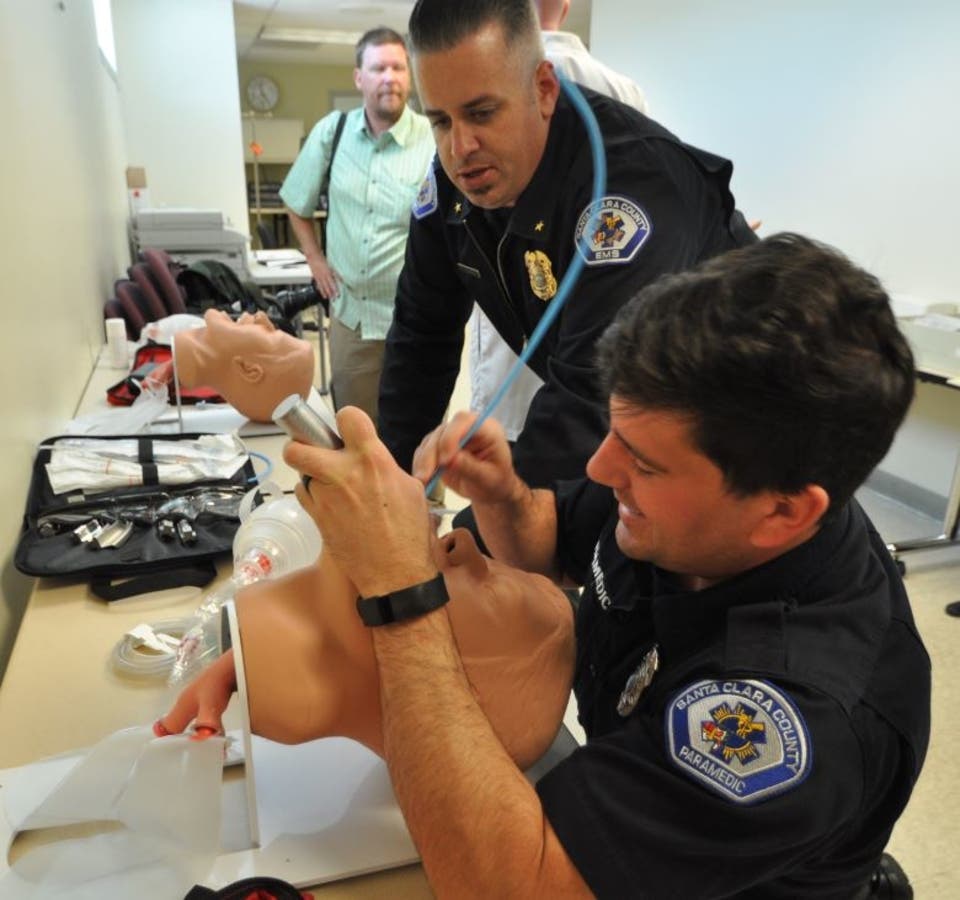


More than three dozen Santa Clara County paramedics and emergency medical techs (EMT’s) spent part of their morning saving the virtual lives of realistic-looking mannequins at Kaiser Permanente Santa Clara’s Emergency Department the other day. These first-responders were practicing intubation skills - a procedure in which a tube is inserted through the mouth down to the trachea, the body’s large airway - under the watchful eyes of emergency department physician Dr. Joshua Markowitz and EMS Duty Chief John Sampson.
“Many victims of traumatic injuries are unresponsive, may have difficulty breathing, or an unstable airway and require a breathing tube,” said Dr. Markowitz, who organized these practice sessions for the county’s paramedics and EMTs. “Fire victims who’ve inhaled smoke may also require an endotracheal tube because the tissue can swell up quickly.”

Of course, breath and oxygen are needed for life, so paramedics arriving on the scene of an accident, fire, or medical emergency where a patient cannot breathe or requires CPR have to move quickly and restore the victim’s breathing.
Find out what's happening in Menlo Park-Athertonfor free with the latest updates from Patch.
“An endotracheal tube is inserted into the larynx, then connected to a ventilator or oxygen tank, to get life-saving oxygen to the patient’s lungs,” said Chief John Sampson. “Paramedics are well-trained in the procedure.”
While intubation saves lives, it’s not a technique used every day by the first responders. Chief Sampson estimated a single ambulance crew may need to intubate a victim two times a year.
Find out what's happening in Menlo Park-Athertonfor free with the latest updates from Patch.
“Intubation is an emergency skill that requires training, and practice,” said Dr. Markowitz. “Kaiser Permanente has these anatomically correct “airway mannequins” that we can use to help the EMS crews practice intubation techniques and freshen skills.”
The mannequins, or SIMs, simulate a patient laying on its back. They have a realistic appearing head with anatomically correct mouth, esophagus and airway, leading to the lungs via the larynx (vocal cords) and through the trachea. The SIM is made of a flexible material that provides the “feel” of a human patient.
On television medical dramas, intubation looks simple, but it’s not.
“Paramedics have to move the tongue out of the way---that’s not easy---- and be careful they’re not damaging the vocal cords or inserting the tube into the esophagus heading to the stomach,” said Duty Chief Sampson.
On training day, the Paramedics used a high-tech video laryngoscope that is being rolled out to many emergency medical service departments and fire departments in the Bay Area. It has a built-in camera and a screen on the handle that lets paramedics actually see where they are placing the breathing tube in the patient’s throat.
Sampson and Dr. Markowitz worked together to set up the “EMS Airway Management Laboratory”. So far, nearly 200 EMS and fire crew members in Santa Clara County have come in to practice the procedure. Some of the first-responders have come back several times to practice.
“It’s really important to have a great working relationship and close collaboration with the Emergency Medical Services,” said Dr. Joel Levis, who is chief of the Kaiser Permanente Santa Clara Emergency Department. “Twenty percent of our patients in the ED are brought in by EMS ambulances. This lab is a way Kaiser Permanente is giving back to the community.”