Business & Tech
Dynamism Will Pull County From Recession
Jon Haveman said the Bay Area has a bright future despite some volatility.


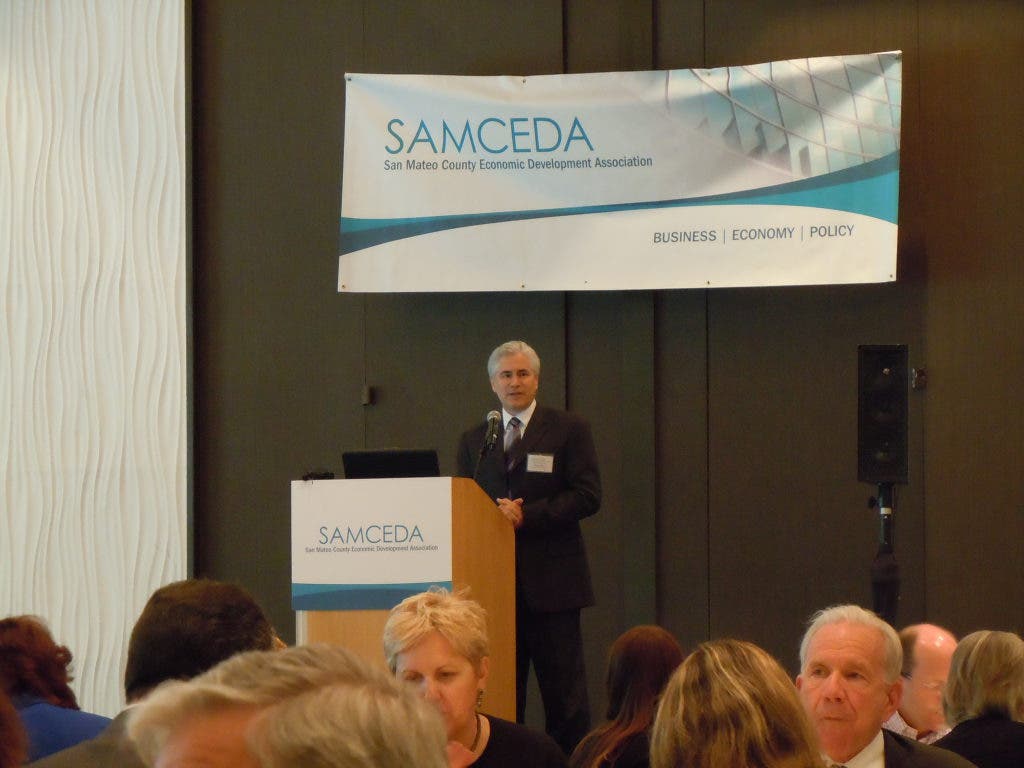
San Mateo County's high job turnover rate makes it one of the most dynamic counties in the nation, and this constant reshaping will ensure San Mateo County’s continued vitality, a leading economist said Wednesday.
Jon Haveman made the statements at the packed in Redwood City, where he presented a sneak preview of the results of a 14-year economic study commissioned by SAMCEDA (San Mateo County Economic Development Association) and the Economic, Vitality, Research and Education Foundation (EVRE) that highlighted various trends in San Mateo County's labor market. They ultimately pointed towards a resuscitation from the recession in the next few years.
Between 1995 and 2009, San Mateo County lost an average of 9.1 percent of its jobs each year, but also gained what would amount to 10 percent of its workforce.
Find out what's happening in Menlo Park-Athertonfor free with the latest updates from Patch.
SAMCEDA president and CEO Rosanne Foust said that the full study’s data, including 2010 statistics, will be released as early as late June.
“This type of long term study has never been done before, and it will help us determine what our next steps are,” she said. “It will benefit businesses, communities and elected officials alike.”
Find out what's happening in Menlo Park-Athertonfor free with the latest updates from Patch.
San Mateo County is an “innovation economy that is cyclical and has high highs and low lows,” Haveman said.
San Mateo County received the second highest number of venture capital dollars as a county in 2010, behind Santa Clara County. More than $1.1 billion dollars were invested in the biotech and software industries last year. Yet only 29 percent of all start-ups actually survive past year five.
Business births and deaths played the biggest role in this employment change: the birth of new businesses were responsible for 50 percent of job creation and business deaths contributed to 60 percent of jobs eliminated. This “job churn” is particularly high in the county, reflecting the dynamic nature of the Bay Area.
“We’re reliant on the private sector to get us out of this recession,” Haveman said. “Jobs at the state and local level are not dependable.”
The largest job churns were in the manufacturing, information, professional, science and technology services sectors.
He added that the notion of job churn was nothing surprising, but this information could enact policy at the state and local level to help reduce some of the churn, in favor of job creation rather than elimination.
Jeff Ira, Redwood City mayor, said that the state needs to place more emphasis on educating the workforce of the next generation.
“The funding cuts at the K-12 and community college level are showing that education is not a priority,” Ira said. “It’s a nightmare for college students.”
He said that universities in states like Nevada are offering in-state tuition rates for California residents. After graduation, these students often stay there because of a lower cost of living.
“We’re going to continue losing some of our best and brightest if we don’t support education more,” Ira said.
Haveman said that there was a wide variety of avenues that local governments could pursue, but it was all dependent on each community’s start-up industry.
“Maybe it’s a labor mismatch, maybe there isn’t a support network,” he suggested. “It all depends.”
But Haveman stressed that the continuing dynamism of San Mateo County would be its lifeline, relying on new and innovative business methods. Rather than relying on old models of business success, businesses in the heart of Silicon Valley would continue to reinvent themselves.
Get more local news delivered straight to your inbox. Sign up for free Patch newsletters and alerts.