Business & Tech
Nealon Park Neighbors Say Cell Antenna Is Unsightly
Three panel antennas may be placed on top of light fixture in park.
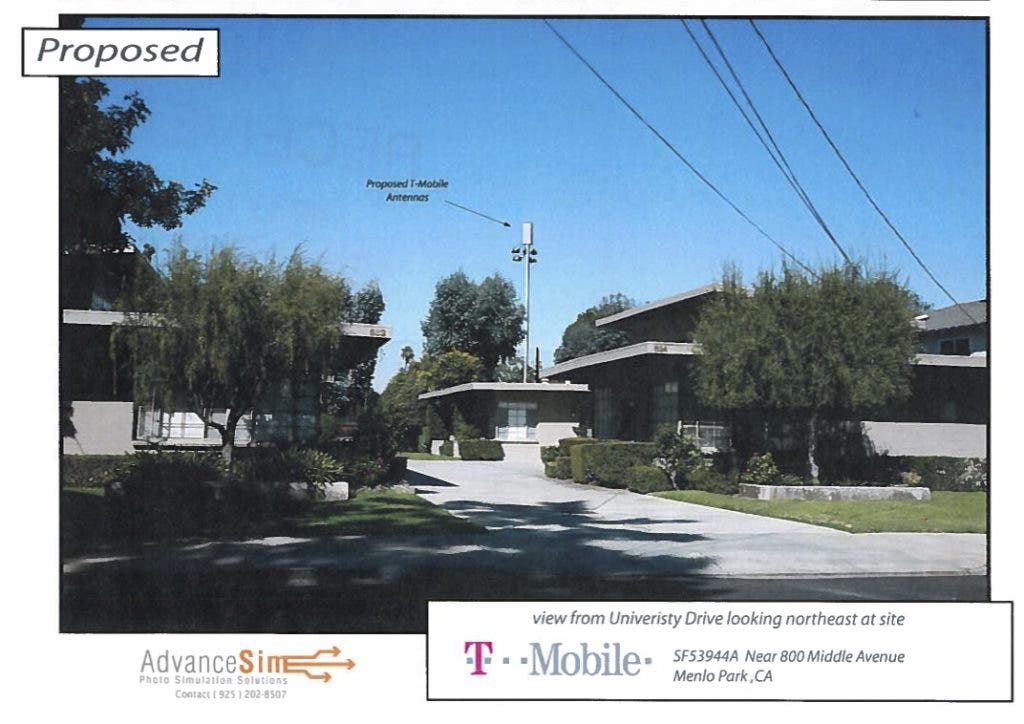


The installation of antennas at has sparked controversy among neighbors about its aesthetic appeal, and the potential danger that radio wave frequency transmissions poses to them.
The panel antennas, proposed by wireless services provider T-Mobile, would be enclosed and mounted to the top of a light fixture at the edge of the baseball diamond.
“There is no doubt in my mind that there are adverse health impacts,” said Andrew Campanelli, a lawyer involved with several cases against cell tower and cell antenna installations.
“The truth is, wireless companies are in the same position tobacco companies were in years ago.”
Find out what's happening in Menlo Park-Athertonfor free with the latest updates from Patch.
The antennas, explained Menlo Park planning technician Kyle Perata, would appear as an extension of the light pole, similar to a cylinder at the top of the pole.
In January, T-Mobile proposed the implementation of six antennas throughout Menlo Park. The first and only antenna to be approved thus far is inside a flagpole at 2400 Sand Hill Road. Other than , Perata said, there are no other T-Mobile applications pending.
Find out what's happening in Menlo Park-Athertonfor free with the latest updates from Patch.
“We have received some correlation relating to concerns about the site,” Perata said. At this point, he said, the complaints received by the planning commission are concerns of aesthetics and the safety of radiofrequency transmissions.
Campanelli, principal lawyer at Campanelli & Associates, said it took him years to believe there were dangers related to cell antennas until he received a study from Princeton University stating a correlation between cell towers and cancer.
“I’m not a scientist, but I listen to scientists and can read expert reports,” he said.
The most troublesome aspect of installing antennas at Nealon Park, Campanelli said, would be the proximity to the
Campanelli said children are the most susceptible to the health effects produced by cell towers and several countries outside the U.S., such as Germany, have set restrictions on the distance between schools and cell towers due to the harm of radiofrequency waves. Campanelli cited a 2004 German study that found living within 400 meters of a cell tower increased the risk of developing cancer by three hundred percent.
An employee at Menlo Atherton Cooperative Nursery School said there were no objections to the proposed installation.
According to the American Cancer Society, there is no evidence that radiofrequency (RF) signals transmitted from antennas are harmful. On the electromagnetic spectrum, the strength of RF waves lies between FM radio waves and microwaves. This means RF waves are significantly lower than radiation known to increase cancer risk such as gamma rays or ultraviolet light.
T-Mobile spokesperson Rod De La Rosa is very much aware of the debate and said he can understand concern, but there is no cause for worry.
“I understand that it’s an emotional issue,” De La Rosa said. “There’s a lot of information out there and a lot of misinformation out there.”
De La Rosa said the RF waves transmitted from the antennas would cause less than many household appliances, for example, a baby monitor.
According to Campanelli, the FCC does not monitor RF emissions.
“We are completely at the mercy of the telecommunications agency,” Campanelli said.
The representative from T-Mobile said T-Mobile’s antennas are typically less than 0.1 percent of the allowable limit for continuous public exposure set by the Federal Communications Commission.
“We are far under the standards we operate in,” De La Rosa said.
The city would benefit from the installation of antennas, De La Rosa said, because we live in an increasingly wireless world.
“We live in a wireless world, people expect their phones where they live, work and play,” he said. “People are making decisions on where they live and conduct business based on their coverage.”
Perata said that because T-Mobile would be required to take out a lease on Nealon Park this would create revenue for the city. The exact amount is unknown.
Residents within a 500 ft radius of the installation site are to be notified when a formal application is received and when public hearings about the installation are scheduled, Perata said.
“The wireless facility will provide residents with improved coverage to better serve the growing need to make calls, browse the internet and send and receive photos and video from their mobile devices,” De La Rosa said. “T-Mobile is happy to provide a robust network with the addition of this proposed wireless facility to our customers in Menlo Park.”
According to Perata, the project is still in review and there are currently no meetings scheduled for public comment or to further discuss the proposed antennas.