Community Corner
No Shaky Ground: New Stanford Hospital Will Withstand Major Quake
The hospital, scheduled for 2017 opening, is being constructed to function through the most severe tremors -- even an 8.0.


The odds of a major earthquake occurring in the Bay Area are high. We live close to the San Andreas Fault, one of the world’s most active faults, and the Hayward Fault, which has been called a “tectonic time bomb.”
Numerous smaller faults run the length of the Peninsula. The U.S. Geological Survey predicts a 63 percent probability of a 6.7 earthquake within the next 20 years for the Bay Area — similar in magnitude to the quakes that rocked Chile and Japan in March.
But the new Stanford Hospital is being constructed to withstand the most severe tremors. When completed, in 2017, the building will be one of the most seismically safe hospitals in the country, able to continue operations after an 8.0, or “great,” earthquake.
Find out what's happening in Menlo Park-Athertonfor free with the latest updates from Patch.
Buffer system
The new hospital will be placed on 206 base isolators, enormous parallel steel plates with a sort of ball bearing suspension system between them, providing a buffer between the building and the moving ground. Each plate can move as much as three feet in any direction, allowing the building to shift up to six feet during seismic activity. Reducing horizontal movement during an earthquake minimizes the strain on a building’s vertical load-bearing structures. Because the base of the hospital is able to move at the same rate as the shaking ground, the building itself will barely shift.
Find out what's happening in Menlo Park-Athertonfor free with the latest updates from Patch.
“During an earthquake, the earth jerks one way and then another — as if you are standing on a carpet that is being pulled back and forth,” said Bert Hurlbut, vice president of construction for the new Stanford Hospital. “But we’re talking about a tremendous force of horizontal acceleration. Since it’s impossible to prevent an earthquake, we’re building structures that keep people safe by dampening the energy and ensuring structural integrity.
Following Southern California’s devastating Northridge earthquake in 1994, the California State Legislature mandated strict seismic safety regulations for facilities that provide emergency or surgical services.
Lucile Packard Children’s Hospital Stanford is incorporating a different but equally efficient system for seismic safety into its expansion project, which will open to patients in 2017.
Safety measures
Because Stanford is the only designated level-1 trauma center on the Peninsula, it is imperative for the hospital to be up and running in order to receive the brunt of casualties in the event of an emergency. The hospital is recognized by the American College of Surgeons as being capable of providing total care for every aspect of injury — from prevention through rehabilitation — for both adults and children.
Two sizes of base isolators have been custom-made for the hospital: 154 “large” ones each weighing 5,400 pounds (about 2.5 tons) and 52 super-sized ones each weighing 8,900 pounds (4.5 tons). Two years in the making, the steel plates were cast in Texas and manufactured by Earthquake Protection Systems, a design firm in Vallejo.
Hoisted in place by massive cranes, many of the base isolators already have been positioned 30 feet below ground level on supports that have been dug 100 feet into the earth. Their design is so precise that there is only 1/32 of an inch of space around each bolt that holds them in place. The design also allows enough leeway for the building to be jacked up if any of the isolators need to be checked or replaced.
Construction challenges
“The base isolators are only part of the solution,” Hurlbut said. “The building and all its components also have to be able to move and not touch anything.”
That means the hospital’s concrete and steel foundation has to be constructed with a cushion of air around it, and any structural elements that contact the ground have to be flexible as well. Each doorway, staircase, and ambulance bay is designed like a drawbridge so that it can slide back and forth, and all pipes and utility connections — medical gas, diesel, water, electricity, etc.—have to be able to move in any direction as well. The foundation walls, 35 feet deep, are shored up with 50-foot steel beams and 70-foot tieback rods placed at an angle to create a kind of bucket in which to position the building.
The pedestrian bridge that will connect the new Stanford Hospital with the existing hospital facility has been a particular challenge, said Hurlbut. The solution was to create pin joints at each end so that it could move almost 5 feet in any direction. “It’s sort of like a jet walkway connecting you from the gate to your plane,” he said.
To facilitate all the ongoing problem-solving needs for such a complex project — and to stay on schedule — the architects, engineers, general contractor and subcontractors work together in an open compound adjacent to the construction site.
“Construction, design and operations all go hand in hand,” Hurlbut said. “We’ve made the process fully integrated.”
Learn more about the Stanford University Medical Center Renewal Project at sumcrenewal.org.
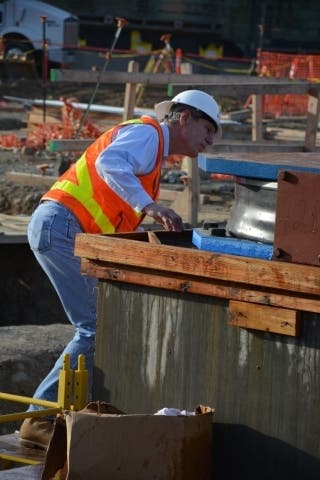
Photo: Bert Hurlbut, vice president of construction for the new Stanford Hospital, at the site of the new hospital, which is scheduled for completion in 2017. Credit: Lisa Curet
Get more local news delivered straight to your inbox. Sign up for free Patch newsletters and alerts.