Neighbor News
La Paz Intermediate Students Study Drought Conditions in Closed-Ecosystem
Innovation in Education grant used for probe-ware to collect and analyze real-time data


Mint or Basil? Which one would grow better using desalinated water?
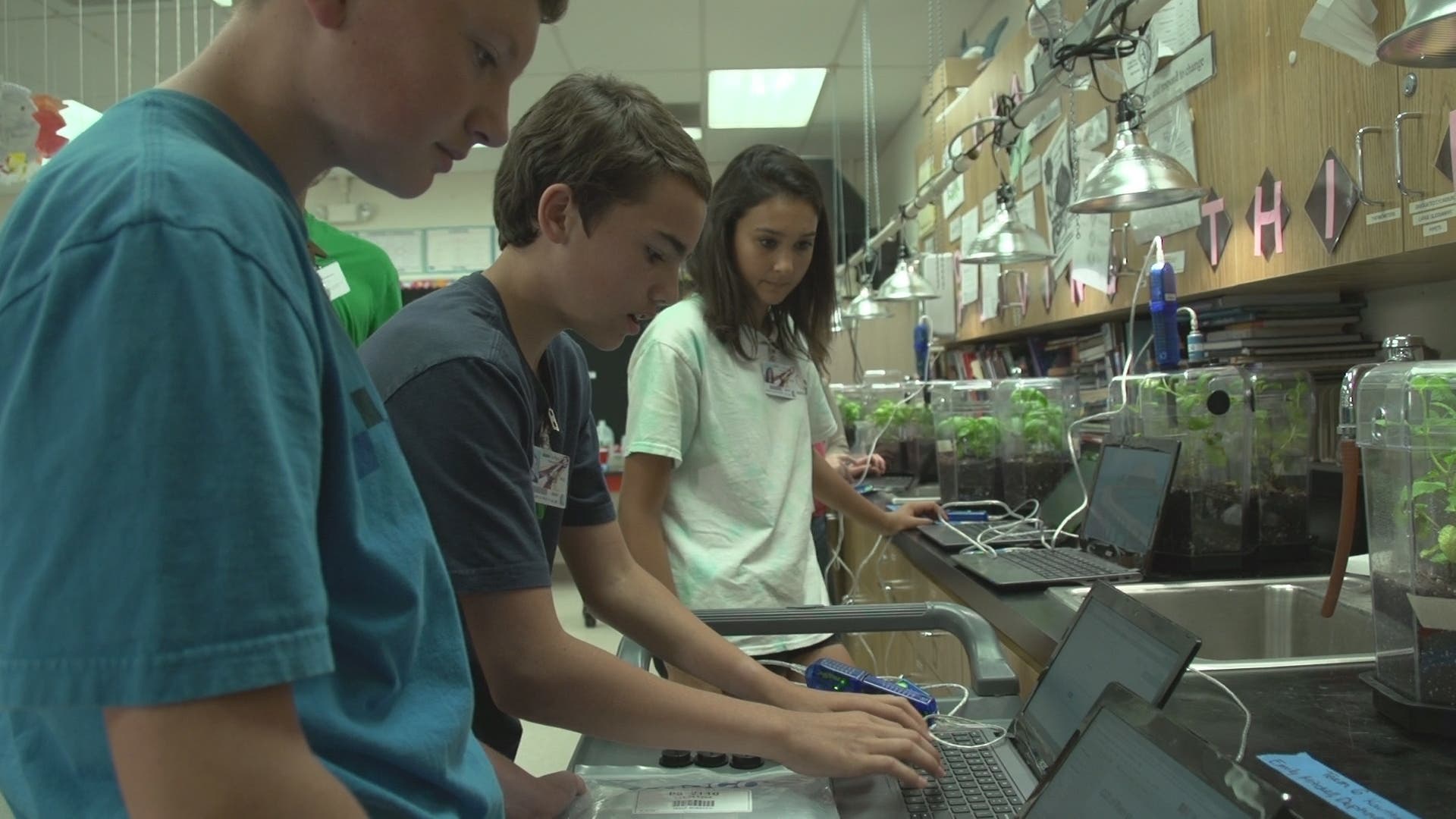
In her integrated science class that combines biology, geology and ecology, Jan Ernsbarger, a science teacher of 19 years, worked with 35 seventh grade students at La Paz Intermediate School in Mission Viejo to find the answer to that question and many more.
“Since California is in a drought, and we’re building desalinization plants, we were trying to see if we can use desalinated water to grow crops,” said student Ethan Gray.
Find out what's happening in Mission Viejofor free with the latest updates from Patch.
The activity is centered on an open-ended challenge in which students are given the task of designing, constructing and implementing a solution to an ecosystem problem.
The challenge is based on fundamental science concepts of photosynthesis, cellular respiration and water quality and simulates a real-world problem of limited resources and conservation of water according to Ernsbarger.
Find out what's happening in Mission Viejofor free with the latest updates from Patch.
To conduct the closed-ecosystem experiment, the class needed probe-ware to collect and analyze real-time data. Through Cox’s Innovation in Education grant, the class received a grant to invest in sensors and equipment ranging from carbon dioxide gas sensors to water quality colorimeter.
“We have around 50 different sensors,” said student Lauren Shulman. “Some measure carbon dioxide, some measure oxygen, and they each measure a different factor that we need to control.”
“We’re testing the rate at which photosynthesis occurs,” said student Wyatt Cottriel. “We’re testing temperature, soil acidity, and a lot of other things.”
The class showcased their innovation while designing each experiment. To simulate real-world conditions, students researched several variables including lighting and water salinity.
“They had to imitate the ocean,” said Ernsbarger.
Ernsbarger couldn’t get to the class lab early enough in the mornings or lunch because the students wanted to be there. On one Friday night, they spent the entire evening learning how to use the probes.
“These students did all of the calculations and engineered the set up before putting it together, and once we put it together, it was pretty cool to see everything that they calculated was right, and it was spot on.”
At the end of the term, the class confirmed their original hypothesis - plants do not grow to full capacity when using desalinated water.
“I think it’s important to do this type of work because it broadens a student’s sense of the real world and what you do as a scientist,” said student Julia Bissonette.
“They know what it means to be technology literate,” said Ernsbarger. “It’s going to take them to the next level. In their future, 85 percent of all jobs will be STEM-related.”
To learn more about this program, visit Cox Orange County Connection.
Cox has re-launched the Innovation in Education grant this year in hopes of funding projects such as these.
The deadline to apply for an Innovation in Education grant is Friday, Oct. 9, 2015.