Community Corner
Brack Groundwater Pumping In SOC: Still Alive and "Well," Thank You!
"Done There, Been That." Why Do OC Media Continue To Ignore SOC's Groundwater Extraction And Surface Diversion Reclamation Strategies?


The Hunt For Brackish Groundwater Supplies: Orange County Media Should Tell Our Story
It frustrates and boggles the mind that here in South Orange County (SOC), when it comes to aggressive pursuit of brackish groundwater pumping, our efforts seem unappreciated let alone noticed by Main Stream Media (MSM).
"The constant search for drinkable water in arid Southern California soon could tap into a new resource – the brackish ocean water that seeps into the southwestern edge of Orange County’s huge natural aquifer." [1]
Find out what's happening in Mission Viejofor free with the latest updates from Patch.
The "Quasi, Semi, Pseudo TED Talk" (soooo yesterday) in the OC Register I provided a link to is a good launch point.
Maybe a supply advocate like myself can help the general public to better understand not only the educational or awareness gap, but why enviro-preservation and eco-protectionists in SOC are perplexed.
Find out what's happening in Mission Viejofor free with the latest updates from Patch.
One polaroid, one snap shot and the narrow bandwidth (northern coastal) side of the water supply tale doesn't constitute the whole industry picture in our region. Not even close.
And as for that "search....for new resources?" Here in the south, our individual districts and one of our JPA's have been pursuing the pumping and reclamation for irrigation (Title 22) supplies going on 50+ years.
Groundwater pumping of "brack," aka brackish subterranean flows, isn't "new" to us, and it's been a challenge we've met, that began 5+ decades ago in SOC.
Brack btw, by definition, is usually in the 3-10,000 mg/liter range. Not all of it is coastal either.
As an enviro-protection leader, the NGO I co-founded (CLEAN WATER NOW) presently entering its 27th year (Established in 1998), I quickly figured out when dealing with MSM that those interviewing me or writing articles were usually reporters not investigative journalists.
Specific to our locale in SOC, like the lower reach of the Aliso Creek Watershed (ACW), there's (a) little groundwater storage capacity and (b) high concentrations of TDS (Totally Dissolved Solids) in the water, i.e., dissolved organic and inorganic substances such as salts, metals, cations and anions which don't meet cost benefit metrics, weren't worth pursuing.
MNWD honorably and in good faith led the hunt in the ACW, drilled a few wells in/around the main stem (permitted via application and pre-approval by OC Health Care Agency), sadly the results discouraging.
Unfortunately it was determined to be too expensive to reduce or remove for re-purposing, and with the progression of Direct and Indirect Potable Reuse (DPR & IPR) standards, hence post-treatment costs didn't pencil out for MNWD.
Instead, MNWD's pursuing diversions of excess surface flows, so-called nuisance water, aka "urban runoff drool."
SMWD has found its own diversion logistics course, a somewhat unusual gamut in the mid to upper reaches of streams within its service area but with similar goals and objectives: Greater autonomy from foreign developed (imported) water.
In the San Juan Creek Watershed (SJCW), groundwater in several sub-sheds are similar to Aliso regarding high TDS, with iron and manganese concentrations major challenges.
The energy costs can be daunting, but providers like Moulton Niguel (MNWD) and to the greater extent Santa Margarita Water District (SMWD), have excellent track records as they seek more independence, increase local supply portfolios and become less reliant on No Cal and Colorado River supplies.
Background
I've been tempted to write a column myself, "The Death Of Investigative Journalism In The OC" for quite some time. One of my petty gripes is that an important element, a pedigreed breed of MSM investigative journalism is dying.
To survive, MSM must be more focused on income/revenue and not alienate anyone. Hence the general public can and often does remain in the dark, uninformed.
Getting hits and selling ad space is MSM's #1 priority (not necessarily veracity), mostly due to the increasing pressures of highly competitive markets.
Slothful, a lot of these media folks haven't a clue, no doubt ask really dumb bunny questions, I know that I've fielded quite a few.
Many fail to perform due diligence (their homework both before and after interviews).
So let's peer review the OCR column, now that I've given you dear reader my "media metrics" regarding how an enviro-influencer and high profile, water resource advocate looks at accurate, fair, equitable and (hopefully) enlightening journalism, to whit:
"OC Agencies Set To Launch Hunt For New Source Of Tap Water"
"Brackish ocean water that seeps into OC's underground aquifer could become a public resource. A study on how much water this could produce, and at what cost, begins in August." [1]
Where has our MSM been the past 30 years? Pumping brackish groundwater is NOT a "new source," these resilience and reliability facilities have been in place, up and running going back decades.
"New" means new, k? All OC water reclamation and reuse agencies have pursued such strategies, and since around 2000 been waiting for the State Drinking Water Division and State Water Resources Control Board to issue formal updates for requirements.guidelines.
In essence, after careful peer review by science panels and State staff, codified parameters were issued regarding implementation and integration of both IPR and DPR into future strategic planning visions, dynamics and funding.
Here in SOC, Santa Margarita Water District, the largest district in SOC, 2nd largest in the OC period, is the undeniable leader when it comes to both storage and being poised, ready for those State updates---which finally crossed the finish line, occurred late last year. [2]
The Upper Oso Creek Reservoir (1.3 billion gallon capacity) which some refer to as a lake, has been up near the 241 Toll Road since 1979. Built by SMWD (I think on donated land?), it anticipated the eventual emergence of both IPR and DPR. [3]
Meanwhile addressing Title 22 (landscape/litigation) demands, thus reducing Title 17 (drinking water) usage, a form of conservation. I think MNWD has a piece of that reservoir's action.
SMWD and Ranch Mission Viejo Corp took it to another level at the more recently built Trampas Reservoir (1.6 billion gallon capacity) off the Ortega Highway near Cristianitos.
SMWD's engineers and savvy hydrogeologists, now having the State's guidelines in hand, can develop assertive projects for the Board of Director's consideration.
These are multi-million dollar investments, so fiduciary oversight, the "long game" is important to get individual projects into the "red zone" (perched or poised) and hopefully across the physically completed "goal lines" (installation and production).
I'd refer readers (especially those in Central and North OC), who wish a wider education, to several of my previous columns, where I've tried as a leader of a community Based Organization Organization (CBO) to raise the conversation level.
Here in the "Deep South," we have neither the subterranean stream, hydrogeological conditions and features as the rest of the County; nor residual, unspoken for open space to avail ourselves of the restrictions we face. In fact, we have no true, isolated aquifers, our groundwater is considered an extension of the surface flow, "hyper-regulated" as such by the State.
We're subsurface, groundwater storage "poor." Our open space has already been dedicated, carved out, preserved and protected as legally binding mitigations for development in perpetuity.
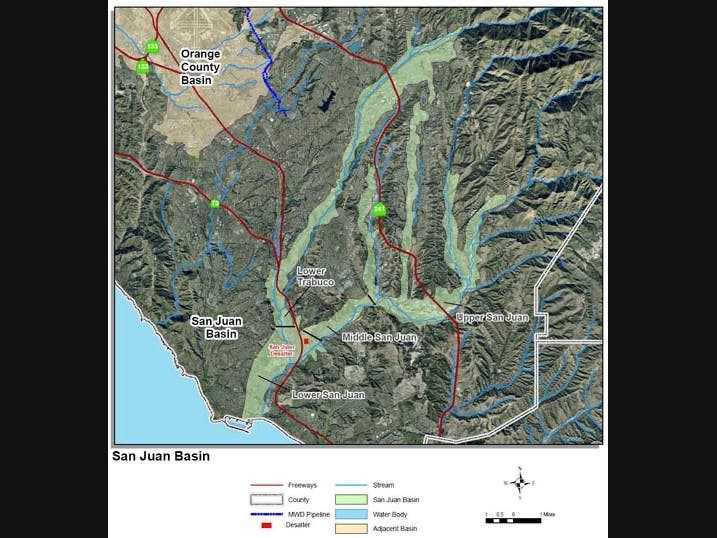
The dominant SJCW groundwater storage is limited to its lower reaches, basically the City of San Juan Capistrano down to Stonehill Drive (see map in slide show, meta data in the 2016 report linkage below).
The State prescriptions to keep our area compliant are daunting, the existing Basin Plan Objectives (BPO) issued and monitored for strict adherence being an example of short-leash compliance by the San Diego Regional Water Quality Control Board (SDRWQCB).
BPOs include Water Quality Objectives (WQOs), and the SDRWQCB staff is vigilant, constantly looking over our virtual shoulders for any failures to comply with those metrics. The public undoubtably doesn't know it, but the incessant reports eat up gobs of staff and vendor time, compliance has expenses ratepayers probably aren't aware exist.
Any ground or surface water reduction that jeopardizes or threatens native aquatic and riparian species habitat is forbidden under numerous permits.
Any groundwater or surface water reduction that incites, via seawater intrusion (high chloride concentrations), upstream migration of high concentrations of TDS, is a fineable violation of certified Salt and Nutrient Management Plans (SNMP).
An integral piece of BPOs, our SOC Wastewater Authority (SOCWA) staff are the dutiful monitors, analysts and SNMP compliance strategists.
Seawater intrusion jeopardizes native aquatic and riparian species habitat, which is taboo. BPOs are considered "anti-degradation, beneficial use" documents, protecting the chemical, biological and physical characteristics on a body-by-body basis.
Surface and groundwater, plus aquatic and riparian biota in residence (or in their migrational corridors) must be protected or water rights holders risk enforcement actions. Worse, if unresponsive, even a rescinding, a mandated withdrawal of those rights.
As a regulatory overlay, the federally mandated National Pollution Discharge Elimination System (NPDES), often referred to as the MS4 permitting process, holds our County and municipalities accountable for both acute and chronic impairment impacts.
Believe me, people in my profession know how critical it is to keep fresh groundwater volumes robust, providing what we call a "viable intrusion barrier."
Once they're reduced at our coast, seawater begins its inevitable march upstream---which then raises the watercourse salinity catastrophically, a type of eco-system collapse.
It can affect, subterranean, adjacent land in the flood plain via osmosis if the porosity, the composition of the soil in these dispersing flood plains is amenable, relatively porous. Deep rooted trees are especially prone as most aren't native, tolerant of the high salinity.
That's why God made hydrogeologists, to help the industry get a better grip on planning.
Alarming seawater intrusion has happened in lower San Juan Creek, where South Coast Water District (SCWD) was found to have coaxed seawater several miles upstream for over a decade before a State investigation by their staff engineers dropped the enforcement hammer.
Over-drafting usually gets the State's immediate, unwanted attention. Irony is that the SJBA investigation was a result of litigation filed by one of its own members, SCWD---and so took quite some time due to possible sanctions, fines and negotiated remedies.
When sorted out, ironically, SCWD was the culprit in their own self-inflicted complaint. Kinda like "We have met the enemy and THEY is US!"
Yet they have not these past few years since "caught" apologized or reimbursed those they litigated (SMWD, MNWD & the City of San Juan Capistrano).
Reducing (or God forbid) eradicating the intrusion barrier that fresh water incursions, replenishment from upstream sources represent is worrisome, requires a lot of staff and outsourced vendor time. And legal counseling.
Monitoring and reporting by pumpers with water rights are constant tasks, meant to keep these groundwater sources robust, required not voluntary. Unfortunately that critical sea water intrusion barrier topic, on my 26+ year watch, hasn't been broached or sufficiently addressed in MSM outlets.
SMWD does their own monitoring in and above San Juan Capistrano, in collaboration with the inland cities, the County and Rancho Mission Viejo.
In the lowest reach of San Juan Creek, our San Juan Basin Authority (SJBA---Founded In 1971) carefully manages 26 square miles of the total watershed's perched groundwater resources, and works in collaboration with the SOC Wastewater Authority (SOCWA).
These are the 2 JPAs that try to keep us on the straight and narrow, monitor, many instances draft reports for the SDRWQCB or Division of Water Rights. Ours employ evidence-based scientists who are the "early warning systems" for us. [4]
The State allows modest drafting of groundwater above Stonehill Drive near the San Juan Capo, Dana Point line. The SMWD water rights permit allows pumping of up to around 8,000 acre feet/year above there, a pittance, a very small % of the agency's needs in their service area.
South Coast Water District (SCWD) has a separate permit in the lower reach (from about Stonehill south) which allows them to draft around 1,300 acre feet/year.
During long drought cycles, both district's often reduce/modulate or even temporarily shut pumping down altogether to adhere to the San Juan Hydrologic Unit's BPOs. The historical impacts and inheritances from the ocean having covered the land many miles inland further confound hydrogeologists.
This "inland sea" dynamic left vestiges, high concentrations of TDS, iron, manganese, selenium and even arsenic, downstream inflow/migration from sub-sheds like the Arroyo Trabuco, Oso and Horno Creeks respectively can be formidable when in drought cycles.
During El Niños, in peak rain events, inland constituents flush downstream in abundance as contaminants are conveyed down-gradient.
Therefore, the lower reach of SJC isn't a 100% reliable, year round source, and putting the SJ Basin under stress by over-pumping becomes a crap shoot. "Red lining," i.e., extracting 50% of the Basin's total capacity (right up to water right's limits) is akin to playing chicken with the State. [5]
Sea water chloride concentration levels offshore of Doheny State Beach are around 33--36,000 mg/liter btw. Hence TDS is in the 1/10th to 1/4th range of open ocean stats. Ensuring intrusion "creepage" doesn't happen, once again hasn't been fully explained or covered by MSM in the greater OC, yet remains a tough balancing act for utilities.
Higher TDS concentrations==Higher reclamation costs, on top of potential State Water Rights staff curtailing pumping or enforcement, liability action options (Assessed Civil Liabilities, aka ACLs). Which in a worst case scenario could rescind or significantly diminish long-held water rights allocations.
"Brack," aka brackish can easily occur miles upstream, albeit ephemerally. This was basis of the (eventually embarrassing) false claim made by SCWD that was debunked by the State investigators: SCWD alleged that its other partners had made intrusion not periodic but systemic.
There's actually two tales: One is our aquifer and groundwater "rich cousins" in Central and Northern OC. We're apparently unimportant.
The other the narrative is about SOC, as we face the crucible of population growth, infill, revitalization, redevelopment, rehabbing and modernizing antiquated water and wastewater systems in our 3 oldest cities (San Clemente, San Juan Capistrano and Laguna Beach).
Our "Conservation As A Way Of Life" challenges to meet State objectives and goals? Reliable, sustainable and resilient supply augmentation strategies like aggressive pursuit of surplus surface flows and groundwater extractions here in South OC?
They look quite different, are unique and thus demand a different approach. Another instance of MSM being gullible, drinking then distributing Pollyanna kool-aid is the Doheny Ocean Desalination Project.
In the 2016 SJBA Optimization link I've provided below, [5], read for yourself: "DoHoHo" as we jokingly call it, was to be online, projected and pitched by SJBA/SOCWA member SCWD to be in full production mode by 2026. It's languishing.
They haven't even secured a definitive contractual agreement with Cali State Parks or gotten a critical permit from the USACE allowing them to proceed to construction....so don't hold your breath.
It could easily be 2031 or later before that train pulls into the supply station, 5 years late, over budget, costs having soared about 50%, from $100 to the $150 million range since SCWD assumed sole ownership. Which translates into much higher rates for SCWD customers and other agencies purchasing it.
Those 2 old industry metrics and their wisdom apply: Supply forages must be technologically possible and economically feasible. What looked doable when SCWD took over sole control 10 years or so ago has been passed by the specter, the advent and embracing of IPR and DPR by MNWD and SMWD.
CONCLUSION
In the meantime, I'd point out that though seemingly off MSM's radar screen (with 1/3 of the County's population), hey, in these parts the 2 largest Districts are not "resource rednecks."
Hello, media? We exist and we're finding our special way forward under extremely limited logistical circumstances compared to our northerly coastal neighbors.
We have a great a level of creative, innovative and sophisticated staff, outstanding analysts and vendors working with forward thinking district directors who are (at minimum) on par with Mesa and Orange County Water District.
Ours are meeting, and confronting head on, our unique regional challenges. Raise your hand and tell me how many times you've read that in MSM, if at all?
Drinking and irrigation water, wastewater reuse and urban runoff reclamation leaders like the aforementioned giants of innovation SMWD and MNWD? Together, they're helping our region achieve our goals and objectives regarding greater independence and self-sufficiency, they're not slouches.
Meanwhile, warning to MSM: Because you're under-serving SOC regarding getting the word out?
The virtual lashings will continue until discipline improves!
[3] https://voiceofoc.org/2021/08/butow-water-storage-in-south-orange-county-a-tale-of-two-counties/
[4] https://www.mnwd.com/wp-content/uploads/2014/12/Handouts91415.pdf