Community Corner
How to Landmark Your Home
A step-by-step process to guide you on the way to acquiring landmark status for your vintage home.
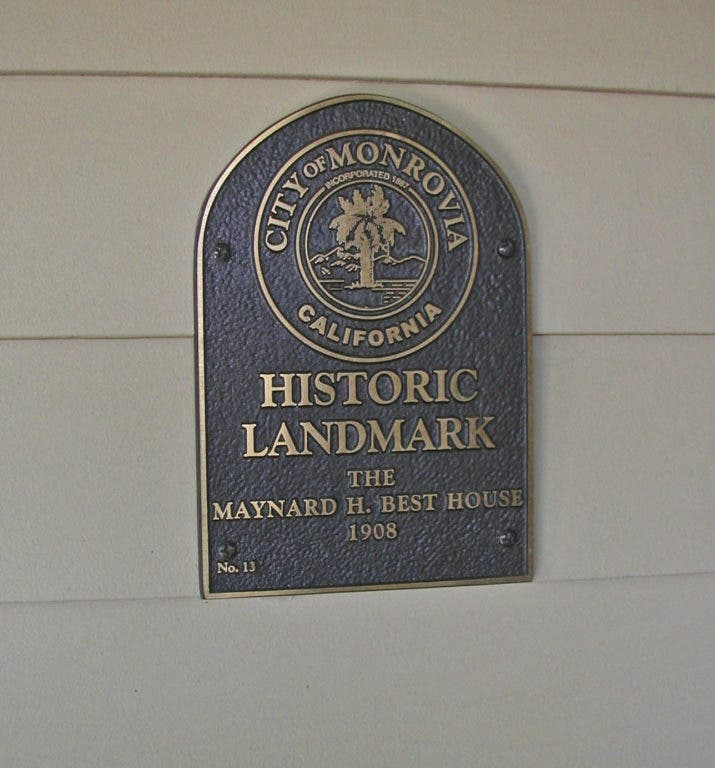
In the second week after Monrovia Patch launched, I presented the pros and cons of landmarking a vintage home. Now it is time to provide some step-by-step guidance for those who would like to achieve that designation for their home.
A few words of caution before we begin: even though your vintage home may be pre-1930 and contain lots of charm and character, it may not qualify for landmark status. We all love our homes but, unfortunately, loving your home is not a landmarkable criterion (by the way, there is no year requirement for an historic landmark. The last home to be landmarked in Monrovia was built in 1949 and is a ranch style house).
The pamphlet for landmark designation published by the city lists seven criteria for eligibility, and a potential landmark must meet at least one (meeting more than one improves your chances but does not guarantee success). The seven criteria are given here in shortened form:
Find out what's happening in Monroviafor free with the latest updates from Patch.
- Home is identified with significant persons or events.
- Is representative of notable builder, designer, or architect.
- Contributes to the significance of an historic area.
- Embodies one or more distinctive characteristics.
- Has location/characteristics making it a familiar feature of an area.
- Incorporates elements to help preserve/protect an area of historic interest.
- It may yield important prehistory/history information.
Ili Lobaco, who works in the building department at city hall, is the go-to person if you need more information about landmarking your home (and, for that matter, obtaining a Mills Act contract). A frank discussion with her about the chances that your home may be landmarked may save you time and money, and she can be very helpful. The current fee to apply for a historic landmark designation is $275, and it is non-refundable once the application has been submitted.
The application form requires some basic information about your home, and it is your responsibility to provide it. Assessor parcel number, architectural style, and architect’s name are but a few of the items you must supply on the form. In addition, you will need to research the home’s history, providing a list of occupants and alterations, if any, and a description of the exterior features and housing style. Be sure to provide a list of the sources used to obtain any of the information!
Find out what's happening in Monroviafor free with the latest updates from Patch.
The trickiest part may be actually finding the required information. Here are some suggestions:
- Tax records. These are located in the basement of city hall (check with the city clerk–you will need permission to access the records). These can help you find a trail of ownership of your house, but these records only encompass the years 1888 to 1916.
- City directories. They are located in the Heritage Room of the Monrovia Library. This is another source for finding past owners.
- Building permit records. These can be found in the building department at city hall. Use them to find when your house was built and the dates that alterations and major changes were made to the house.
- Census records. Look online for these. An excellent source of information is ancestry.com but this requires a monthly fee for access. However, a free, 14-day trial period is offered. If you know someone who already has a subscription, they might be willing to help.
- Try Googling the owner’s name. This will sometimes yield information.
- Once you have an owner’s name and year of residence, use the newspaper microfiche records in the Monrovia Library to get more information.
- The L. A. County tax assessor’s office in Norwalk is another source of ownership records.
The Monrovia Historic Preservation Group may be able to assist you in your search. Go to their website, www.mohpg.org, and use the Contact Us feature to get in touch with them.
A special thanks to MOHPG historian and researcher Pam Barkas for her suggestions on how to research information needed in the application.