Community Corner
Recovering and Preserving the Roots of Monrovia’s Black Community
Monrovia's Historical Museum celebrated Black History Month on Sunday.
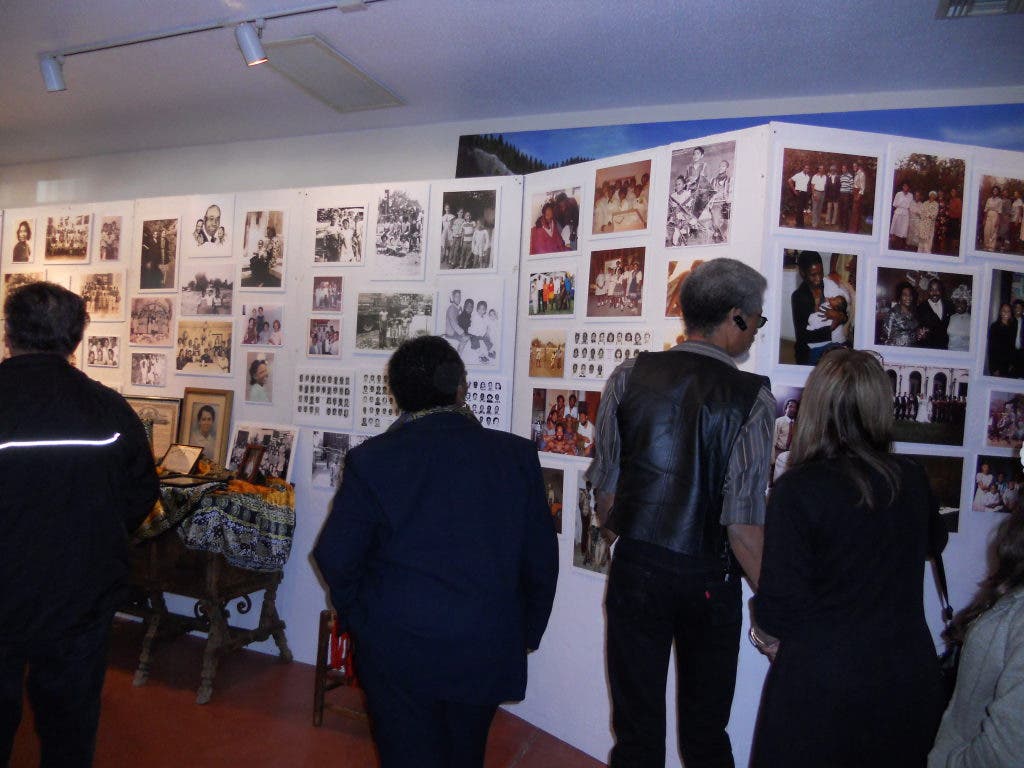


The hosted its annual Black History Month event Sunday where attendees reminisced in front of photographs and browsed the art booths focusing on the rich history of the city's black community.
The day’s featured exhibits, which included historical pictures of Monrovia’s black community and an exhibit on Monrovia resident Le Roy "Buster" Criss, a Tuskegee Airman in World War II, ensured that an important part of Monrovia history would not be forgotten.
The event was co-sponsored by the Monrovia Duarte Black Alumni Association.
Find out what's happening in Monroviafor free with the latest updates from Patch.
John Parker, an artist whose work was on display at the event, was one of those who contributed pictures of his family, including a photograph of Hazel Parker, his mother.
A resident of Monrovia for 59 years, Parker said that although his mother was originally from Kansas and his father, Julius Parker, was from Oklahoma, both lived in Monrovia for most of their lives, and his father graduated from high school here.
Find out what's happening in Monroviafor free with the latest updates from Patch.
"It’s good for everybody, not just for black people to come and see it. It’s good for the young people," he said.
Curator Jimmy O’Balles said that being a part of this month’s exhibit was also important to him as a Latino. Roughly prior to the 1950s, blacks and Latinos lived in communities that were segregated from whites. In light of some modern problems, which have included violent encounters between black and Latino gangs, one of the subtle points he and other community members are trying to make is to point out that the communities have a common shared history.
"Hopefully there’s something positive that comes out of it," he said.
Local historian said that O’Balles contacted numerous local community members to gather memorabilia to add to the exhibit.
"It’s good to combine the black history event with a recognition of early Monrovia black families," Baker said.
Mark Still, a curator at the museum, also said that it was a good time to recognize the contributions of everyone in the community.
"The famous people in Monrovia like the Monroes were just the beginning," Still said. "It’s time to celebrate all the people that made Monrovia what it is."
In addition to this year’s exhibit on the Gullah community of the South, the museum hopes to host members of the Gullah community for next year’s festivities, Still said.
"I think from a cultural standpoint it’s to show our children their culture. It’s to show them themselves," said Samella Sibley of Anna H. Jones chapter of the National Association of Colored Women’s Clubs and Youth Affiliates.
"This is a way to bring community together," Sibley added.
Sunday's event included musical accompaniment provided by the local band Sea Breeze.
Tim Garcia, one of the members of Sea Breeze, said the band likes to play a combination of well known standards mixed with lesser known, older blues and bossanova.
"It’s like a lost art to us," he said. "It’s kind of a forgotten language."
Ruhiyyih Yuille of Foundation 44, an academic counseling service, said that the day was meaningful to her because hearing everyone’s stories helps her know "what it means to be a Monrovian."
Ralph Walker of KGEM was also covering the event for the Monrovia station and served as the master of ceremonies.
"What began as Negro History week in 1926 has blossomed into a month long celebration," Walker said. "The greatness of people is when you share the power. Because when you don’t share the power things fall down."
, Sibley’s fellow club member and member of the NAACP, acknowledged the contributions of Issac Epperson, former president of the Monrovia NAACP from 1933-1965.
"We’re taking our hats off to Mr. Issac Epperson and to his seeds everywhere," she said.
According to Betty Thomas of the Monrovia Duarte Black Alumni Association, class of 1960, that chapter of the NAACP existed here because "Monrovia had a need."
Thomas, who is both Issac Epperson’s and Julian Fisher’s granddaughter, said that she remembers when segregation was practiced in many of Monrovia’s restaurants, stores, movie houses and even the schools. There were few children of color in the early 1900s so schools were integrated then, Thomas said. But as the population grew, black and Latino children were segregated from white children.
"It wasn’t separate but equal," she said.
Thomas' mother graduated from in 1941, but as a black woman she was unable to find work in Monrovia unless she became a domestic worker.
"Most of the women had more work than what they could do," she said. "Their wages were low but they knew how to save."
Thomas said that people of color lived in the area between the train tracks, which were by Duarte road, and the red car tracks, on Olive.
"But it was a beautiful, thriving community," she said.
She spoke of homes with gardens and some with livestock. Often, people had large families, and neighbors would help each other out with babysitting. It was a lower middle class community, she said, but many had steady work as janitors and domestic workers. Blacks also had their own businesses, including beauticians, cleaners, and restaurants.
"The redevelopment of Huntington took a lot of our landmarks," she said.
Thomas’s grandfather, Epperson, was instrumental in leading the NAACP when they organized boycotts of department stores with discriminatory practices. She said she remembered some of the first changes that began to occur in the 1950s and 60s. These included instances when the school district hired a black clerk, the first blacks were hired by Penny’s department store, and a young black woman was hired as a bank teller.
Of Epperson, who was also a deacon and trustee at the , Thomas said "he was a very outspoken, spiritual, intelligent man."
"He made it plain that it was going to take some hard work," she said. "He always told me I had to try harder. That was because I’m a woman of color. But that was good."
In spite of growing up in an era where prejudicial attitudes and practices were all too prevalent in Monrovia, Thomas said she has many fond memories, especially as a result of her strong family ties.
"I just was loved. And you felt that love," she said.
"This was a great place to live," she added. "I thoroughly enjoyed it."