Arts & Entertainment
Tai Chi Instructor Brings New Perspective On Martial Arts to Monrovia
Laura Gloster teaches tai chi to Monrovia residents and throughout the San Gabriel Valley.
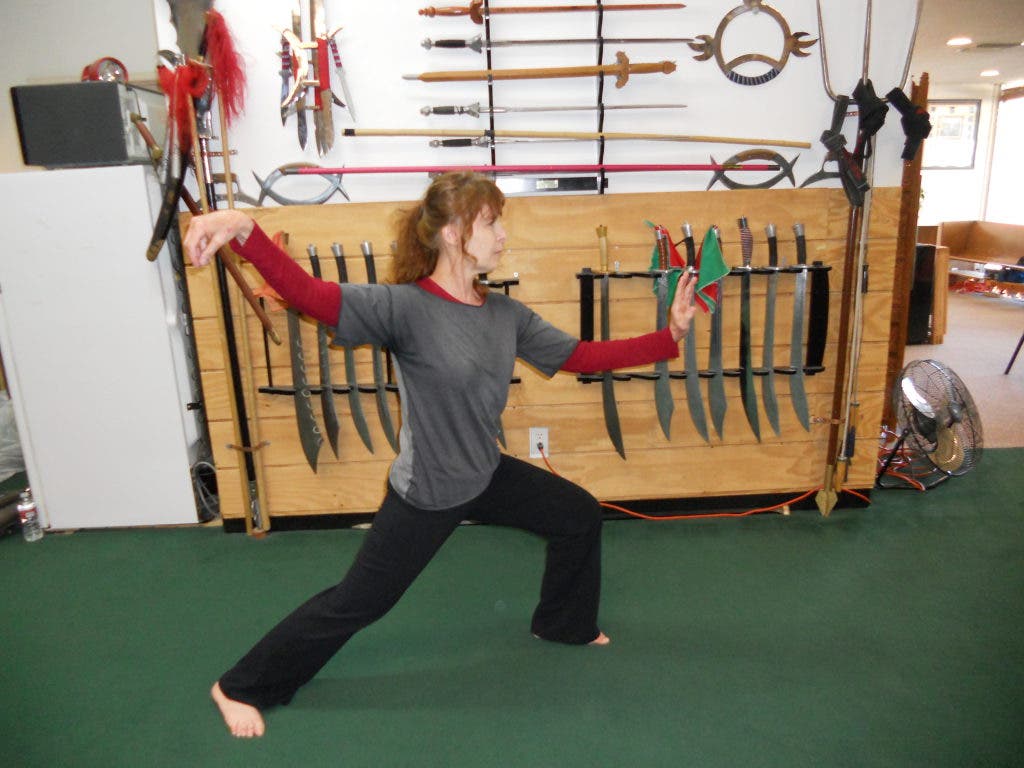
If martial arts can combine hard and soft techniques, Laura Gloster is determined to bring both to the lives of her students.
Every Saturday morning at the in Monrovia, Gloster leads the students in her class on tai chi from slow to swift yet graceful movements. In addition to playing Celtic harp and practicing massage therapy, Gloster holds an 8th degree black belt in kung fu san soo and also teaches classes with Tony Horton, the kung fu studio’s owner.
Horton said Gloster helped him realize that tai chi was the root of the fighting art he teaches. He calls her "Sima," a Chinese word that can be used to refer to an esteemed older sister.
Find out what's happening in Monroviafor free with the latest updates from Patch.
"It really fits her," he said.
"When I found his school, I was just a black belt," Gloster said. "I like to say he’s my Sifu."
Find out what's happening in Monroviafor free with the latest updates from Patch.
Sifu, a Chinese term that is commonly used in reference to a martial arts master, means teacher.
Gloster has been teaching in Monrovia about 14 years. At the end of her Saturday morning tai chi class, she often lets students practice their tai chi movements with swords.
"It just turns out my students really love all of this so I give it to them," she said.
Gloster said she first started learning about tai chi at the Japanese Cultural Center in Pasadena in the early 1990s. Although she had earned black belts in kung fu, she felt something was lacking. Tai chi seemed to offer what she needed, but it was hard to find classes on it. There were no tai chi videos and only a few books available. She said she spent eight to ten years reading everything she could get her hands on.
"I practiced relentlessly," she said. "I needed it badly."
According to Gloster, tai chi teachers could be found on the East Coast back in the 1940s, but it took a good 50 years for the art to become more known and sought after by the general public. In the beginning, tai chi masters were rare, and the ones who were in America mostly taught other Chinese or Chinese Americans. Gloster said that if you want to learn as much as you can about tai chi, it’s a good idea to seek out a master from China.
"It is a martial art after all," she said.
She found the traditional teacher she sought, Jack Fu in Temple City, only after searching for seven to eight years.
"At that time, people didn’t even know what it was. So I’m kind of archival in that regard," she said.
"Now they want to know what kind of chi gong I teach, so there’s your evolution," she added.
Tai chi is considered to be a more active aspect of chi gong, which is the practice of directing "chi," or life force energy, in the body.
"It’s about the whole body having the right moments," she said. "Really it’s about the mind-body interaction, and as a result your energy is fired up. It’s regulating body, mind, and breath so energy can be released and start to move."
As tai chi has become more popular, people have also started accepting the idea that the life force energy known as "chi" exists.
"I think once chi was known, that tai chi was OK then, and the healing properties were OK then," she said.
Tai chi can be beneficial for both younger and older students. In a new class that Gloster has just started teaching at an assisted living facility called the Regency Grand in West Covina, one of her students is 100 years old. Classes with Regency Grand residents are different from her other classes. Many have heart problems or are impaired in other ways. For them, she teaches chi gong breath techniques and basic balance.
"It’s the ones who can’t stand or are in a wheelchair, they’re the ones who really need it," she said.
She said that even when there is limited mobility, students can benefit from the techniques.
"You get a vitality that wasn’t there before. They’re not sitting in their wheelchair by themselves, waiting to die," she said.
She also enjoys witnessing the healthier students, who seem to also help energize the ones with more physical limitations.
"Of all my classes that gives me the most gratification," she said.
Gloster also leads classes at Descanso Gardens and at Jet Propulsion Laboratory, where she teaches tai chi to a room full of scientists. Students in this class have reported improvement in their knees and hips, or with problems related to hypertension. One day, a scientist came running into the class, ecstatic that she’d just been tested by the JPL health mobile and told that her blood pressure was low.
Gloster also said one older woman found herself unexpectedly using tai chi techniques to relax into a fall when she stumbled down some marble steps. A crowd of concerned onlookers gathered, but the woman recovered easily in a matter of minutes.
Stories like this show Gloster that the self protective aspect still is relevant to tai chi. She enjoys recognizing this, because she wasn’t always comfortable with the idea of participating in a martial art.
"Frankly speaking, my temperament is the furthest from this," she said.
She began to study martial arts when she was 27, after her mother bought her a class as a birthday present. As a child, she loved to dance and began teaching her friends certain movements when she was ten. As she worked her way through college she taught dance, gymnastics and aerobics classes. She had always been "kinesthetically inclined," as she put it, but the fighting aspect of kung fu took some getting used to.
"I had to work pretty hard at the time," she said. "But once I committed, then it got under my skin a little bit."
Still, Gloster said she eventually needed to turn to tai chi because she wanted something that felt deeper and more internal.
"I needed the mental relief," she said.
Tai chi not only helps with physical balance or ailments that afflict the joints, she said, but it can also help people who suffer from anxiety or depression.
"It brings balance, and it’s a deeper balance," she said.
As a result, when people feel better, they also likely to become more active physically.
"It precipitates into the next thing, into the next thing, into the next thing," Gloster said.
"The more you do it the further you go with it, and the deeper you take it, the greater the benefit," she added.