Community Corner
Marker Honoring Historic Stone Placed At Clinton Keith Road Extension
A boulder bearing the markings of history was destroyed in June, making way for wider roads and ease of transit. It will not be forgotten.


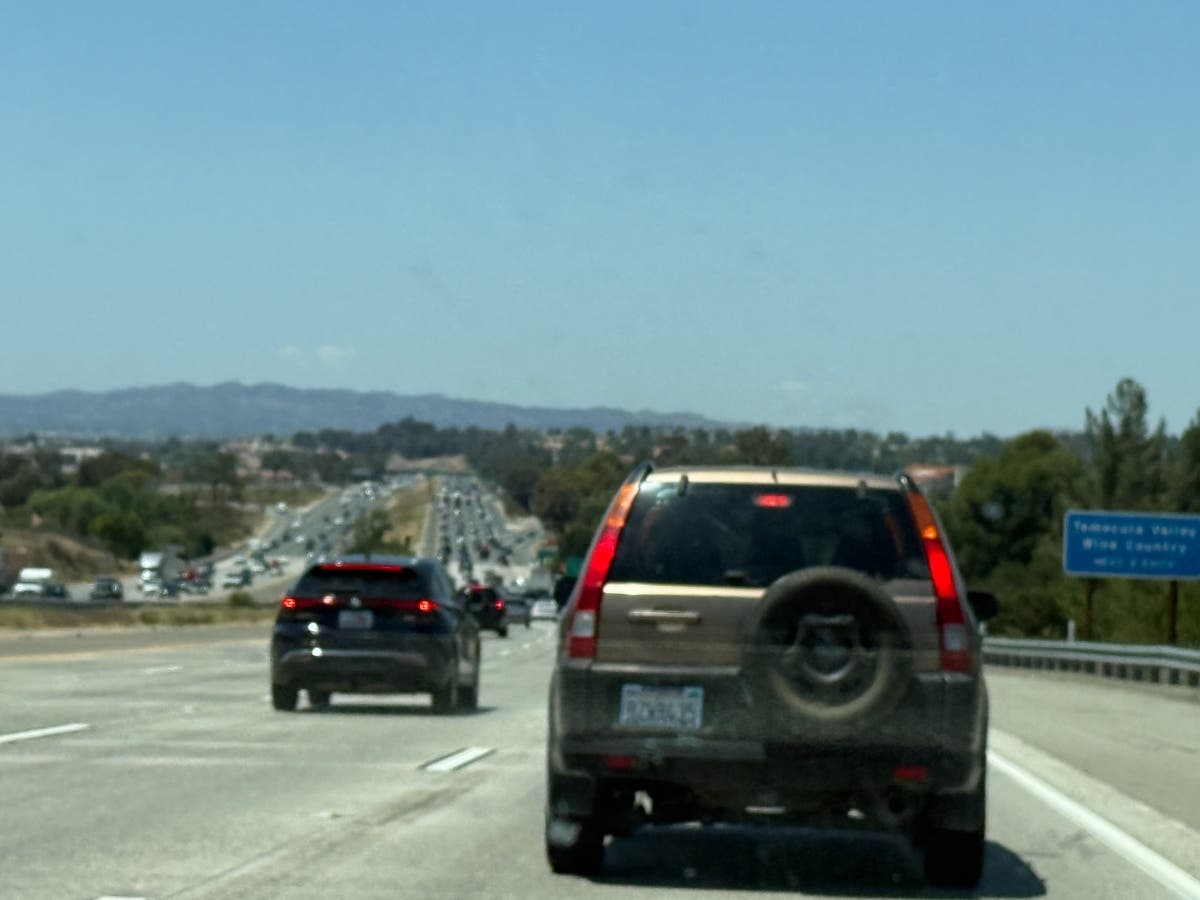
MURRIETA, CA — The Clinton Keith Road connecting Leon Road and Winchester Road (SR 79) in the French Valley and City of Murrieta opened for drivers, but not without controversy.
Back in June, there was a rub in the expansion plans: a Volkswagon Beetle-sized boulder known to locals as the "Leonard Smohl Memorial Rock." The boulder perched above the "T" intersection at Briggs Road and Los Alamos Road.
It bore the scars of both historic and prehistoric people in the way of groundstone historic graffiti from the 1900s, and even held the emblem of a USGS survey marker, according to photographs and archaeological reports.
Find out what's happening in Murrietafor free with the latest updates from Patch.
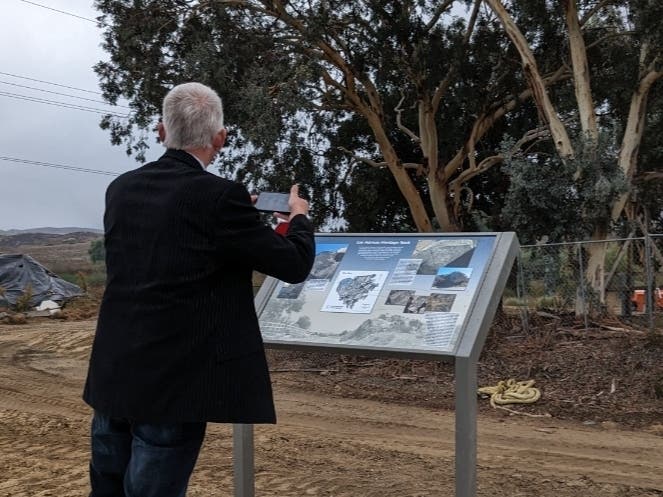
Though the rock was lost to time when it was decimated in the way of progress, Director of the County of Riverside Transportation Mark Lancaster and others at his department worked with historians to make it right. This month, upon the roadway's opening, the plaque honoring those who went before. Now known as the Los Alamos Heritage Rock, it has found a permanent place just off a bit of sidewalk where the rock once stood.
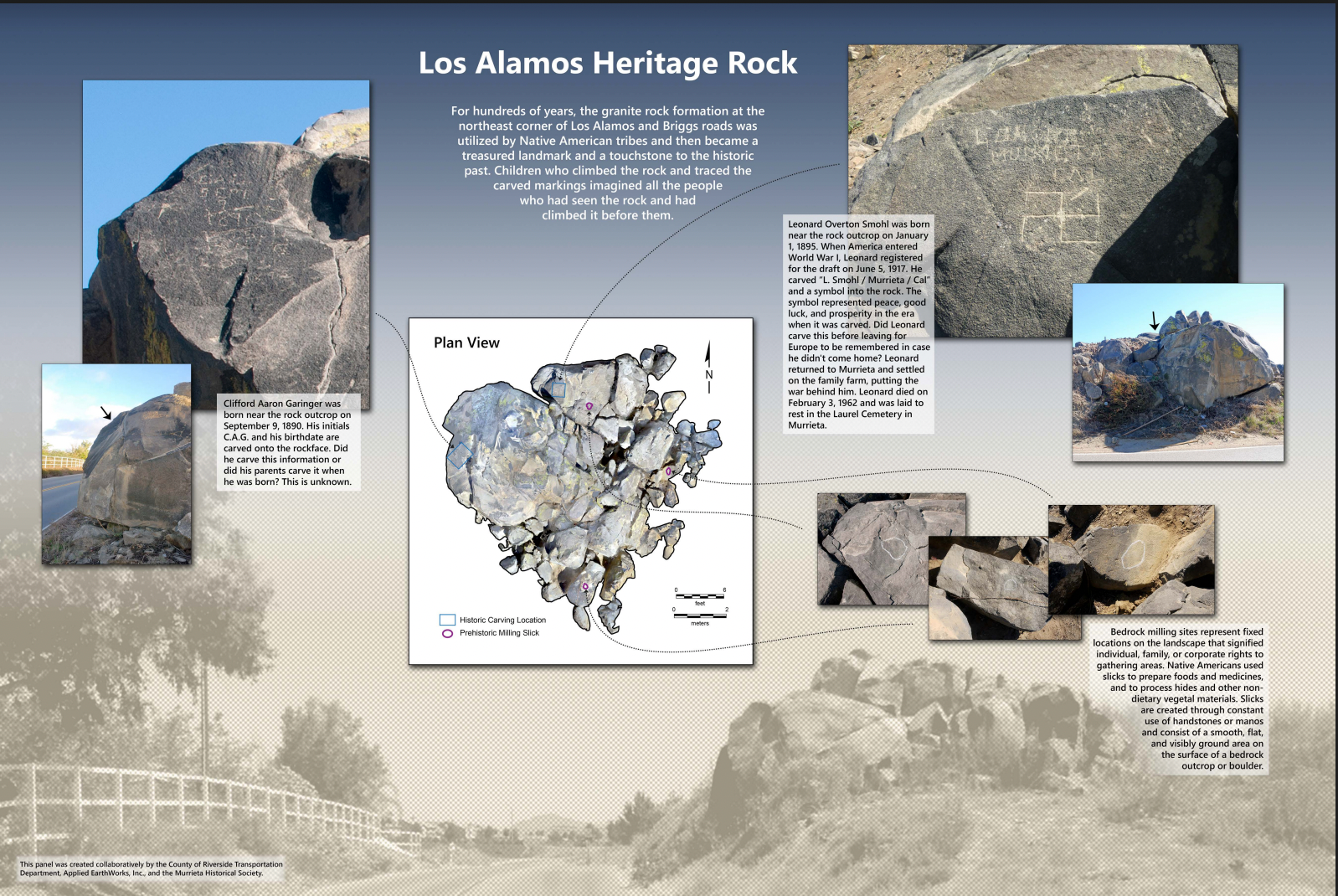
After painstaking work and back and forth with area historians, the plaque was designed to honor those who came before, but not everything was salvageable. Thanks to the plaque and the diligent efforts of local historians, the story of Leonard Smohl and others goes on.
Find out what's happening in Murrietafor free with the latest updates from Patch.
"Leonard Overton Smohl was a grown man in about 1918 when he set out to fight in World War I," Jeffery Harmon told Patch in July. "He used small, careful handwriting as he carved his name, L. Smohl Murrieta, Cal, into the stone, underlined with that reverse swastika peace symbol. This was an ancient symbol of peace. It may have been a prayer for peace as he marched off to war."
The stone bore evidence of both ground stone indentations from a Luiseño garden site in the Adobe Springs village. It held two historical etchings from French Valley's first homestead residents before they set off to fight overseas in World War I.
Historians took many photos of the stone's significant historic etchings. Resident and nearby neighbor Ann Borel shared photographs of the stone with Patch.
One of the markings was carved by founding pioneer resident Leonard Overton Smohl between 1914 and 1918, underscored by a backward swastika, a controversial marking to modern eyes. This glyph, however, was a prehistoric symbol of peace, local historians say.
The significance of the historic carvings bearing dates of 1890 and 1918 was not mentioned by archaeologists who considered the mark "graffiti" in their report.
In 2014, archaeologists John Eddy and Susan Goldberg signed off on the study and subsequent surveys, including the boulder, noted as CA RIV 11585 in the reports. In the study, Eddy stated that the visibility of the "stone marker" was high and 360 degrees around, and the boulder was set atop a small hill.
Ten photographs of the stone were taken at that time, outcroppings 1 and 2, which were "two milling slicks on the bedrock exposures." Eddy also mentions that there were disturbances to the site in the way of graffiti and some trash and boulder piles nearby. However, there are no known photographs of those areas.
In 2018, Applied Earthworks conducted a secondary survey of CA RIV 11585 as a follow-up to its report, Historic Properties Treatment Report: Six Bedrock Mills Within The Potential Adobe Springs Archaeological District.
Archaeologists photo-mapped the remaining outcroppings at that time, capturing the Smohl etching.
In their report, archaeologists mentioned the stone had been "vandalized recently with graffiti etched into one of the surfaces." The marking they photographed on the western face of the rock, considered "recent," bore Smohl's name and the 1918 date.
Why was the history overlooked? What The Archaeologists Missed With CA RIV 11585
The fact that the archaeologists overlooked the significance of the boulder's markings in 2018 was a travesty, according to local historians.
"Those marks were not new in 2018. They were new in 1918," Harmon told Patch. There were two dates etched in the stone: one, a marking by Leonard Smohl, who was among the founding residents of French Valley and Murrieta, and the second by Clifford Aaron Garinger, a pioneer resident who carved his initials C.A.G. and birthdate Sept. 9, 1890, into the stone.
This was no ordinary boulder, according to many who've driven past the T intersection at Briggs Road and Los Alamos Road. It served as a "dividing line between the county and Murrieta land," Harmon said.
Read the full story on Patch: Historic Murrieta Memorial Stone Smashed By Road Crew
Meanwhile, the Clinton Keith project continues.
The traffic signal at Leon Road is activated with new traffic patterns for Clinton Keith Road eastbound traffic (two left turn lanes for Leon Road and three straight through for Clinton Keith Road). The contractor will continue with the construction to complete contract work, correct discrepancies, and other improvements. Please continue to use caution and observe construction warning signs.
Get more local news delivered straight to your inbox. Sign up for free Patch newsletters and alerts.