Crime & Safety
Hazmat Gas Leak Forced Hundreds To Evacuate, 215 Reopened
The 215 Freeway is open Saturday, and all previous evacuations were lifted.


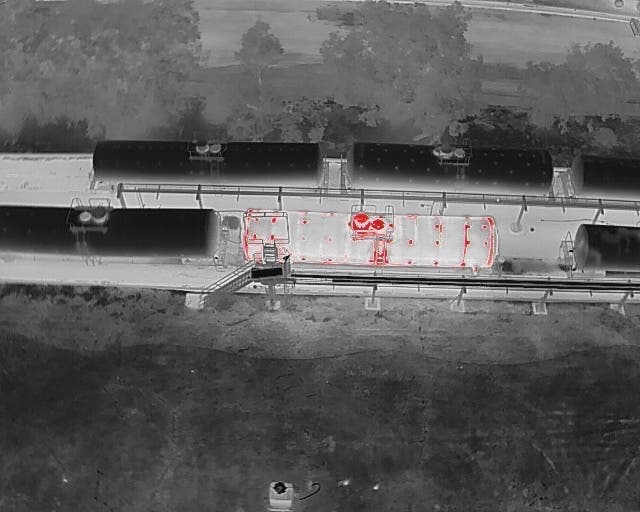

PERRIS, CA — A canister of chemicals inside a Perris railcar near the San Bernardino (215) Freeway was in danger of exploding Saturday.
All evacuations were cancelled as emergency crews continued working in the area of the incident. An evacuation shelter was also closed but people were asked to avoid the area.
Initially, officials anticipated that the incident could lead to the evacuation of at least 170 homes and multiple nearby businesses.
Find out what's happening in Murrietafor free with the latest updates from Patch.
After a full day of closure the California Highway Patrol reopened the 215 both directions through the area shortly before midnight, determining there was no immediate threat to drivers. The Harley Knox on and off-ramps will remain closed for an unknown period of time.
On Friday, Riverside County drivers filled side streets and had their will tested as Cal Fire/ Riverside County Fire officials worked to keep the area safe.
Find out what's happening in Murrietafor free with the latest updates from Patch.
At 7:30 p.m. Thursday night, a train car loaded with a canister of styrene expelled a cloud of styrene gas due to a chemical reaction. The air immediately around the facility filled with a sickly odor noticeable by drivers on the 215 Freeway. Meanwhile, the gas superheated to over 350 degrees, bringing the added danger of the rail car's possible explosion. Officials evacuated a half-mile radius which expanded as the day progressed.
As hazardous materials teams work to come up with a solution all day they placed the safety of the community over the headache of commuters frustrated with the shuttered 215 Freeway.
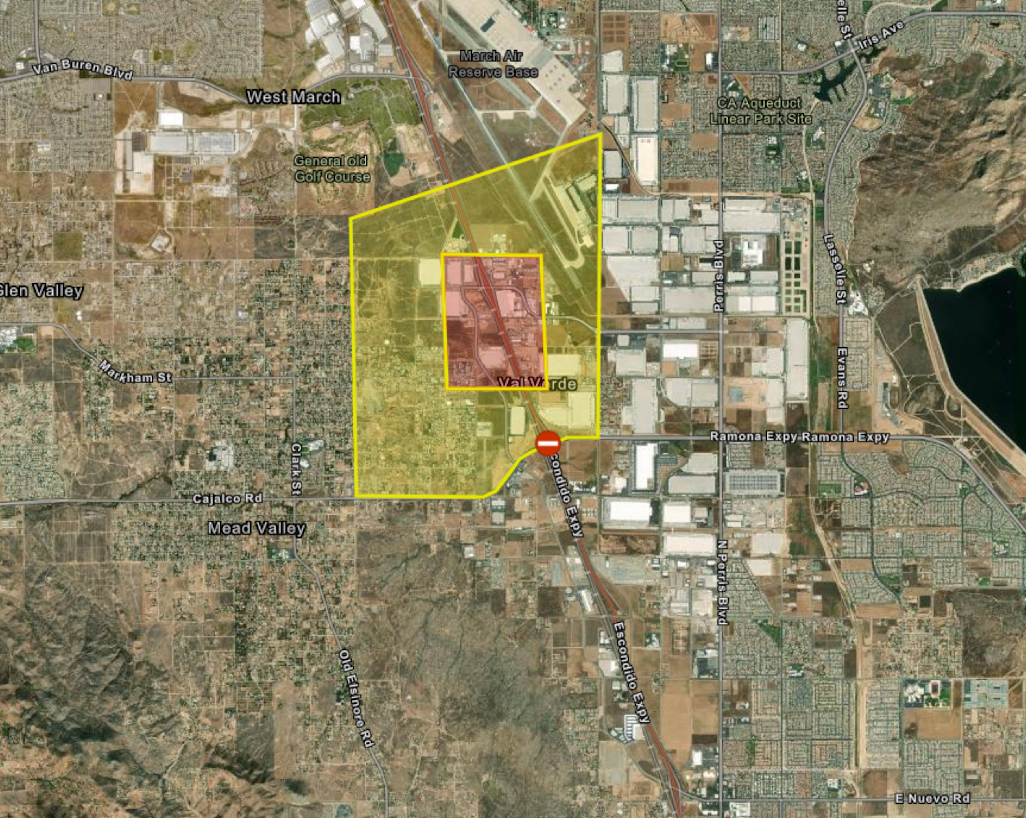
Residents were advised to consider relocating to a safer place until further notice and the Red Cross's care and reception center was opened at Pinacate Middle School, 1990 S. A St.
The train car that was loaded with 188,000 gallons of styrene, a thick fluid material that chemically turns into a gas, has sat since Aug. 3, according to a Cal Fire spokesperson. For unknown reasons, the canister contents underwent a chemical reaction where it has reached extreme and volatile temperatures.
The initial gas release into the atmosphere lasted for "a few minutes" before it dissipated, Cal Fire Capt. Richard Cordova said.
There have been no injuries reported from the incident, according to officials.
"The immediate concern is an explosion, not the gaseous release," Cordova told Patch. A secondary concern is more similar train cars are also loaded with chemicals. Though there is no current danger to the secondary cars, officials are working on plans to remove them, officials reported late Friday.
The challenge to all is the volatility of the situation. It could take days for residents to safely be able to return to their homes.
Cal Fire Division Chief John Crater spoke at a Friday news conference, describing the evolving situation.
"This could resolve itself in two days, but it could get worse before it gets better," Crater said. "Due to the heat building in the car, that builds pressure and it could have a release, meaning some sort of violent explosion. That's why we're taking an abundance of caution with this."
The material, stable at 85 degrees, reached temperatures upwards of 320 degrees overnight. At 6 a.m., that temperature reduced with the cooler night air.
Still, Perris and Riverside County remain under a heat advisory through Sunday. High temperatures upwards of 102 degrees are expected in the afternoons which could drastically alter the situation.
The railcar itself is not in danger of melting due to the extreme heat. The car would explode before reaching a melting point, according to Cordova, which is why officials have prepared for the worst-case scenario of a half-mile blast radius.
"Once we start seeing that that rail car is actually cooling, what that tells us is the chemical reaction that's happening in that car is actually now starting to solidify, which is the trend we want to see happening," county Fire Department Capt. Oscar Torres said.
Due to the unstable nature of the chemical, authorities are unable to get near the car, and they've been using drones to get closer looks.
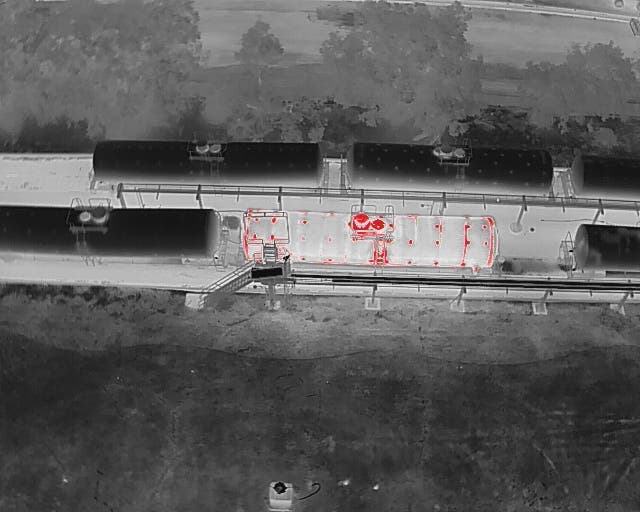
Meanwhile, the lowering temperatures were a good sign, fire officials reported.
"We are hoping that trend continues," they said.
Residents reported something that "smelled like fiberglass" all night, which is consistent with styrene, used in making rubber and styrofoam.
Because Cal Fire HazMat teams could not approach the railcar as of Friday morning, they will monitor the volatile situation using drones hovering 100 feet above the railcar.
Officials said it could be days before the substance is rendered safe enough to approach. It will likely be more than 48 hours before the evacuated residents can return to their homes.
The spill at Harvill and Oleander avenues and was first reported around 7:30 p.m. Thursday.
What is Styrene?
The chemical styrene is used to make rubber and latex and commercial foam products.
It is a "colorless liquid that evaporates quickly," according to the CDC. Manufactured styrene has a sharp, unpleasant odor.
A chemical reaction to the resin-like material increased the temperatures well above stability levels Thursday, according to reports.
"Styrene is quickly broken down in the air, usually within two to three days," according to the CDC.
The Department of Health and Human Services and the National Toxicology Program list styrene as a suspected human carcinogen.
The top portion of the train was still expelling gas as of 6 a.m. Friday
What are the Health Effects Of Styrene Exposure?
Styrene exposure can cause some negative health effects when inhaled of nose and throat irritation, headache, dizziness, lightheadedness and in extreme cases, loss of consciousness.
Removal from the exposure area is the first step of decontamination, according to the CDC.
School, Business Closures & Evacuation Center:
The Mead Valley Elementary School was closed Friday during the incident. Students were taken to the Citrus Hill High School gymnasium to await reunification with their families.
A nearby middle school is being used as an evacuation site for those in the area near the spill.
"The @PinacateMS Gym is serving as the evacuation site in response to a hazardous materials leak North of Perris," the Perris Union School District reported over Twitter. "In cooperation with RivCo EMD, the evacuation site is being run by the American Red Cross. @puhsd schools are in session."
The Living Spaces Distribution Center was affected by the closures, as were numerous restaurants and businesses.
The Riverside National Cemetery closed Friday due to the county emergency. A spokesperson reported they would reach out to families and reschedule all Friday services — and presumably any scheduled over the weekend— on Monday morning.
Road Closures:
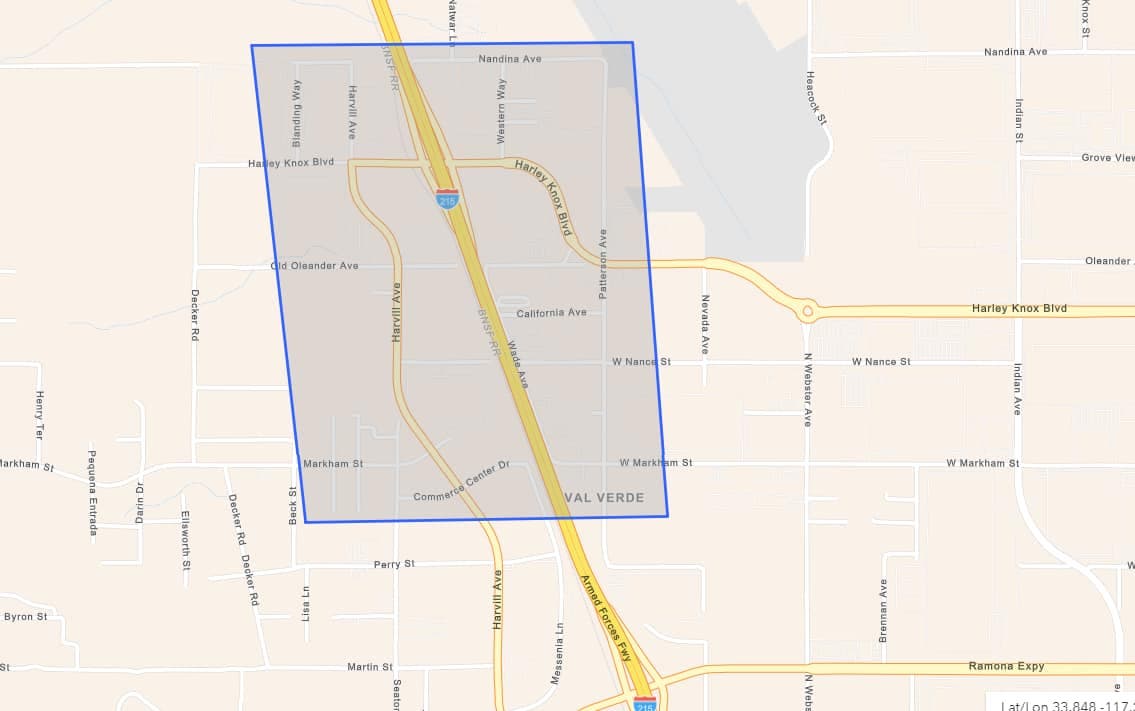
Harvill Road was closed in the area from Oleander to the north and Commerce Center to the south, the fire department posted on Twitter.
The I-215 is completely closed between Ramona Expressway and Van Buren Boulevard.
Rail travel in the area has also been disrupted.
Metrolink service on the 91/Perris Valley line was also interrupted through the area, with the tracks closed between the Perris-Downtown and Moreno Valley/March Field stations. Service will remain disrupted until the situation is resolved.
Get more local news delivered straight to your inbox. Sign up for free Patch newsletters and alerts.