Neighbor News
Newark's Park Maintenance Dilemma
We need funding sources and a savings plan for park maintenance and destination recreation.

To date, the City of Newark has hosted three citywide parks masterplan meetings to get feedback from the community on what changes they'd like to see in their park system. One common theme is that residents would like to see an improvement in park maintenance, including litter removal, more garbage cans, and cleaner and operational bathrooms. Although I believe the state of our neighborhood parks can be improved by increasing utilization, park maintenance is an important budget line item worthy of research.
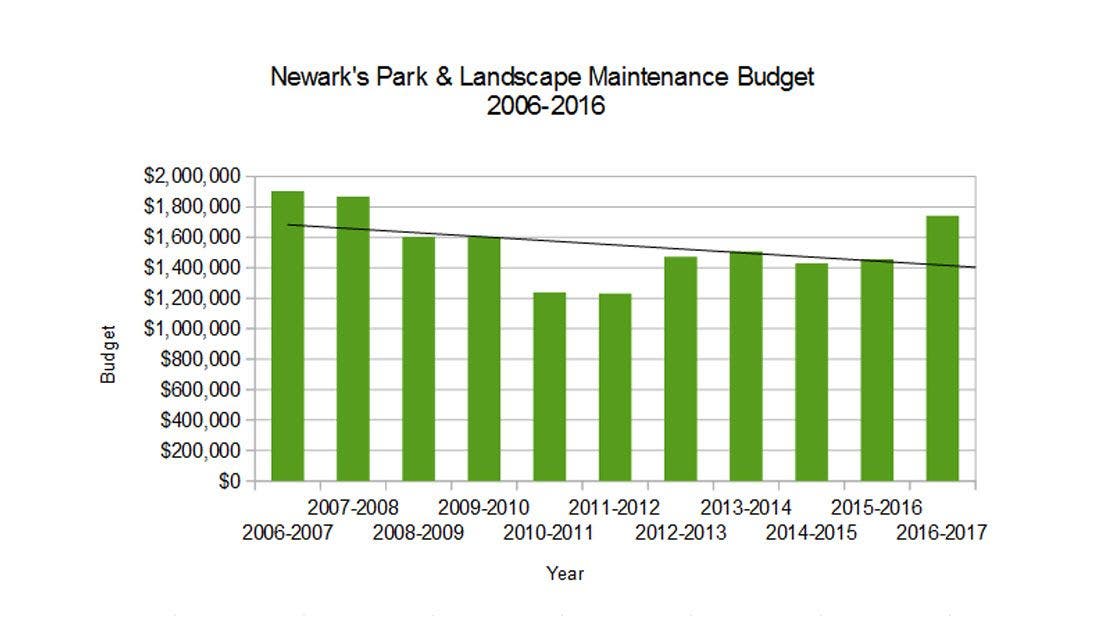
In 2006 the budget for Newark's Park & Landscape Maintenance was $1,903,200. Today it is $1,742,700, less than it was 10 years ago and excluding any adjustments for inflation. A comparison of Union City's budget suggests that Newark's park and landscape maintenance funding is 44% less per park acre (Newark has 10% less park acreage) and 18.5% less per person than Union City's. With Union City having greater economies of scale (and not nearly the challenge from our Bay winds and siegels "on steroids"), you'd expect Newark's funding to be higher per capita.
Keeping in mind that parks can generate revenue, one funding strategy for park maintenance might be to allocate an applicable share of that revenue to Park & Landscape Maintenance. For example, skateparks can generate revenue from skateboarding programs; pump tracks generate revenue from summer camps; soccer fields provide rental revenue (1,000 field play hours at a artificial turf market rate of $63/hr yields $63,000/year); and dog parks generate revenue from dog training courses. Obviously these revenues, in some cases, only supplement a need for budget increases for park maintenance. (Park impact fees paid by developers can only legally be used for park improvements, not park maintenance.)
Find out what's happening in Newarkfor free with the latest updates from Patch.
Park improvements that reduce maintenance are commendable. However, those savings also need to be evaluated in context of their initial capital outlay, the cost to replace the improvement (Fremont's Irvington artificial turf was recently replaced after 9 years at around 50% of initial outlay), and to what extent that need is currently being met, especially for destination recreation where a city uses local funds to subsidize non-residents to achieve high utilization.
An artificial turf (aka sportsfields) investment of 5.4M that covers 4.5 acres can lower maintenance costs; however, the improvement's life expectancy is 10 years max and 6-year warranties are commonplace, assuming poor maintenance schedules don't void the warranty even sooner and there isn't high utilization. Cities charge high rates for artificial turf not to cover initial outlay (because that cost doesn't get recovered), but to help cover the re-turf and lighting repairs. Cities also stagger their fields so that the bills don't come due all at once. (High park impact fees prior to Newark's housing boom was a lost opportunity: we would have had additional capital to cover replacement costs!) Cities also use General Revenue funds to supplement re-turf, though Newark has a pension problem that's consuming its surplus revenues.
Find out what's happening in Newarkfor free with the latest updates from Patch.
Therefore, it's critical that revenue generated from destination recreation with high capital outlays be reserved for replacement costs. Without such a model (and additional money), such park improvements can be fiscal disasters and spell doom for our park system and organized sports. We need funding sources and a savings plan for park improvements: a restricted hotel tax with a spending floor on park maintenance might be one solution, though problematic given the city's track record on funding Park & Landscape Maintenance despite tax increases. A privately-sponsored sportsfield for destination recreation might be another solution. Additionally, the city can replace one Silliman headcount with a Grounds headcount to support new facilities. The city can also register with HandOn Bay Area so as to tap into the local company volunteers waiting to pick up a shovel, rake, and pruner to maintain our parks.
A dependence on artificial turf fields results in higher rental rates or low rental rates and less money for replacement. Currently Newark's organized sports teams have lower registration fees for its members than counterparts in other cities, but that could change with higher rates (see current contract rate), potentially making organized sports less affordable for lower income families in Newark.
There are no simple answers. But, what's clear is the city must SAVE and restrict park revenue, starting with the revenue facilities are generating today, and transfer significant capital funds from its General Fund to its park budget to compensate for the low park impact fees previously set. Presumably park impact fees were set low to attract housing developers and produce an increase in property tax revenue, and that money is slowly trickling in.
Thoughts? Other solutions? Email your representatives at city.council@newark.org.
Angela Akridge
Volunteer, Newark Parks Foundation
www.newarkparks.org