Neighbor News
Enterprise Drive Housing Project Gets City Council OK; A Health Disaster in the Making
A transcript of the speech I gave at the 4/23/2015 Newark City Council public hearing outlining the many issues with the proposed project.
Good evening City Council members,
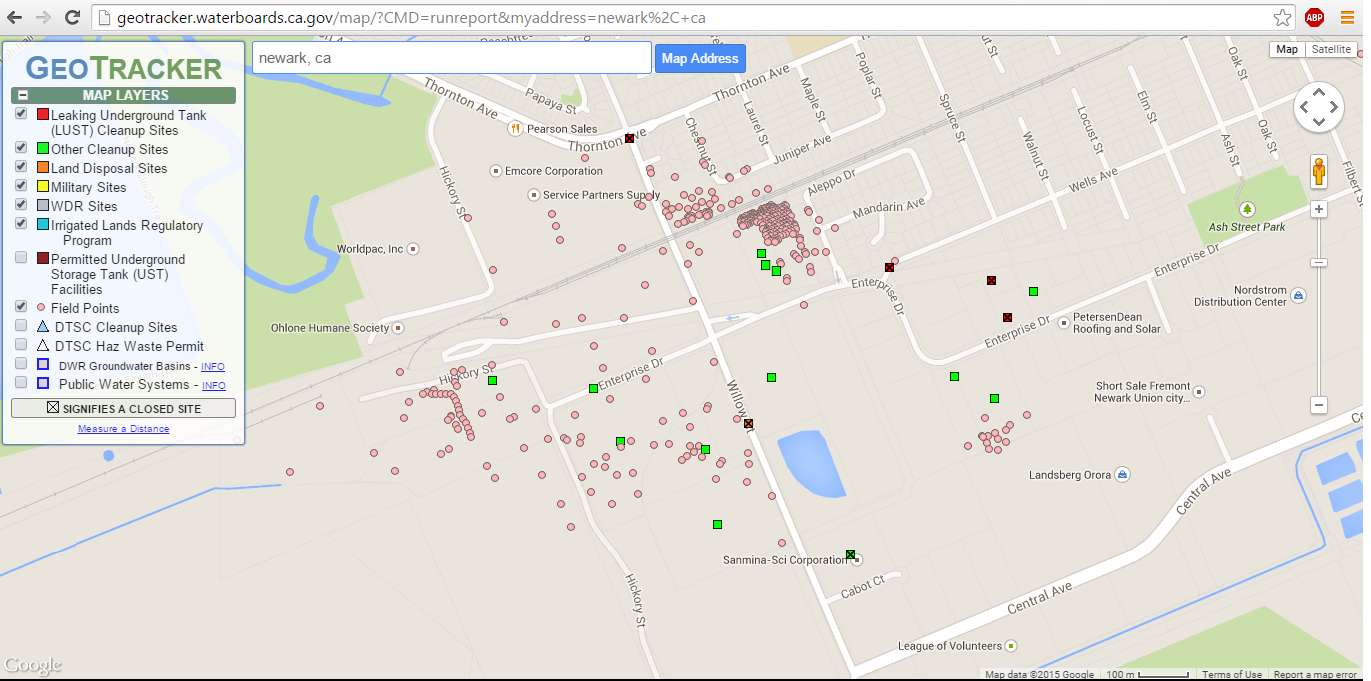
My name is Ricardo Corte. Today, I will ask City Council to not approve the Final Supplemental Environmental Impact Report (FSEIR) for the Trumark housing unit development on both the Enterprise Property and Jones-Hamilton Property. The primary reason being the chemical contaminants in the soil and groundwater. Page 88 of the SEIR lists many of the chemicals, which are highly carcinogenic and toxic, and are at unsafe levels for residential development.
At the May 8th, 2014 City Council hearing, Assistant City Manager Terrence Grindall stated that, “there would not be any residential development allowed unless (the developers) are able to reach the standards that the agencies, such as the Regional Water Quality Control Board (RWQCB) set”. I am alarmed at the continued failure by the City to candidly disclose what it is truly proposing in comparison to regulatory agency guidance. Mr. Grindall’s comments are at best a deceptive statement.
Find out what's happening in Newarkfor free with the latest updates from Patch.
First, on page 19 of the Final Environmental Impact Report, a 2013 letter from the RWB to the City recommended that “significant groundwater remediation must be implemented and its success must be demonstrated with post remediation monitoring that includes collection of soil gas and groundwater samples for a period of time prior to occupancy of new buildings on the property”. Yet on the same page in its response, the City refused to obey the RWB, claiming that a 2011 Vapor Intrusion Mitigation Advisory overrode the suggestion made by the RWB. Simply, despite the City claiming the developer would follow the standards set by the RWB, this suggests the opposite.
Second, RWB noted the remediation strategy proposed in 2007 was found to be ineffective in cleaning up groundwater contamination in 2011. Additionally, on page 19 of the FSEIR, RWB noted that the 2013 Alternative Clean Up Strategy was noted to be ineffective and capable of creating more toxic byproducts than the chemicals it is supposed to be cleaning up. In both cases, the City pointed to the 2011 Vapor Intrusion Mitigation Advisory claiming they would not need to change course and provide new mitigations despite RWB stating the mitigations currently being done and those planned are not enough.
Find out what's happening in Newarkfor free with the latest updates from Patch.
I understand this development is part of a larger project called the Dumbarton Transit-Oriented Development (DTOD). The development is aligned around the long-promised rail service called the Dumbarton Rail Corridor. But the plans for this rail service has been in discussion since the 1990s. Almost three decades later, there is no indication this rail service will ever be in service. At their last Policy Advisory Committee meeting on February 27, 2015, it was noted that no amount of funding has even been guaranteed for the project.
Rushing the construction of homes on chemically contaminated lands that have well-known carcinogens is not considering the future well-being of the city. Ignoring that prior efforts at remediation have failed is not considering the future well-being of the city. Pretending that newer mitigation strategies will be effective and not ultimately more harmful when the Regional Water Board has stated otherwise is not considering the future well-being of the city. Risking the health of countless future and current Newark families and children in the name of a transit oriented development without a feasible rail service being provided anytime in the near future is not considering the future well-being of the city.
Thus, I strongly encourage City staff to consider an alternative. Rezone the lands of the DTOD into technology and business parks, which have lower standards for chemical remediation compared to housing. Some of the businesses and industries throughout the City can then be moved to the current lands for DTOD opening up housing opportunities in their prior locations. This is an alternative that protects the health of our current and future Newark residents, while also maximizing the vacant lots throughout the City.
Thank you.