By Roy Nakano
There’s a technology battle going on in the electrification of automobiles, and it’s between battery electric cars (BEVs) and electric cars with fuel cells (FCEVs).
In one corner, we have Tesla and Nissan—the most vociferous proponents of battery electric cars. Nissan is betting the farm on its electric cars, and has been working with partners to boost the number of charging stations throughout the country.
Find out what's happening in Newport Beach-Corona Del Marfor free with the latest updates from Patch.
In the other corner, we have Honda, Hyundai and Toyota, which decided to place a good portion of their eggs in the fuel cell basket—a technology that uses hydrogen to generate electricity for an electric motor-propelled car.
Fuel cells address the two biggest problems hurdles associated with battery electric cars—namely, range and the time it takes to re-charge. Tesla will argue that it’s addressed both of these issues with its Model S, which has a range of up to 300 miles and the availability of quick battery swap stations that can fit a fully charged battery into the car in less time than it takes to refuel a luxury sedan.
Find out what's happening in Newport Beach-Corona Del Marfor free with the latest updates from Patch.
But the Tesla is the only plug-in electric car that’s overcome these hurdles, and it’s largely the reason for its premium cost. Virtually all of the other electric cars (except those with a back-up gas motor) have a range limit of around 75-80 miles—a range that’s just short of being anxiety-free for most commuters.
On the other hand, the rarity of fuel cell vehicles are exceeded only by the rarity of the number of hydrogen fuel stations. Up until now, the availability of fuel cell vehicles has been limited to a couple of very limited production models.
That all changed last month when Hyundai delivered the first mass-produced fuel cell electric vehicle to Timothy Bush at Tustin Hyundai. There have been fuel cell vehicles from Mercedes-Benz, Honda and others in very limited production, but the 2015 Hyundai Tucson Fuel Cell is designed for much broader application. Based on the gasoline-powered Tucson crossover utility vehicle, the fuel cell version goes for a down payment of $2,999 and a lease rate of $499 per month for 36 months. For that rate, however, Hyundai will pay for an unlimited amount of hydrogen fuel. In addition, Hyundai will provide At Your Service Valet Maintenance, which means you don’t have to visit the car dealership for service—they will come to your home or office.
If all this sounds too good to be true, it might be—depending on where you live. That’s because happiness in a fuel cell vehicle is heavily dependent on the availability of hydrogen fuel stations nearby. As a result, Hyundai is very careful about who they’ll lease this vehicle to. Fitting the lease profile, in this instance, means living near a fuel cell station. In Southern California, that doesn’t leave too many options. As a result, only three Hyundai dealers currently carry the car: Win Hyundai in Carson, Hardin Hyundai in Anaheim, and Tustin Hyundai where the first car was delivered. Patch readers can find out if they fit the profile by going to hyundaiusa.com/tucsonfuelcell.
So, how does the car drive? Like a good electric vehicle. On the road, the Tucson Fuel Cell is utterly quiet. Since full torque is available from a standing start, it doesn’t need multiple gears to get up to speed. Consequently, it accelerates with a smoothness unmatched by gasoline-powered cars, and without the droning that accompanies cars with continuously variable-ratio transmissions (CVTs). This car rides with a sense of luxurious calm that makes the drive less stress-inducing.
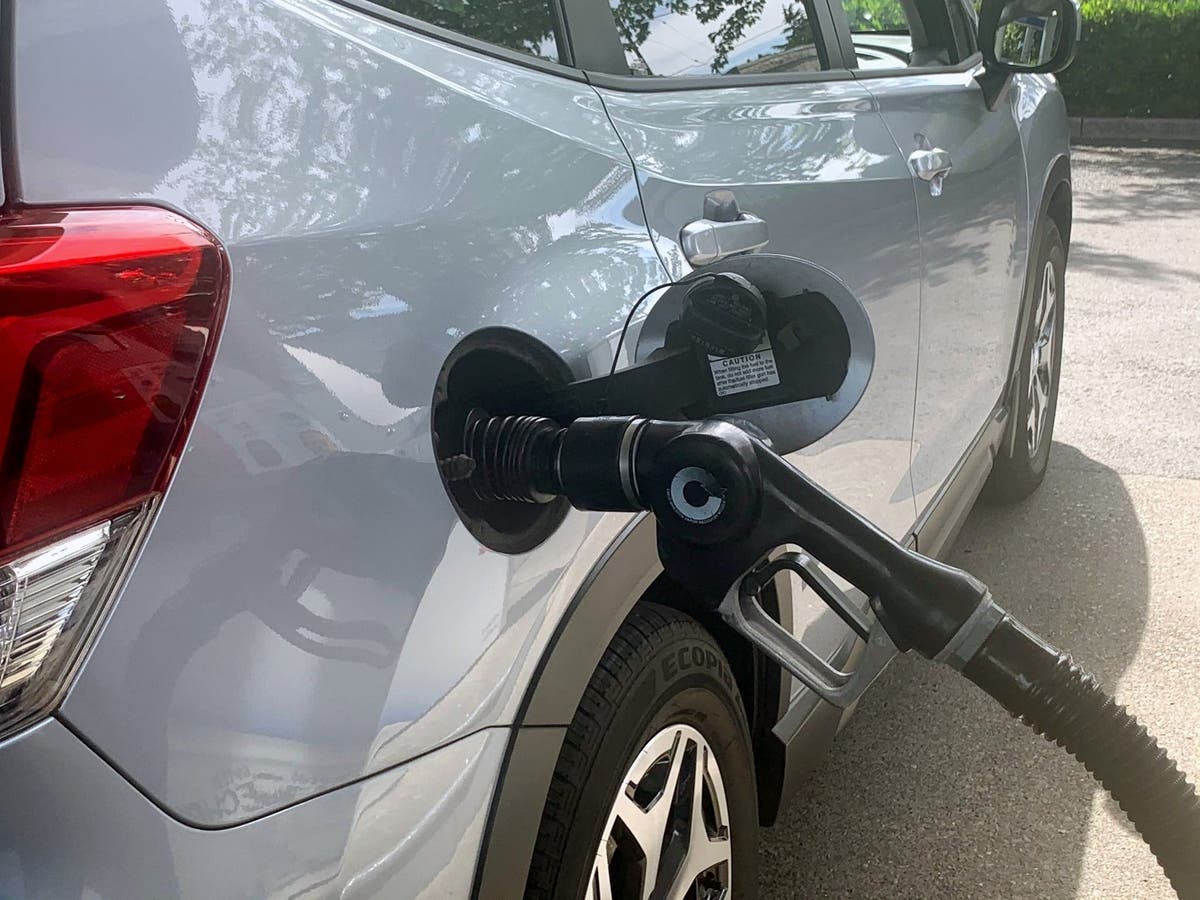
I also got a chance to see the Tucson Fuel Cell get a fill-up at one of the two hydrogen fuel stations in Orange County. This one was at the Newport Beach Shell station on 1600 Jamboree Boulevard. It’s not much different from a petroleum fill-up. After 10 minutes at the pump, we are good for another 265 electric car miles. The bad news: There are only nine hydrogen fuel stations in all of California. The good news: 49 more are in development.
More good news: Unlike petroleum, sources for hydrogen are abundant in this country. It’s no wonder that Toyota and Honda, as well as Hyundai see the future in fuel cells. I saw and drove the future in Tustin, California, and the future looks pretty bright.
The author is the executive editor of LA Car. You can see more photographs and get specifications on the Hyundai Tucson Fuel Cell at LACar.com or Facebook.com/lacarcom.