Arts & Entertainment
How The Group Rep Sets Lonny Chapman Theater On Fire
Patch sits down with Larry Eisenberg, the co-creative director of The Group Rep, for a history of the theater company and the secret of their latest fiery production,'The Poor of New York.'
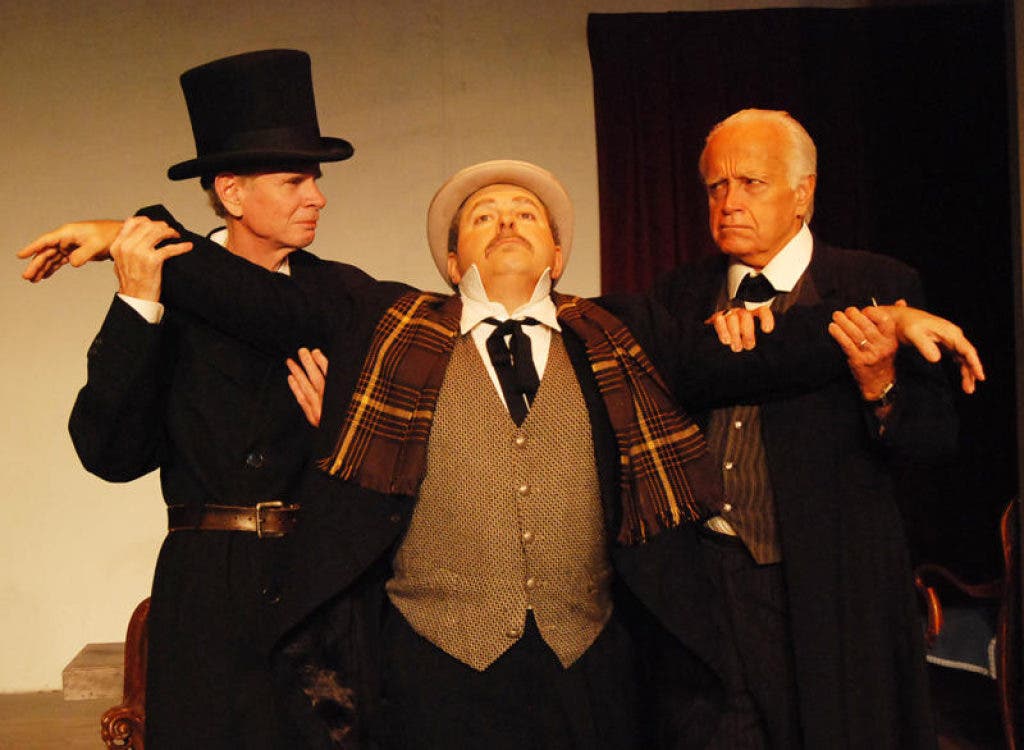


Stationed in the since 1984, The Group Rep is one of North Hollywood’s oldest staple theater companies. Founded in 1973, The Group Rep moved into the building that was formerly a motorcycle shop. They offer a full season of shows throughout the year, performed for up to 90 viewers at a time, and often even more intimate audiences.
Larry Eisenberg is the current co-artistic director of The Group Rep, along with Chris Winfield. As director of the current production, The Poor of New York, Eisenberg invited Patch upstairs to the second level of the theater to share anecdotes about the NoHo institution’s history. Eisenberg spent time with The Group Rep from 1990 to 1994, then came back in 2003. He also works as a computer programmer at USC.
Eisenberg began sharing that he chose Dion Boucicault’s because he wanted to stage a real melodrama. Set in the years 1837 and 1857, the play dramatizes the then-deadly economic differences in the city. Eisenberg also invited Group Rep member Sherry Netherland to chat with us. As one of the Group Rep's bloggers, she had researched the historical context of the play and wanted to help Larry set the tone for audiences.
Find out what's happening in North Hollywood-Toluca Lakefor free with the latest updates from Patch.
LARRY EISENBERG: When I was looking at these melodramas, and I looked at a bunch of them, there was something very unsatisfying about them. I said, “F***, I’d like to do the real thing.” You look at America in 1837 and 1857 and that opens up a whole other can of worms. That’s where Sherry has a lot of expertise because she did a lot of research into the world of that time.
SHERRY NETHERLAND: There were two stock market crashes, one in 1837, another in 1857. There was another one in 1879 just like any time even today. They called it the Panic of 1837, the Panic of 1857, the Panic of 1879. Civil War brought America out of economic disaster. There was a big savings and loan that went belly up, so four tons of gold was coming from San Francisco. The banks were going to be replenished with gold and the boat that carried the four tons of gold sunk in a hurricane off the coast of South Carolina. So there was no rescue for the bank. In 1857, the country was thrust into poverty. The Scorsese movie, The Gangs of New York, Bill the Butcher (Daniel Day-Lewis) was an actual character. He was already dead by 1857.
Find out what's happening in North Hollywood-Toluca Lakefor free with the latest updates from Patch.
EISENBERG: But his movie takes place in 1857 the same year and it takes place in Five Points of New York where this play takes place. It’s talking about the same exact world. There’s one whole scene where people have to be careful coming into the apartment because the gangs are out there.
NETHERLAND: The mayor of New York, Fernando Wood, was so corrupt that Albany tried to have his term ended. So he held up in City Hall and created his own police force, The Municipal Police, that had about 300 police officers. The Metropolitan Police had 50 members, so two police forces went to war with each other. While the police were distracted, the gangs of New York had a riot and that’s what they tried to depict in the movie. That was going on at the time this play was written and there are lines in the play that reference what’s actually going on on the streets.
EISENBERG: The climactic scene takes place in a five story building as it is burning to the ground. When they did it, [Boucicaut] would have this huge fire on stage and have the entire set burn down. It was extravaganza. It was epic proportions.
PATCH: How many nights a week did he burn the set down?
EISENBERG: Every night, and rebuild it.
NETHERLAND: He is credited with inventing fireproof scenery and fire safety in theaters because he demanded this set to be burned down in the theater, and he never burned down the theater. So he developed fireproof scenery and fireproof techniques for theaters. It all started from him wanting to do this play.
PATCH: How do you handle the climax at The Lonny Chapman Theater?
EISENBERG: We handle it with video. You’ve got to have the fire payoff and you’ve got to make it a world that the audience will accept. The closest thing that I could find that a modern audience could relate to the style and the world are silent films, things like Intolerance, Birth of a Nation, D.W. Griffith, Murneau’s Dr. Faust, Phantom of the Opera. I made a concerted effort to create a style that would mimic the silent films. There are 20-some different scenes. I have title cards taking us from scene to scene. We used musical backgrounds and I took music from some of the old silent films and put it in the background of the scene and even worked with the actors in terms of coming up with an acting style that mimicked the acting style in the silent films. We create a silent film world. Once that’s done, between every scene there’s some video. The video is flickering kind of silent film video. A guy named Christian Ackerman was our videographer. We did a whole [video] on blue screen where the main actor who’s in the burning building trying to rescue a receipt, we shot it out in the parking lot with a big blue screen. At the appropriate time when the building is supposed to go up in flames, the video comes up and you see the building burn and you go inside the room. He’s got like a minute and a half inside the room going through the flames, then finally getting out and coming back onto the stage carrying the receipt, to audience applause.
PATCH: Did you know Lonny Chapman in your time with The Group Rep?
EISENBERG: Yeah, I knew Lonny very well. I did Time of Your Life with Lonny so I’ve had the opportunity to spend some time on stage with him, been directed by him, have directed him. A lot of the reason that I’m here and doing what I’m doing now is to continue the legacy of Lonny. The thing that Lonny loved about it was that it happens for the first time every night. I was directing a play called Chaim’s Love Song towards the very end of Lonny’s life. He was becoming more frail and he finally stopped driving. We have basically 18 performances, three performances a week for six weeks. One night I was driving him home and I noticed it was his 11th time coming to see the play. I asked him, “Lonny, I really appreciate your coming to see it so much, but why do you keep coming back every week? You’ve seen it already.” He said, “Yeah, but it’s different every night.” That’s the thing that’s really special about small theater. They can feel your heartbeat as it quickens within the scene that you’re playing. At the same time, you can feel their heartbeat and you can feel as they get excited or enraged or amused. It’s all happening inside a small room where essentially we’re all breathing the same air.
PATCH: What was North Hollywood like in the early ‘90s when they were first building up the Arts District?
EISENBERG: Back then it was much more active. There were a lot more originals. We weren’t as dependent on the box office as we are now. I think part of that is the fact that there are many more theaters now, so more of us are competing for the same audiences. Also, I think a lot of it is just the housing situation. Frankly, the rents on the buildings have skyrocketed. You didn’t have to pay as much for the building back in 1990 as we do now.
PATCH: Did Chapman have a distinctive style of acting that distinguishes The Group Rep productions?
EISENBERG: Yeah, Lonny was mentored by [Elia] Kazan. He came out here to do East of Eden with Kazan. Lonny for a while was very powerful in The Actors Studio. In times when Lee Strasberg would be gone. It would be Lonny and Leo Penn would run The Actors Studio together. That’s how Sean Penn came into this company. We call it The Group because it’s an homage to the 1930s group: Kazan, Cheryl Crawford, Clifford Odets and Luther Adler, those method pioneers. Stella Adler and Luther Adler went and spent time with Stanislavski and brought his ideas back to the group. That was the company that ended up starting The Actors Studio. It is that very Stanislavski kind of approach. That’s the world he came from, American naturalism. Lonny worked with James Dean. Our roots are there and I would say if there was any world of acting, [it would be] Strasberg/Stella Adler.
PATCH: Not every theater does a full season. What goes into planning a Group Rep season?
EISENBERG: For us, a lot of it is we want to do stuff that we can do better than anybody else. So one prime consideration, not counting the material itself, is making choices that fit the actors that we have. You know who you’ve got, you know where the real strengths are. Even though every show we do, we will open up auditions and sometimes we’re very surprised by who ends up getting the parts, invariably when we pick a play, we say, “You know what? Here’s something that we can do very well.” We don’t have a lot of really strong singers, so it’s harder to convince me to do a musical. A lot of it is around the company and part of it is speaking to the talent we have and then also speaking to the objectives we have for the talent. We’ve got now about 90 members. I want my members to grow. Part of the idea of being a membership company is that we all thrive as artists and we improve as artists. Another facet to picking a season is picking some material that will then challenge us. As we were talking about a season, last year we said we’d like to do a classic. We haven’t done many classics. I’d like to do a language play simply because it would be good for this company to work on that. We considered different things and decided on Poor of New York because here was something that wasn’t King Lear but it was a language play and it helped broaden us. Playing to the company we have, developing our skills, developing new audience. There are things our audience is used to seeing so we need to give them stuff that they’re used to seeing, that they want to see, but at the same time, want to expand. That’s one of the reasons we’re doing a season, so that the audience, our subscribers, feel that they’re part of a community. That way I can get them to come and see Barefoot in the Park, get them to come and see , get them to come and see . Then also have them see Dion Boucicault’s Poor of New York. Then maybe pick a couple other things that will expand their tastes.
PATCH: How does someone become a member of The Group Rep?
EISENBERG: Members have to audition.
PATCH: From how far around do the members come?
EISENBERG: Some of them come from quite a distance. Tom Regan lives down in Orange County.
NETHERLAND: Someone lives in Diamond Bar.
EISENBERG: Los Angeles, obviously, and we’ll tend to be North Hollywood, this area. Sherry and I both live in Highland Park but that’s pretty close. There are a lot of people on the west side but the bulk of them are near here because it’s easier for them.
PATCH: What can we expect from the next Group Rep production, Next Window Please?
EISENBERG: We can expect a character driven comedy focusing primarily on six energetic, exciting women, mostly young women but not exclusively young women. We can expect an uplifting story dealing with the current recession and how a community of people can support each other rather than fight against each other. The story is about a bank, and we deliberately put two banking plays back to back, and they are going to eliminate two positions. The employees know that two of them are going to be fired by the time the play is over and by the time the week is over, and what that does to the dynamics of those people. It’s written by Doug Haverty who’s a longtime member who is a very successful playwright in his own right. He’s a member of Theater West as well and his plays are done a lot.
The Poor of New York plays weekends through July 10. Next Window Please opens August 5. Contct The Group Rep's Web site for ticket information.