Business & Tech
75 Neighbors Confront Utility Over Underground Gas Storage Plans
Expanded project in hills above Chatsworth could be operational within three years.


Joycelyn Turner of Granada Hills walked away uneasy on Tuesday from a community workshop hosted by the Southern California Gas Co. to explain a $200-million expansion plan that includes more power lines and underground storage space for natural gas in the hills north of Chatsworth and Porter Ranch.
Turner said her main concerns center on the extremely high winds inherent to the area and the continuous threat of wildfires should the gas catch on fire.
She said she can’t seem to get a straight answer from company representatives who “talk around you.”
Find out what's happening in Northridge-Chatsworthfor free with the latest updates from Patch.
“Nobody will address the wind,” said Turner who has lived in the canyon area for 40 years. “That’s a major factor for my neighborhood.”
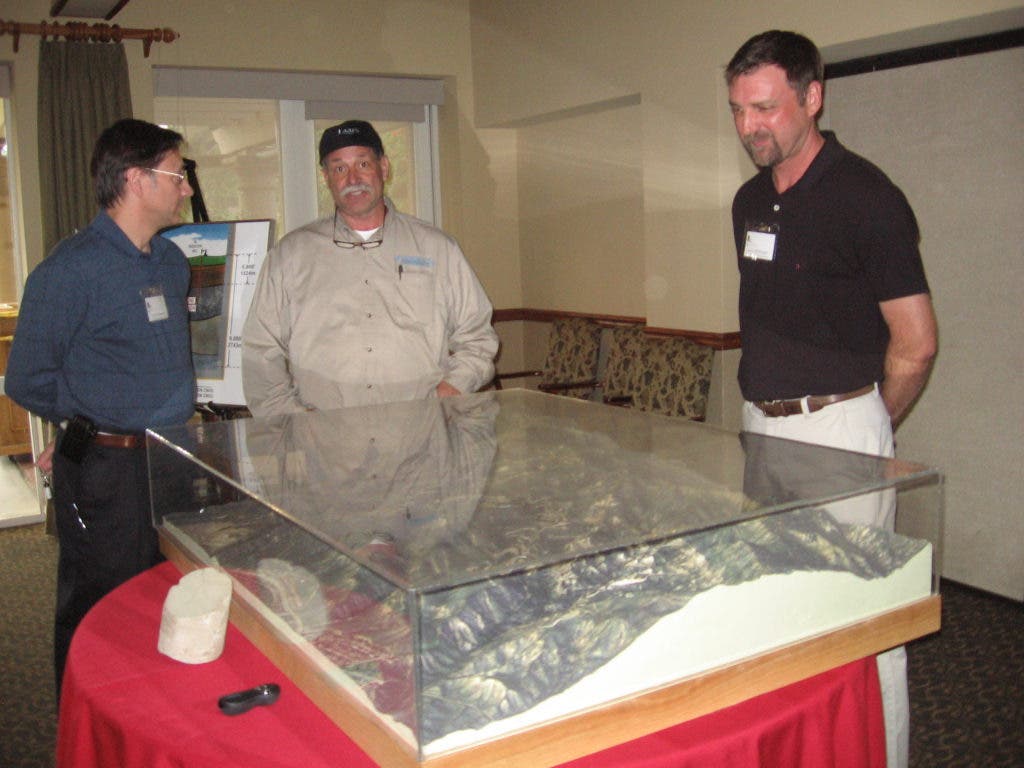
Turner said she wanted to know the exact earthquake fault locations and their proximity to the natural gas facility presented as a 3-D model of the company’s property at the north end of Tampa Avenue.
Find out what's happening in Northridge-Chatsworthfor free with the latest updates from Patch.
“They said they didn’t know where the fault lines were. He said everything will be at the top of the hills,” Turner said. “That’s where the (2008 Sesnon) fire started.”
The proposed project on 3,600 acres could be operational three years from now.
Today, the proposal is going throughout what is known as a public comment and review period. Residents and stakeholders can review the draft proposal and submit any comments and concerns, which then becomes part of the public record.
This was the second community workshop held this year by the gas company. About 75 people gathered between 4 p.m. and 7 p.m. at the Porter Valley Country Club where various aspects of the project were laid out and representatives were asked one-on-one questions.
Porter Ranch resident Wes Rogers was among those who attended. The Sesnon Fire came up to his property line, but he and his family were able to keep the flames from destroying the house.
Rogers is among those residents who want the project to be put on hold until the responsibility from the Sesnon fire has been officially determined and a fire prevention plan is in place.
“It’s the same modus operandi,” Rogers said about the gas company’s efforts to inform the public. “We want to talk about the project expansion but (they) won’t because of litigation. They want to talk to you like that fire never took place. When they take shortcuts on safety and safety maintenance of equipment and power lines, bad things happen.”
Rogers said opponents to the proposed expansion want a full account of the events that led to the Sesnon Fire two years ago.
“We want a complete review of safety and maintenance practices taking place on the hill,” he said. “Once, and if, it is determined the project is approved, we want the newly established protocols be posted online for all to see.”
The October 2008 Sesnon Fire scorched 14,703 acres in the Porter Ranch and the Twin Lakes and Indian Hills area of Chatsworth, destroying 15 homes, 63 outbuildings and damaging another 11 residences resulting in at least $12.6 million in damages, according to city fire reports.
The Gas Co. is in litigation with property owners who suffered losses over whether a Gas Co. power line was responsible.
The Southern California Gas Co. "Aliso Canyon Turbine Replacement Project," would replace existing storage compressors with state-of-the-art electric-powered technology to help meet the region's demand for natural gas and reduce greenhouse gas and other air emissions from the current storage site.
The Gas Co. operates and maintains the Aliso Canyon natural gas storage facility, the largest of four such facilities north of Porter Ranch and Northridge on approximately 3,600 acres about a half-mile beyond the Sesnon Boulevard entrance at Tampa Avenue.
This natural underground reservoir allows the company to safely inject and store natural gas when prices are lower, and withdraw the gas for customers when prices and demand are high, thereby, protecting customers against price spikes and helps to maintain reliable natural gas supplies, according to company officials.
Three natural gas turbine-driven compressors are used to inject the gas deep into the ground. The equipment, installed in the 1970s, will not provide sufficient power compared to the demand. To inject and withdraw the natural gas as needed, new, efficient electric motor-driven compressors must be installed. They said they can withdraw natural gas faster than it can be injected.
The project includes the construction of a new building and installation of new equipment including three 22,000-horsepower motors, compressors, piping, coolers and other additional equipment required for the storage operations.
Existing offices and a guard house will be relocated to help improve traffic on Sesnon Boulevard, they said.
The California Public Utilities Commission is expected to approve the engineering and construction phases of the project by the end of this year, leading to the project being operational in 2014. The Commission is now collecting public comment as part of drafting an environmental impact report.