Arts & Entertainment
China Philharmonic's Conductor Throws Some Left Hooks at CSUN
Valley Performing Arts Center acoustics need some tuning, but the program was a knockout with the audience.
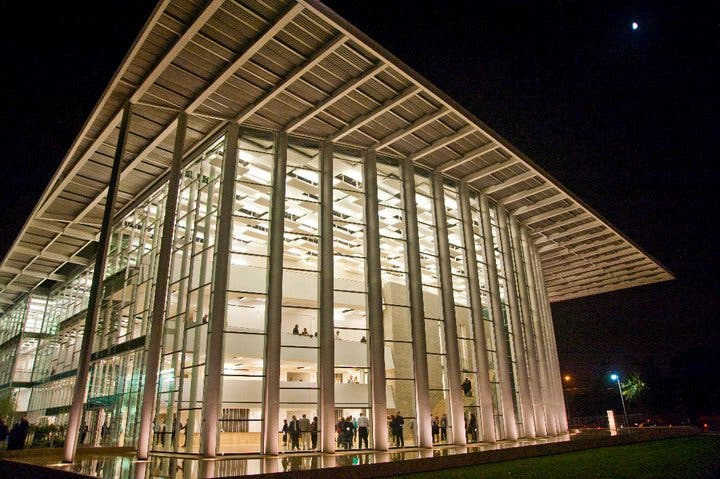


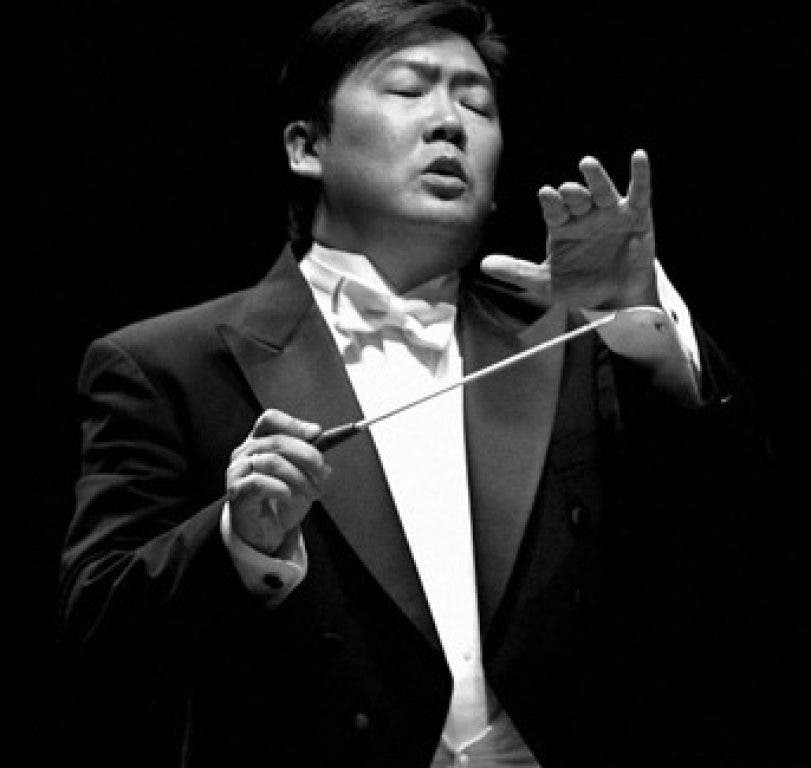
At the end of the at the Valley Performing Arts Center Saturday night, the conductor smiled and put his hands to the side of his face to signify a need for sleep. It’s understandable, given that the orchestra played San Francisco, Davis, Santa Barbara, Costa Mesa in the previous two weeks.
Hardly time for jet lag to lag.
And if the Beijing-based ensemble’s “show,” as the charming California State University, Northridge student ushers called it, might have benefitted from some ProTools-style pitch correction and tightening here and there, it was no great crisis.
Find out what's happening in Northridge-Chatsworthfor free with the latest updates from Patch.
Unless, of course, you took the eleven-year-old orchestra’s publicity to heart, in which case you would, of course, conclude that it is one of the world’s greats. Uh-uh. This is a band of practiced young prodigies of the type commonly found in Asian societies, marshaled (word chosen carefully) by conductor Long Yu, who is not short on gesture.
At times, the vigorous, antic conductor threw some left hooks that might have decked Joe Frazier.
Find out what's happening in Northridge-Chatsworthfor free with the latest updates from Patch.
No matter, it was a knockout with the audience—in this, the inaugural orchestral concert at the Valley’s brand-new, glass-and-travertine $125 million concert hall.
And just how did the joint sound? Short answer: it’s not Disney Hall (what is?), but it does loud well.
In a pops-leaning program of Berlioz, Bruch, Borodin, Puccini, and Ravel, the orchestra variously roared, blared, sighed, caressed, wobbled, and understandably showed off (for a two-thirds-full house that seemed about 70-30, blue hairs vs. raging hormones). Had it not been for the nascent lyricism of young Puccini’s Preludio Sinfonico, I would not have guessed that the group was capable of grace. It is, though, and might do well to perform fewer fireworks and more delicacies.
Berlioz’s Roman Carnival overture, as Aaron Grad’s very thorough and interesting program notes explained (take note, L.A. Phil), is a bit of a fluke, a stand-alone concert overture cannibalized from his failed opera, Benvenuto Cellini. The nothing-if-not-spirited CP meant this to be a wow, and where there were hairpin tempo turns, sudden stops, splashes and crashes, it sometimes was. But there was stridence where there might have been stateliness, opening string legato passages that went sour and abiding tension instead of couched explosiveness, élan. You got the sense that this is a group heavily, heavily drilled for displays of technique and razzle-dazzle, which is fine as far as that goes.
Max Bruch’s ever endearing Violin Concerto No. 1 is as warm and lovely a piece as it intends to be, from the dreamy flights of solo fancy in the first movement to the plain outpouring of heart in the adagio, to the Mendelssohn-worthy pluck (literal and figurative) of the allegro energico. And while it is a laudable trend to avoid sentimentality in romantic interpretations, avoiding sentiment altogether is another matter. Yu’s approach was taught, tight and fleet. Notes seemed barely allowed to linger—there’s a concerto to finish here, folks—before the next passage bumped them aside. There was an iciness and clinical quality that would have been perfectly fine had this been the Stravinsky concerto. Where was the vaunted embrace by Asian musicians of western romanticism?
And it must be noted here that Yu’s relentlessly large physical gestures, even for quiet passages, managed to distract from the soloist, Renaud Capucon, something I don’t ever recall witnessing in a concert hall. This was the Lang Lang School of conducting, where extroversion is everything. I’m talking semaphore for myopics, people. If this was a “show,” as the ushers informed, then Yu was the star here, not Capucon, which was a shame as the 35-year-old French violinist played with a refreshing lack of gratuitous gesture so popular among soloists now. This guy’s no rock star, just a disciplined fiddler serving the music. Yes, you might have wanted more richness, more luster, more ... beauty (spoiled by Sarah Chang here), but this was handsomely, adroitly played. You had to wonder if the soloist’s expressiveness was stymied by the conductor’s speed excessiveness.
By intermission, I was wondering about the acoustics of the hall, and its undulating beige wood ribbons. I was sitting in the very back of the second section, “parterre,” and there was a definite drop-off in volume and clarity that I suspect is not the case in the front of parterre, or the orchestra section. There was nothing of the surround-sound envelopment of the acoustically freakish Disney Hall, where timpani make your chest cavity vibrate and Bruckner can make you plug your ears---but you wouldn’t expect that. This was a “sound-is-in-front-of-you” experience, no way around it, yet the sound was very... mono. I did not get much separation or discretion of tone colors, with woodwinds often swallowed by strings and timpani not really punching through.
That all changed for the better, though, when the orchestra resumed with the raucous, many-colored, many-themed Polovtsian March from Borodin’s Prince Igor, its “greatest hit” melodies inducing unembarrassed murmurs of recognition from the Valley audience. You had an image of a half-time basketball pep-talk backstage, so much greater was the volume and zing of the playing here. (No more sound dropoff!) And Yu’s well-rehearsed Terpsichore was not so out of place this time, with his roundhouse Frazier left hooks urging thunderous eruptions from bass and kettle drums (that elicited unembarrassed ooo’s), and full-body pumping that would not have been out of place on the back of Seabiscuit in the home stretch. Still, woodwind solos were too often prosaic, lacking nuance, where they should have been artful, shaped. Fatigue again, perhaps?
The Puccini Preludio was the highlight of the night, demonstrating that both orchestra and conductor can carry long, flowing lines with elegance, opulence, and sense. The young composer’s derivative student composition (for a final exam at the Milan Conservatory in 1882) is nothing if not an exercise in gentility and ambience, with its blend of diatonic and chromatic, and hints of characteristic operatic melody to come. The orchestra rose to this occasion. String passages were alternately lush and golden, silvery and shimmery. Yu put down his baton and gestured more rationally, hands only. The technique of this burgeoning group was far more impressively displayed here than in the preceding pyrotechnics. While this is hardly a Mahler slow movement, I found myself wondering how the group might tackle the adagio from the fifth—or tenth.
The “show” ended on a somewhat wobbly high note, with the crowd-pandering Ravel Bolero, complete with the snare-drummer-up-front gimmick. This piece, arguably either early minimalism or the result of brain damage the composer sustained in a car accident (or both?) is one long, steady crescendo of repeated melody appearing in color after color of the signature Ravel palette. It banks on steadiness. It’s very steady. And did I mention that it is meant to be ... steady? Well, there was unintentional rubato in this crescendo, sorry to say (though not on the drummer’s part), and it’s reasonable to ascribe this to breakneck tour schedule and sleep deprivation. One hopes that this also explained the otherwise fine piccolo soloist being so wildly out of tune as to seemingly introduce a touch of John Cage to the proceedings.
One’s heart went out to these musicians, though, and to conductor Yu. It’s tough enough playing in an orchestra, or being good enough to play in an orchestra. Its tough enough to represent a city, let alone a whole country. Let alone that country being China. And when you factor in that the China Philharmonic also represents The Party, well, you know the pressure is heavily on these fabulously skilled young people to deliver flawlessly. (Think: China Olympics.) On this night in Northridge, they played with great spirit and discipline, and left the audience shouting for more. Jet lag or not.