Community Corner
Green Comet: How To See It In Los Angeles Before It Disappears
The last time the newly discovered green comet known as ZTF passed by earth, Neanderthals were roaming the land.


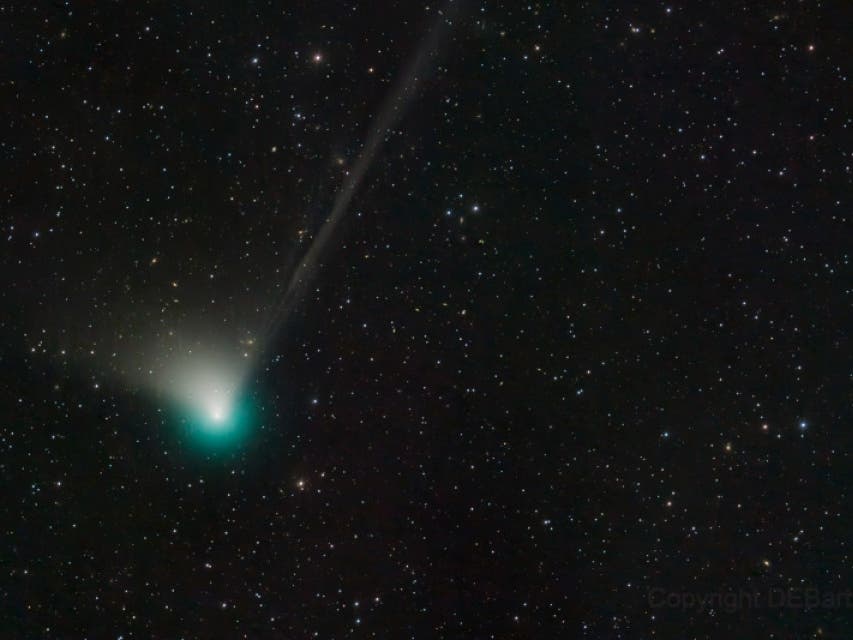
LOS ANGELES, CA — A rare green comet not seen since the ice age will make its closest pass by the Earth Wednesday, and it may be visible to the naked eye.
Comet ZTF won't be this close again for another 50,000 years, if at all, according to NASA scientists. It will be a mere 26 million miles away Wednesday night.
"Excitingly, the comet C/2022 E3 (ZTF), which last passed through the inner solar system around 50,000 years ago, will be at its brightest during this time and may even be visible to the naked eye under the right conditions," according to Space.com. "The comet should be observable for days as it approaches our planet and then recedes on its way to the outer solar system."
Find out what's happening in Northridge-Chatsworthfor free with the latest updates from Patch.
The comet looks like a glowing ball with a green tail streaking across the sky.
The comet, which had never been seen by human eyes before last year, was discovered by California Institute of Technology scientists in the spring. It's made up of ice with a gas tail, containing compounds that give it its green hue by reflecting light, according to NASA scientists.
Find out what's happening in Northridge-Chatsworthfor free with the latest updates from Patch.
Scientists are confident in their orbital calculations putting the comet's last swing through the solar system's planetary neighborhood at 50,000 years ago. But they don't know how close it came to Earth or whether it was even visible to the Neanderthals, said Chodas, director of the Center for Near Earth Object Studies at NASA’s Jet Propulsion Laboratory in California.
When it returns, though, is tougher to judge.
Every time the comet skirts the sun and planets, their gravitational tugs alter the iceball’s path ever so slightly, leading to major course changes over time. Another wild card: jets of dust and gas streaming off the comet as it heats up near the sun.
“We don’t really know exactly how much they are pushing this comet around,” Chodas said.
The comet — a time capsule from the emerging solar system 4.5 billion years ago — came from what’s known as the Oort Cloud well beyond Pluto. This deep-freeze haven for comets is believed to stretch more than one-quarter of the way to the next star.
While comet ZTF originated in our solar system, we can't be sure it will stay there, Chodas said. If it gets booted out of the solar system, it will never return, he added.
Don’t fret if you miss it.
“In the comet business, you just wait for the next one because there are dozens of these," Chodas said. "And the next one might be bigger, might be brighter, might be closer.”
The comet is flying through the edge of our solar system and could exit our solar system never to return.
“While it currently appears to be on a ‘gone forever’ path, it is also likely that it will shift onto a returning orbit in the tens-of-millions of years range, thanks to the extra gravitational tugs from the planets,” Geoff Mathews, an astronomy instructor at Foothill College in Los Altos Hills told The San Francisco Chronicle.
The comet has been visible for months and can still be seen into mid-February for anyone who misses it Wednesday.
To see the green comet before it streaks back into the distant cosmos, look into the night sky towards the northeast after 9 p.m. Wednesday.
Comet C/2022 E3 (ZTF) appeared above the North Star Tuesday and will make its way to Ursa Major and the Big Dipper by Thursday. Stargazing apps like SkyView Lite can pinpoint the constellations for those who aren't sure where to look.
The skies above Los Angeles are forecast to be mostly clear Wednesday, according to the National Weather Service. Stargazers, ideally, would find an isolated location away from city lights as much as possible.
“It’s sort of like searching for some endangered species, and then it pops into view,” said E.C. Krupp, director at Griffith Observatory in Los Angeles told The Spokesman-Review. “That really is a charmer of an experience.”
Viewers should be able to see it with the naked eye, but binoculars or telescopes will make it easier to see the tail.
“Comets are notoriously unpredictable, but if this one continues its current trend in brightness, it’ll be easy to spot with binoculars, and it’s just possible it could become visible to the unaided eye under dark skies,” according to NASA.
And if you miss it Wednesday, you can try for a couple more weeks before it's gone. Even then, it's not the only comet in the sky.
“Fortunately, our solar system was very messy when it formed planets 4.5 billion years ago, so there will be many more comets for us to see,” Mathews told the Chronicle.
The Associated Press contributed to this report.
Get more local news delivered straight to your inbox. Sign up for free Patch newsletters and alerts.