Politics & Government
Parts of Chatsworth Park South Might Open as Soon as This Summer
The park has been shuttered for four years because of toxic soil contamination.
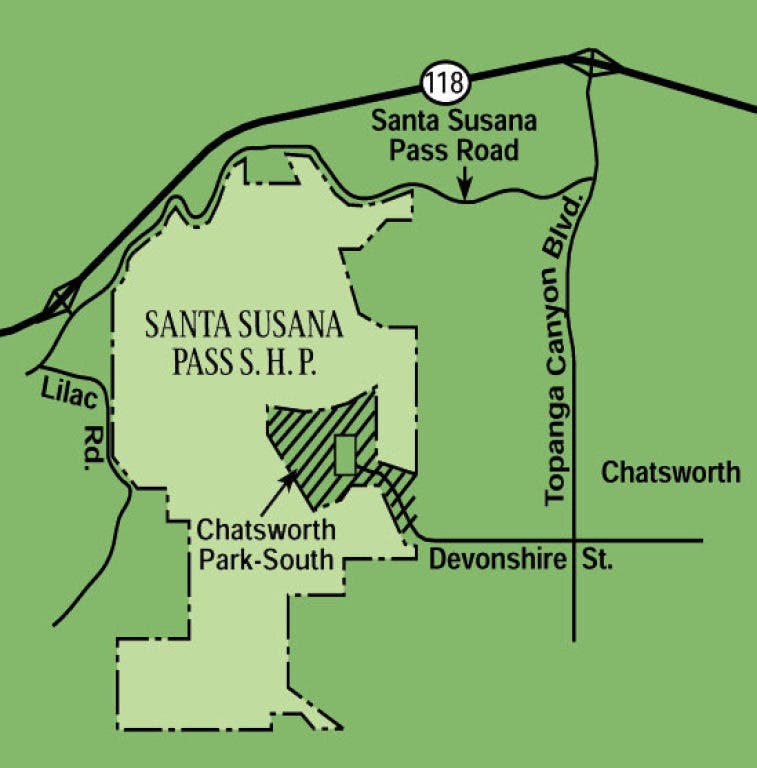


Scientists from the state Department of Toxic Substances Control say it may be possible to reopen of parts of as soon as this summer.
The park has been although the scientists admit that there is no evidence of any individual or animal falling ill from visiting the park during the past 50 years.
The recreation building and adjoining parking lot could open this summer, the tennis and basketball courts by the end of the year, and a picnic area by mid-2013, the scientists told the Chatsworth Community Coordinating Council on Monday at the .
Find out what's happening in Northridge-Chatsworthfor free with the latest updates from Patch.
The team of state scientists said they are working with city officials to come up with a plan to remove lead left from a before it became a city park in 1978. The city and state last met to discuss the situation on April 3.
Lead contamination came from shotgun pellets and clay pigeons used on the 12-acre skeet shooting range. The most contaminated area is just west of the recreation building and main parking lot. Most of the shooting was directed to the north. The park has 81 acres. About 21 acres are used for a children’s play area, parking lots, a sand pit, two tennis courts, a basketball court and landscaped fields.
Find out what's happening in Northridge-Chatsworthfor free with the latest updates from Patch.
The department’s project manager, Chand Sultana, said the park has been divided into two areas according to a draft plan.
By the end of the year, the toxic substances crew hopes to pound out a remedial plan to clean up the contamination and put into action a final scenario to attack the problem, along with a timeline and cost.
All of phase one could all be open as early to mid-2013, Sultana said.
The will not be known until the plan is approved by the state and then by the City Council. The scientists said they don't know how much has already been spent on testing the grounds where pieces of lead pellets about the size of BBs have been found on the surface as well as underground.
Glenn Bailey, vice president of the Foundation for the Preservation of the Santa Susana Mountains, said he was alarmed to hear that the pellets could be seen by the naked eye.
“I didn’t realize the pellets were on the surface, nor did I think about the birds (eating the lead bits). This is a greater concern now for me that (there’s contamination) on the surface,” Bailey said.
Resident critics said the toxic substances department and the city have missed deadline after deadline in the past, and they are not banking on them meeting additional deadlines. The city has the final say as to whether or when the park reopens based on the department’s recommendations. Budget restraints could be a factor, they said
Paul Davis, of the city’s Recreation and Parks Department, said it has lost employees during the city’s attempt to balance its budget. Davis said they have not been replaced and projects are piling up.
“(We) have to vie for priority with other city-funded issues. It sounds like an excuse, but that’s reality,” Davis said.
However, Chatsworth Neighborhood Council member Diana Dixon-Davis said, “This is the best news we have ever heard -- opening the community building, which many groups use and the parking lot and perhaps the rest (of the park) like the tennis court.”
Eight-year Chatsworth resident Lorry Reeves, who lives within walking distance of the park, said there seemed to be a struggle between the state and city officials.
“The city blames (Department of Toxic Substances) and (the department) blames the city. It’s all back to the money,” Reeves said after the meeting.
Monday’s presentation covered the site cleanup process and overview, background on the property, how the toxic substances department investigated remediation, human health and ecological risk assessments and an interim cleanup proposal.
Lead and polycyclic aromatic hydrocarbons are the major contaminants. The clay-pigeon targets generate the polycyclic aromatic hydrocarbons and lead, antimony and dioxin/furans are associated with the ammunition.
In response to questions, state toxic substance specialists said no workers have been tested for carcinogens at the park, but they are the ones who are most likely to feel the effects since they spend the most time on the property.
They also said children could be more vulnerable because the smaller ones are prone to eating dirt.
Staff toxicologist Shukla Roy-Semmen said there is no evidence that anyone has ever become sick over the past 50 years because of contamination at the park.
However, Roy-Semmen said people could be exposed by ingesting contaminated soils, dust and pellets or clay pigeon bits in surface water. She also said inhaling airborne particulates could lead to exposure as can skin contact with contaminated soils, dust or surface water. The result could be cancer or other maladies.
Raymond Grutzmacher said the groundwater, which lies 12-to-15-feet deep and is not a source for drinking water, has not been contaminated.
For more background visit www.envirostor.dtsc.ca.gov/public and enter 22360 Devonshire St., Chatsworth as the project address, or,contact: Project Manager Chand Sultana at (818) 717-6552 or csultant@dtsc.ca.gov; or Public Participation Specialist Yvette LaDuke at (866) 495-5651, 3, 2 or yladuke@dtsc.ca.gov.